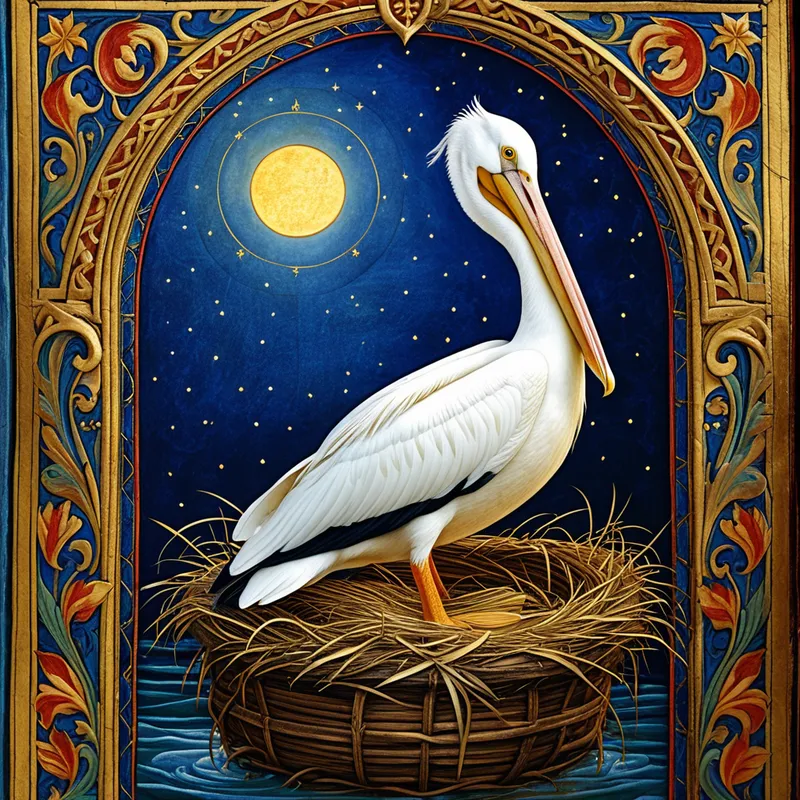
Pelican in Piety Myth Meaning & Symbolism
A mother pelican, believing her young dead, pierces her own breast to revive them with her blood, becoming an eternal emblem of ultimate sacrifice.
The Tale of Pelican in Piety
Listen, and let the silence of the marsh settle in your bones. In the grey, predawn world where mist clings to the reeds and the water is a sheet of cold glass, a mother pelican keeps her vigil. Her nest, a fortress of woven rushes, cradles her greatest treasure: three downy chicks, still as stone. A serpent, cold and silent, had passed through in the night, its venom a thief of breath and warmth. Now, the mother stands over a stillness more terrible than any storm.
Her world, once filled with the clamor of hungry cries, is a cathedral of silence. She nudges them with her great beak, a gesture met with a terrible, feather-soft resistance. A sound escapes her, not a cry, but the rending of the air itself—a grief older than wings. The rising sun stains the clouds the color of a wound. In that crimson light, a knowing descends upon her, a terrible and sacred logic written in the blood of life itself.
What is a body, if not a vessel? What is love, if not a currency that demands the final payment? She bows her head, not in defeat, but in a dreadful resolution. With a force born of absolute surrender, she strikes her own breast with the dagger-point of her beak. Once. Again. The pain is a white fire, but it is a distant thing. The true agony was the silence.
And then, the miracle. Not from the sky, but from within. From the sacred wound she has opened, her life’s essence begins to flow. Three crimson streams, not of death, but of a fierce, liquid vitality. She leans over her still children, and lets her blood fall upon their beaks, anointing them with her own substance. Drop by precious drop, it touches their tongues.
A tremor. A faint, almost imperceptible shiver in the down of the smallest chick. Then a weak, gasping breath. The life that had fled returns, not summoned from the heavens, but called forth from the deepest well of sacrifice. They stir, they drink, they live—revived not by water or food, but by the very source that once gave them form in the egg. The mother, growing pale and light, watches the color return to their world. Her strength ebbs, but her being swells with a paradoxical triumph. She has not conquered an enemy; she has undone death by becoming its conduit. She dies into their life, and in that act, becomes eternal.

Cultural Origins & Context
The myth of the Pelican in Piety is not a story with a single author, but a symbolic narrative that migrated into Christian iconography from the ancient natural histories of writers like Pliny the Elder. Medieval bestiarists, those compilers of moralized animal lore, seized upon this observed (though misunderstood) behavior—parent pelicans were seen to press their beaks against their chests to feed chicks from their pouches—and infused it with theological profundity.
It was passed down not by bards, but by monks in scriptoria, illuminating the margins of psalters and missals. It was carved into choir stalls, cast in chalices, and woven into sermons. Its societal function was didactic and devotional: a ready, natural symbol for the sacrifice of Christ on the cross, whose side was pierced, releasing blood and water for the salvation of humanity, the Church. The pelican became a living typology, a creature whose very biology was a gospel written in feather and blood.
Symbolic Architecture
At its core, the Pelican in Piety is an archetypal map of a specific kind of love: a love that is generative only through its own dissolution. The pelican is not a warrior-hero; she is a priestess of the interior, performing the ultimate ritual of sacrifice.
The deepest nourishment does not come from taking, but from a willing rupture of the self. The wound is not an end, but a source.
Psychologically, the myth represents the ego’s confrontation with a catastrophic failure of its nurturing role. The "death of the young" symbolizes a profound creative or relational sterility, a project, a dream, or a part of the psyche that has gone inert. The ego, in its identification as the caregiver, faces annihilation. The pivotal turn is the shift from external seeking (trying to find life out there) to an inward, radical offering. The breast, the seat of nourishment, becomes the site of the wound. This signifies that the resources needed for revival are not external skills or tools, but one’s own essential life-force—the libido or psychic energy itself. The act of piercing is the conscious, painful decision to redirect that energy from self-preservation to other-creation.
The Dreamer's Resonance
When this myth stirs in the modern dreamer’s unconscious, it often manifests in dreams of profound, somatic responsibility. You may dream of a child, a pet, or a precious, fragile object that is lifeless in your care. The overwhelming emotion is not fear, but a devastating, guilt-ridden grief—the caregiver’s shadow. The landscape is often one of isolation: an empty house, a deserted shore, a silent nursery.
The somatic process is one of constriction in the chest, a literal feeling of heartache. Psychologically, the dreamer is at the crisis point of a complex related to nurturing or creativity. The dream presents the stark, mythical truth: the old ways of caregiving (the un-pierced self) have failed. The dream does not provide an answer, but it sets the stage for the alchemical question: What within me must I break open to bring this back to life? It is an invitation to a sacrifice, not of martyrdom, but of transformative offering.
Alchemical Translation
The alchemical process mirrored here is the nigredo-albedo transformation. The nigredo is the black despair of the dead chicks, the absolute desolation of the caregiver. This is the necessary dissolution of the old identity. The piercing of the breast is the mortificatio, the symbolic death of the ego’s self-contained completeness.
The gold of new life is not found; it is minted in the crucible of personal sacrifice. To resurrect another, one must first die as one was.
The flowing blood is the aqua vitae, the divine water of life, but it is sourced from the individual’s own depths—the Self offering its substance to the ego’s sterile projects. For the modern individual undergoing individuation, this myth models the move beyond transactional caregiving (I give because I should) to transformative nurturance. It asks: What cherished role or identity have you constructed that is now failing? What life within you—a talent, a passion, your vital energy—are you hoarding in self-preservation, that must be "wounded," offered up, and surrendered to flow into a dormant part of your world or psyche? The revival of the young symbolizes the birth of a new relationship to one’s creativity, responsibility, or love, now animated not by duty, but by the sacred, self-renewing flow from the center of one’s own being. The Pelican does not survive her act in the literal sense, but she achieves a symbolic immortality: she becomes the source.
Associated Symbols
Explore related symbols from the CaleaDream lexicon: