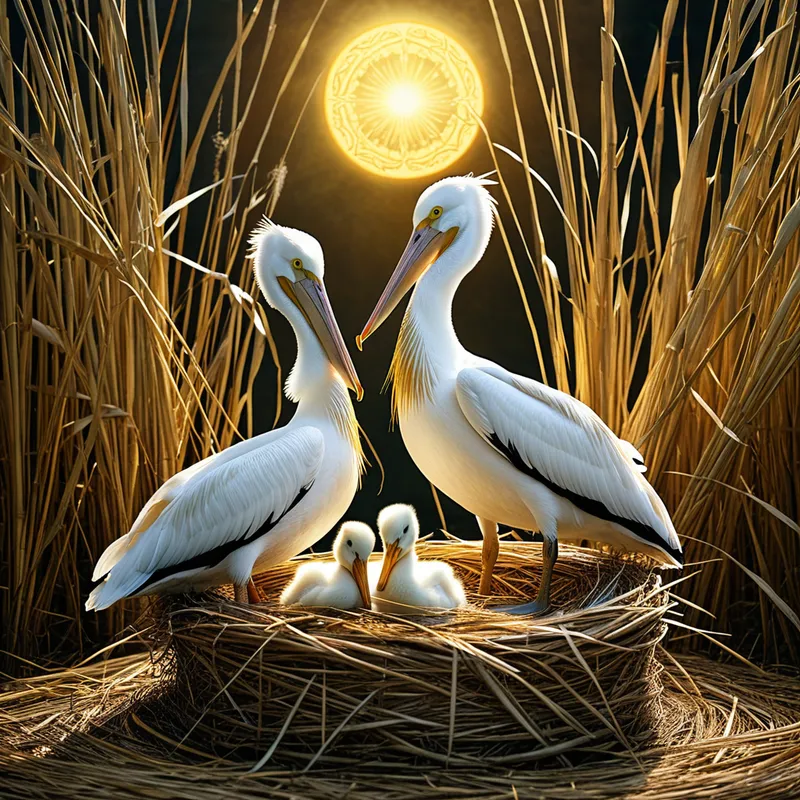
Pelican in Her Piety Myth Meaning & Symbolism
A mother pelican, believing her chicks dead, pierces her own breast to revive them with her blood, becoming an emblem of sacrificial love.
The Tale of Pelican in Her Piety
In the silent, reed-choked margins of [the world](/myths/the-world “Myth from Tarot culture.”/), where the [water](/myths/water “Myth from Chinese culture.”/) meets [the earth](/myths/the-earth “Myth from Hindu culture.”/) and [the sky](/myths/the-sky “Myth from Persian culture.”/) bleeds into both, there lived a Pelican. Her nest was a kingdom of soft down and patient warmth, cradling her three fledglings—her entire world embodied in three fragile, beating hearts.
For days, she labored, her wings heavy with weariness, her beak a relentless tool of providence. She dove into the murky depths, emerging with silver flashes of life to feed the ever-gaping mouths. But a shadow, cold and silent, crept from the marshes. A serpent, perhaps, or a pestilence borne on the damp air—the stories vary. The only truth that matters is the stillness that followed. Returning from her foraging, the Pelican found her nest silent. Her children lay cold, their bright eyes shuttered, their tiny bodies limp. The song of her world had been extinguished.
A cry tore from her—a sound not of this earth, a raw keening that shook the reeds. She nudged them, preened them, sheltered them with her wings, but the chill of death was unyielding. Despair, a black flood, filled her. In that absolute darkness of maternal grief, a terrible, luminous thought was kindled. It was said, in the old whispers of nature, that her own blood held the spark of life.
Without hesitation, driven by a love that defied all natural law, she turned her own sharp beak upon herself. She struck her breast, piercing the vibrant plumage until a crimson river welled forth. Then, with infinite tenderness, she let her life’s essence fall, drop by sacred drop, onto the still forms of her chicks. The warm, vital fluid bathed them, seeped into their beaks, anointed their cold bodies. One drop, then another. The world held its breath.
And then, a miracle of the deepest order. A tiny foot twitched. A wing shuddered. One by one, the chicks stirred, their eyes fluttering open, their weak cries returning to the air. They lifted their heads, not for food from the marsh, but for the holy sustenance flowing from their mother’s wound. She stood over them, bleeding and glorious, a living fountain of resurrection. The Piety was complete. She had journeyed into the heart of death and returned, bearing her children in her own lifeblood.
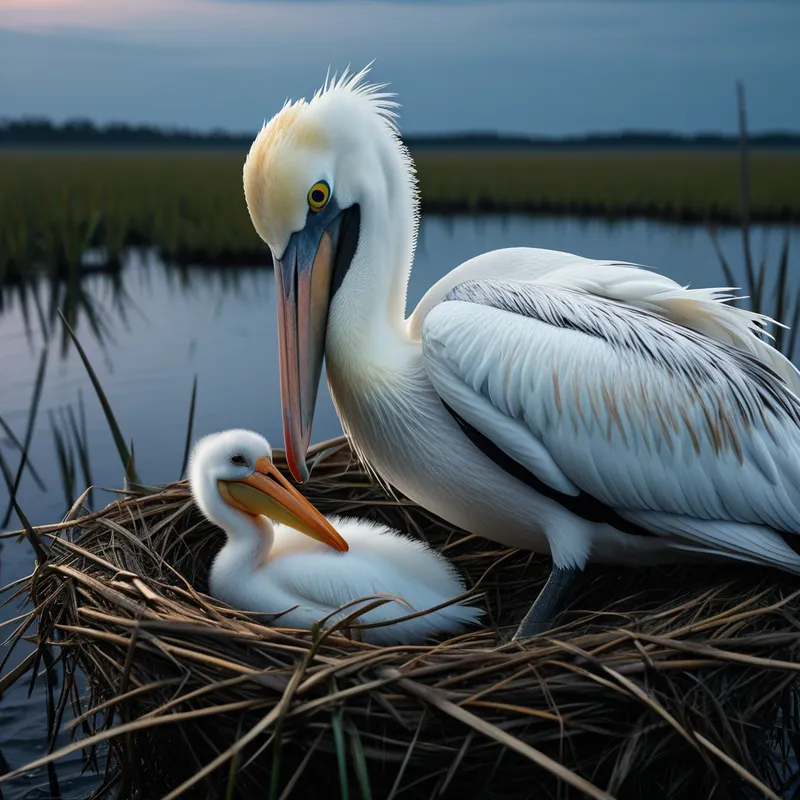
Cultural Origins & Context
The Pelican in Her Piety is not a myth with a single, pagan origin later baptized, but a physiologus tale—a moralizing explanation of animal behavior that blossomed within medieval Christian symbolism. Its earliest roots are often traced to the natural world’s misunderstandings; ancient naturalists like Pliny the Elder noted pelicans pressing their bills against their chests to empty their pouches, a gesture mistaken for self-wounding.
This image was irresistibly adopted by early Christian homilists and scholars. It found fertile ground in the allegorical mind of the Middle Ages, appearing in bestiaries, those illuminated manuscripts that read the natural world as a book written by God. Here, the pelican became a prefiguration of Christ, whose side was pierced on the cross, from which flowed blood and water—the sacraments of [the Eucharist](/myths/the-eucharist “Myth from Christian culture.”/) and Baptism—that give eternal life to the faithful, his spiritual children. The myth was propagated from pulpits, carved into choir stalls, and wrought in gold upon chalices, serving a core societal function: to provide a visceral, unforgettable emblem of the doctrine of Atonement and the nature of divine love as fundamentally self-emptying.
Symbolic Architecture
At its core, the myth is an archetypal map of sacrifice that transcends doctrine. The [Pelican](/symbols/pelican “Symbol: The pelican symbolizes generosity, selflessness, and nurturing, being a provider in its natural habitat.”/) represents the ultimate [Caregiver](/symbols/caregiver “Symbol: A spiritual or mythical figure representing nurturing, protection, and unconditional support, often embodying divine or archetypal parental energy.”/), but one who operates at a catastrophic extremity. Her piety is not quiet devotion but a violent, transformative act.
The deepest nurture sometimes requires a sacred wounding. The source of life and the source of pain become one and the same.
Symbolically, the [breast](/symbols/breast “Symbol: The breast symbolizes nurturing, comfort, femininity, and the relationship with maternal figures.”/) represents the [heart](/symbols/heart “Symbol: The heart symbolizes love, emotion, and the core of one’s existence, representing deep connections with others and self.”/)-center, the seat of love and vitality. [The self](/myths/the-self “Myth from Jungian culture.”/)-inflicted wound is not masochism, but the conscious, agonizing [choice](/symbols/choice “Symbol: The concept of choice often embodies decision-making, freedom, and the multitude of paths available in life.”/) to break open one’s own wholeness for the sake of another’s survival. The [blood](/symbols/blood “Symbol: Blood often symbolizes life force, vitality, and deep emotional connections, but it can also evoke themes of sacrifice, trauma, and mortality.”/) is [anima](/symbols/anima “Symbol: The feminine archetype within the male unconscious, representing soul, creativity, and connection to the inner world.”/), [life](/symbols/life “Symbol: The symbol of ‘Life’ represents a journey of growth, interconnectedness, and existential meaning, encompassing both the joys and challenges that define human experience.”/)-force, [soul](/symbols/soul “Symbol: The soul represents the essence of a person, encompassing their spirit, identity, and connection to the universe.”/)-substance—the very essence of one’s being offered as sustenance. The revived chicks symbolize new life born not from external sources, but from the internal, sacrificial [crisis](/symbols/crisis “Symbol: A crisis symbolizes turmoil, urgent challenges, and the need for immediate resolution or change.”/) of the giver. Psychologically, this maps the process where a dominant [attitude](/symbols/attitude “Symbol: Attitude symbolizes one’s mental state, perception, and posture towards life, influencing emotions and actions significantly.”/) (the nurturing [mother](/symbols/mother “Symbol: The symbol of ‘Mother’ represents nurturing, protection, and the foundational aspect of one’s emotional being, often associated with comfort and unconditional love.”/)) must be “wounded”—deconstructed or surrendered—to feed and revive dormant or dying aspects of the [psyche](/myths/psyche “Myth from Greek culture.”/) (the fledgling potentials).
The Dreamer’s Resonance
When this myth stirs in the modern dreamtime, it rarely appears as a literal pelican. Instead, one might dream of a parent figure bleeding light onto a wilting plant, of a healer using their own body as medicine, or of a cherished project that can only be completed by “spilling your own blood” into it.
Somatically, this can manifest as a profound sense of depletion coupled with a fierce, non-negotiable imperative to give. The dreamer may be undergoing a psychological process where an old identity—perhaps the over-responsible caretaker, the relentless provider, or the idealized parent—is facing a crisis. The “chicks” are the aspects of life for which they are responsible (children, creative works, a business, their own inner child) that feel lifeless or stagnant. The dream signals that continuation of former methods of care (the foraging in the marsh) has failed. The unconscious is presenting the drastic, alchemical solution: renewal can only come from a sacrificial offering of the dreamer’s own core substance, a willingness to be profoundly wounded in the act of loving.
Alchemical Translation
In the alchemy of individuation, the Pelican in Her Piety models the stage of [nigredo](/myths/nigredo “Myth from Alchemical culture.”/) transforming into albedo. The black despair in the nest is the [nigredo](/myths/nigredo “Myth from Alchemical culture.”/)—the utter hopelessness that precedes transformation. The piercing of the breast is the crucial, voluntary sacrifice of [the prima materia](/myths/the-prima-materia “Myth from Alchemical culture.”/), the old, intact state of being.
The psyche, like the pelican, must learn to feed its future from its own wounds. The scar becomes a sacred font.
For the modern individual, this translates to those moments when love, creativity, or responsibility demands we go beyond our limits. It is the parent who must draw on reserves of patience they did not know they had. It is the artist who must mine their personal pain to create something true. It is the leader who must sacrifice their comfort for the team’s growth. The “chicks” revived are the new consciousness born from this act: a deeper compassion, a more authentic creation, a resilient community. The myth teaches that our greatest giving is not from our surplus, but from our essence. It is a painful, glorious reminder that the path to resurrecting what we love most often leads directly through the heart of our own vulnerability.
Associated Symbols
Explore related symbols from the CaleaDream lexicon: