
Pele and Hi'iaka Myth Meaning & Symbolism
A volcanic goddess sends her beloved sister on a perilous journey, igniting a conflict that reshapes the land and the soul.
The Tale of Pele and Hi’iaka
Listen, and let the smoke of Pele’s heart carry you to the beginning. In the primal fire-pit of Kīlauea, the goddess of flame dwelled, a restless sovereign whose passions shaped the very bones of the land. From her essence, she had formed a cherished sister, Hi’iaka-i-ka-poli-o-Pele—Hi’iaka in the bosom of Pele. Hi’iaka was not of fire, but of [the mist](/myths/the-mist “Myth from Celtic culture.”/) that cools it, of the [ferns](/myths/ferns “Myth from Celtic culture.”/) that uncurl from warm ash, of the chant that gives form to chaos.
One day, a longing pierced Pele’s fiery core. A chief of Kaua’i, the handsome Lohi’au, had captured her spirit in a dream. She could not go to him, bound as she was to her volcanic home. So she turned to the one she trusted above all: her youngest sister. “Go,” Pele commanded, her voice the rumble of [the earth](/myths/the-earth “Myth from Hindu culture.”/). “Journey to Kaua’i, find Lohi’au, and bring him to me. But you must not embrace him, nor let him embrace you. This is my kapu.”
Hi’iaka, whose heart was loyal, accepted the charge. Yet she asked one promise in return: “Protect my beloved grove of lehua trees while I am gone. Let no flame touch them.” Pele swore an oath on her own life.
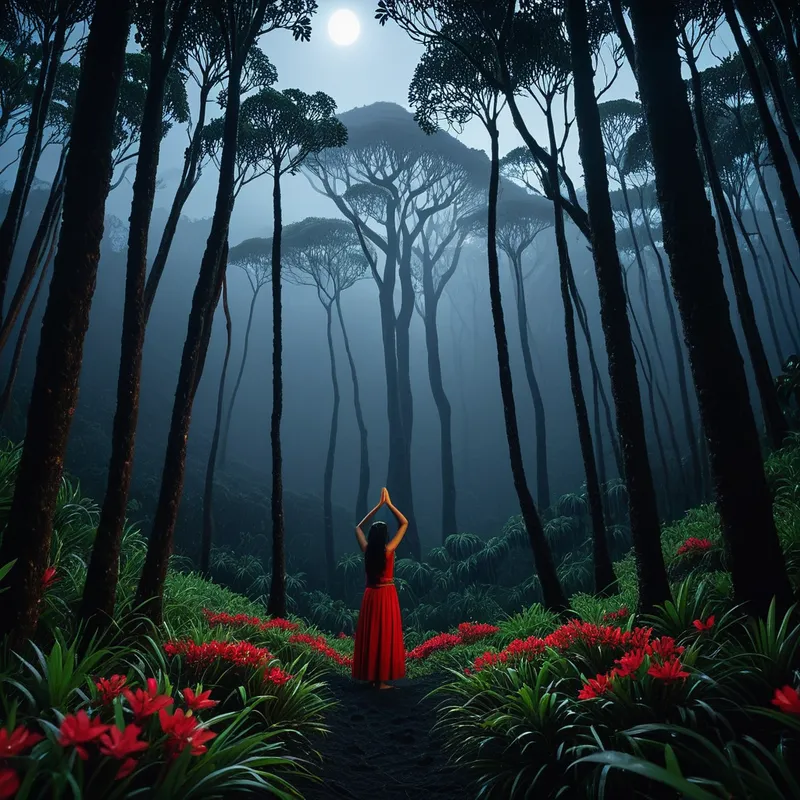
Thus began the epic walk. Hi’iaka, accompanied by her steadfast companion Wahineʻōmaʻo, traveled not as a goddess, but as a pilgrim. The journey was a tapestry of trials. She battled the lizard demon Mokoli’i, whose poison threatened the land. She revived the dead, her chants a bridge between realms. She danced the hula of creation, causing deserts to bloom and forests to spring forth in her footsteps. Each act was a testament to her power—a power of life, not destruction.
On Kaua’i, she found Lohi’au dead, his spirit broken by Pele’s overwhelming dream-visit. With profound mana and patient ritual, Hi’iaka spent forty days chanting his spirit back into his body. A bond, tender and deep, grew between the healer and the healed. The return voyage was longer, fraught with more monsters, more tests of her character.
Meanwhile, in the fire-pit, Pele grew impatient. Seeing only delay and imagining betrayal, her jealousy erupted. She broke her sacred oath. She sent waves of lava to consume Hi’iaka’s cherished lehua grove, turning the vibrant forest to a field of smoldering stone.
Hi’iaka, sensing the destruction from afar, felt her heart crack like cooling pahoehoe. Arriving at the rim of the caldera with Lohi’au, she witnessed the blackened remains of her trust. In a final, devastating embrace of the man she had rescued and come to love—a direct defiance of the broken kapu—she let Pele see. The volcano exploded in rage. Pele’s fires engulfed Lohi’au, turning him to a pillar of ash.
The sisters faced each other across a landscape of shared ruin. Their war shook the islands. Hi’iaka, the life-giver, dug deep into the roots of her own power, summoning torrential rains and earthquakes to quench Pele’s fires. It was a battle not for a man, but for the integrity of a promise, for the right of life to exist alongside creation’s fury.
In the end, there was no victor, only a terrible, new understanding. The land itself was forever changed by their conflict—new peaks formed, new coasts were born. Pele remained in her fire, sovereign but solitary. Hi’iaka withdrew to the misty forests and cliff faces, a goddess now separate, her innocence transformed into a resilient, enduring strength. Their bond was not severed, but eternally scarred, a fundamental rift in the family of the earth.
Cultural Origins & Context
This epic, known as the Pele Cycle, is the foundational mythology of the Hawaiian people. It is not a single story but a vast oral literature, passed down through generations by kumu hula (hula masters) and kahuna. It was chanted, not merely told, its rhythms and kaona (hidden meanings) carrying the history, geography, and moral codes of the society.
The myth functioned as a geo-spiritual map. Every cliff, forest, and coastal feature mentioned in Hi’iaka’s journey is a real place, embedding the divine drama into the very topography of the islands. It explained the active, creative-destructive nature of the volcanoes and the resilient life that clings to their slopes. Societally, it explored profound themes of pono (righteousness, balance), the sanctity of oaths, the consequences of jealousy, and the complex duties within an ʻohana.
Symbolic Architecture
At its core, this is a myth of [differentiation](/symbols/differentiation “Symbol: The process of distinguishing or separating parts of the self, emotions, or identity from a whole, often marking a developmental or psychological milestone.”/) within the [psyche](/myths/psyche “Myth from Greek culture.”/). Pele and Hi’iaka are not just sisters; they are two essential, opposing, and ultimately inseparable forces of a single creative principle.
Pele represents the Primordial Urge: the unconscious, instinctual, transformative fire that demands manifestation. She is the raw libido, the eruptive passion that creates land from sea but recognizes no boundary. Her domain is the id, the molten core of being.
Hi’iaka represents the Form-Giving Spirit: the conscious force that guides, heals, and cultivates. She is the ego emerging from the unconscious, tasked with a mission. Her tools are ritual, chant, and relationship—the structures that give sustainable form to chaotic energy.
The [journey](/symbols/journey “Symbol: A journey in dreams typically signifies adventure, growth, or a significant life transition.”/) is the necessary [separation](/symbols/separation “Symbol: A spiritual or mythic division between realms, states of being, or consciousness, often marking a transition or loss of connection.”/) of these forces. The lehua [grove](/symbols/grove “Symbol: A grove symbolizes a sacred space of nature, tranquility, and introspection, often associated with spiritual growth and connection.”/) is the symbolic [child](/symbols/child “Symbol: The child symbolizes innocence, vulnerability, and potential growth, often representing the dreamer’s inner child or unresolved issues from childhood.”/) of their union—the beautiful, fragile creation (art, [relationship](/symbols/relationship “Symbol: A representation of connections we have with others in our lives, often reflecting our emotional state.”/), a new [aspect](/symbols/aspect “Symbol: A distinct feature, quality, or perspective of something, often representing a partial view of a larger whole.”/) of [the self](/myths/the-self “Myth from Jungian culture.”/)) that requires protection from the very force that gave it potential. Pele’s [betrayal](/symbols/betrayal “Symbol: A profound violation of trust in artistic or musical contexts, often representing broken creative partnerships or artistic integrity compromised.”/) is the inevitable [moment](/symbols/moment “Symbol: The symbol of a ‘moment’ embodies the significance of transient experiences that encapsulate emotional depth or pivotal transformations in life.”/) when the unconscious, impatient and absolute, threatens to consume the delicate structures the conscious self has built. The tragic embrace of Lohi’au is Hi’iaka’s painful, necessary declaration of independence—[the ego](/myths/the-ego “Myth from Jungian culture.”/) claiming its own experiences and loves, even at the cost of the primal [connection](/symbols/connection “Symbol: Connection symbolizes relationships, communication, and bonds among individuals.”/).
The Dreamer’s Resonance
When this myth stirs in modern dreams, it often signals a critical phase of psychic differentiation. You may dream of a powerful, intimidating figure (a parent, a boss, an internal critic) destroying something you’ve tenderly nurtured. This is the Pele-force, the old pattern or primal loyalty, reacting to your growth.
Alternatively, you might dream of a long, arduous journey through strange landscapes, tasked with reviving something lifeless or battling serpentine obstacles. This is the Hi’iaka journey: the somatic experience of the ego undertaking the difficult work of integration, of bringing something valuable but neglected (a talent, a feeling, a truth) back from the land of the dead. The dream may be saturated with the color red (fire, lehua blossoms) and the textures of rough lava versus soft fern, mapping the conflict onto the dreamer’s body. It is the psyche’s drama of forging an individual identity separate from the engulfing fires of family complexes or innate temperament.
Alchemical Translation
The alchemy of Pele and Hi’iaka models the individuation process—the forging of a whole Self from warring inner elements. The initial state is identification with the Pele archetype: we are our passions, our eruptions, our creative impulses that burn others and ourselves.
The call to journey is the summons to develop the Hi’iaka function: the conscious discipline to carry that fire into [the world](/myths/the-world “Myth from Tarot culture.”/), to give it form through patience, skill, and respect for other life. The trials—slaying demons, reviving the dead—are the neuroses and complexes we must overcome to gain strength.
The central, devastating transformation occurs when the nurturing ego (Hi’iaka) realizes the primal force (Pele) cannot be trusted with its creations. This is the nigredo, the blackening, the destruction of the lehua grove. It is the dark night where one feels betrayed by one’s own deepest nature.
The subsequent war is the painful but necessary internal conflict that leads to a new equilibrium. One does not defeat the volcano; one learns to build a life on its slopes, respecting its power but no longer living in its pit. The individual who undergoes this alchemy no longer is Pele’s rage or Hi’iaka’s innocence alone. They become the island itself—the enduring landmass born from and shaped by that eternal conflict, capable of hosting both the desolate lava field and the resilient, blooming forest. They achieve a sovereignty that acknowledges its fiery origins but is defined by its hard-won, compassionate form.
Associated Symbols
Explore related symbols from the CaleaDream lexicon: