Pegasus and Bellerophon Myth Meaning & Symbolism
A mortal hero, aided by the divine winged horse Pegasus, achieves impossible feats but is cast down for his arrogance in reaching for Olympus.
The Tale of Pegasus and Bellerophon
Hear now the story of a mortal who dared to ride the wind, and of the storm-born creature who carried him to the edge of heaven.
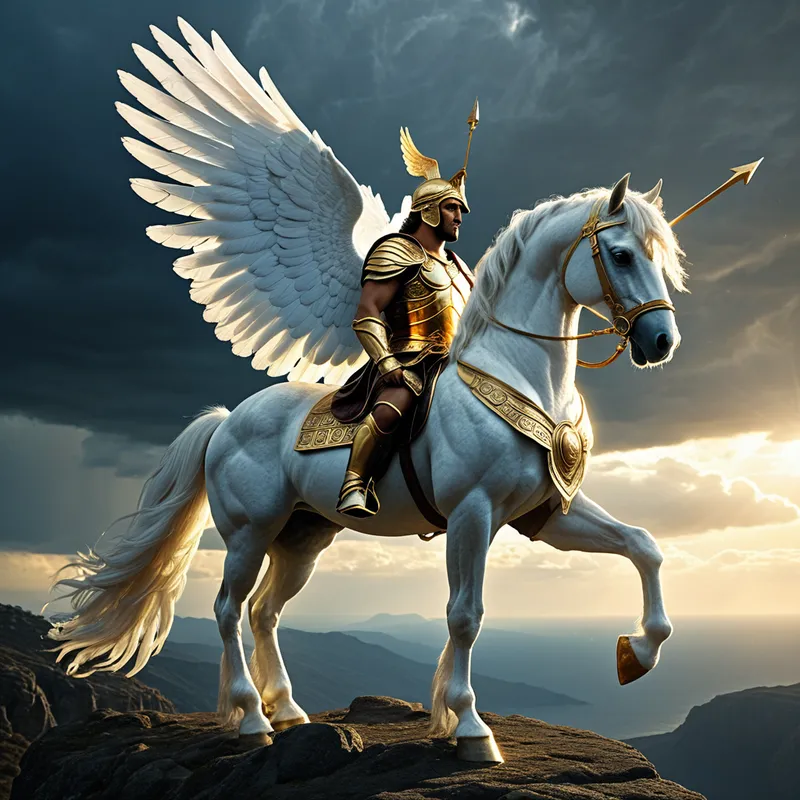
From the blood of the slain Medusa, as it soaked into the earth of the ocean shore, a miracle was born. With a sound like tearing silk and a rush of salt air, Pegasus</abrasprang forth, fully formed, a stallion of purest white with wings vast enough to blot out the sun. He kicked free of the ground and ascended, a living tempest, leaving the realm of men for the high, lonely crags where only eagles dared.
His rider was yet to come. A prince named Bellerophon, noble but stained by a tragic accident, sought purification. He came to the court of King Proetus, but the queen, spurned, whispered lies that coiled like vipers in the king’s ear. Bellerophon was sent east, bearing his own death warrant sealed in a folded tablet, to the court of King Iobates.
The king, bound by the laws of hospitality and the secret message demanding the youth’s death, devised a seemingly impossible task: slay the Chimera, a beast that ravaged the land with unquenchable fire. Bellerophon, in despair, sought the seer Polyeidus. The old man’s eyes grew distant, seeing paths in the stars. “You cannot face the beast on foot,” he whispered. “You must ride the one who shares your exile, the storm-horse. Seek him at the Peirene spring. And take this.”
He gave Bellerophon a golden bridle. That night, at the moon-drenched spring, Bellerophon waited. He felt the air grow heavy, heard the thunder of hooves that did not touch the earth. Pegasus descended to drink. As the magnificent beast bowed its head, Bellerophon, heart hammering, stepped forward and laid the divine bridle upon him. There was no struggle, only a profound, silent recognition. The alliance was forged not by force, but by a sacred offering.
Man and steed became a single entity of purpose. They rose together, the wind screaming past, the world shrinking to a map below. They found the Chimera in its fiery lair. From the safety of the sky, Bellerophon rained down arrows, but the beast’s hide turned them aside. In a moment of desperate inspiration, he fixed a lump of lead to the tip of his spear. He drove Pegasus into a daring dive, plunging the spear into the Chimera’s flaming maw. The beast’s own breath melted the lead, which flowed down its throat and choked the life from it.
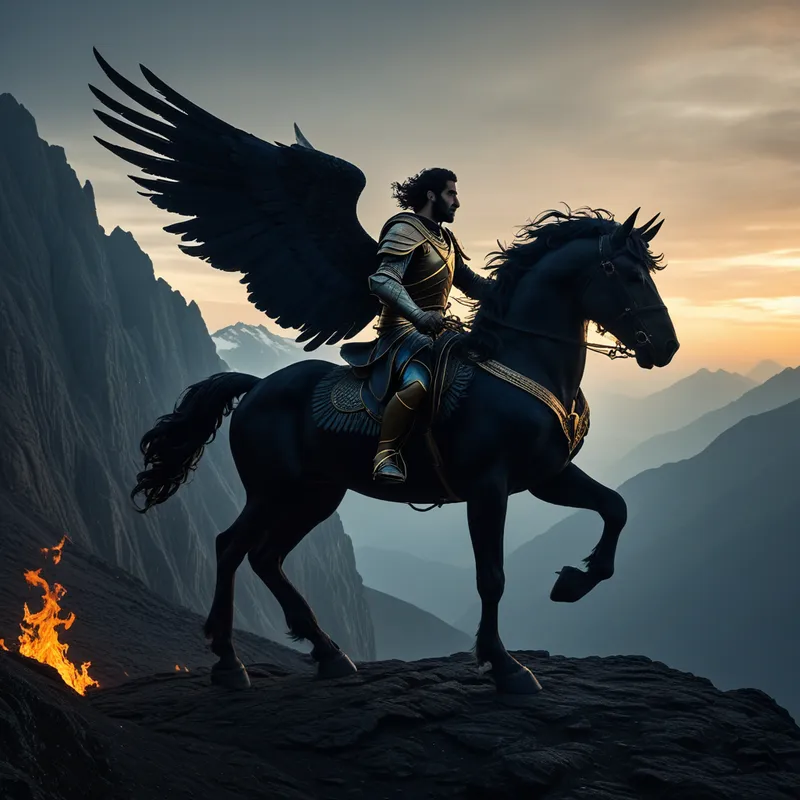
Victorious, hailed as a hero, Bellerophon’s fate turned. He and Pegasus went on to triumph over the fierce Amazons and a band of ruthless pirates. But with each victory, the mortal’s heart grew heavier, not with gratitude, but with ambition. The memory of the earth grew faint; the allure of the home of the gods grew irresistible. He looked at the distant, cloud-wreathed peak of Mount Olympus, and a terrible thought took root.
One fateful dawn, he turned Pegasus not toward any earthly task, but upward, toward the sacred heights. Higher and higher they climbed, above the clouds, the air growing thin and cold. The gates of the gods’ domain seemed almost within reach. But Zeus, protector of the divine order, looked down. This was a trespass no mortal soul could be allowed. With a thought, he sent a single, furious gadfly to sting the flank of the winged horse.
Pegasus, in sudden, agonized shock, reared. The sacred bond shattered in an instant of animal pain. Bellerophon, the great hero, the slayer of monsters, lost his grip. With a cry lost to the vast winds, he fell. He did not die, but was broken, condemned to wander the earth alone, hated by the gods, a cautionary whisper on the lips of men. Pegasus, however, flew on, ascending to the stables of Olympus, where he carried the thunderbolts of Zeus, his journey complete. The mortal who sought heaven was cast down; the divine creature found his home.
Cultural Origins & Context
This myth, in its most complete form, comes to us from the Theogony of Hesiod and, most notably, the Bibliotheca of Pseudo-Apollodorus. It was a tale told not just for entertainment, but as a foundational narrative reinforcing the Greek worldview. It articulated the unbreachable boundary between the mortal and the divine, the themis. Bellerophon’s arc served as a powerful societal lesson on hubris, a core concept in Greek tragedy.
The figure of Pegasus likely has even deeper, pre-Greek origins, possibly connected to ancient Minoan symbols of power and nobility. His association with springs (like the Peirene) ties him to poetic inspiration and the life-giving, mysterious forces of the earth. The myth functioned as an etiological story, explaining the origin of the winged horse constellation and justifying the heroic, yet tragic, history of certain noble lines who claimed descent from Bellerophon.
Symbolic Architecture
At its heart, this is a myth of a sacred partnership and its catastrophic rupture. Pegasus represents the numinous, instinctual power of the unconscious—the creative, transcendent force that can be approached, respectfully engaged with, and temporarily harnessed. He is the embodied spirit, born from a moment of profound violence (Medusa’s death) and transformation.
Bellerophon is the conscious ego. The golden bridle, a gift from the goddess Athena via the seer, symbolizes the mediating principle—wisdom, craft, and respectful ritual—required to safely connect ego consciousness to the immense power of the unconscious. The Chimera is the terrifying, chaotic complex that must be integrated: the fire-breathing monster of unresolved trauma, inner conflict, or shadow material.
The true hero’s task is not to conquer the beast with brute force, but to use the gift of divine alliance to transform its energy from within.
The fatal flight toward Olympus is the ego’s inflation. Having successfully navigated great challenges with the help of the unconscious (Pegasus), the ego begins to believe the power is its own. It identifies with the Self, the god-image, a psychological state of utter inflation. The gadfly sent by Zeus is the necessary, painful puncture of this delusion—a psychic correction that, while shattering, restores the natural order of the psyche.
The Dreamer’s Resonance
When this myth stirs in the modern dreamer, it often signals a critical juncture in relating to one’s own inner power and ambition. Dreaming of riding a winged horse may reflect a beautiful, empowering phase of creative flow or spiritual awakening, where one feels “in the saddle” of a newfound talent or insight.
Dreams of falling from a great height, especially after a period of soaring success, directly mirror Bellerophon’s hubris. Somatic feelings of vertigo, sudden panic, or a lurch in the stomach upon waking are the body’s record of this psychic correction in process. The dream is not merely punishing; it is re-grounding. It speaks to an ambition that has become disconnected from its source, a project or identity built on an inflated self-image that the psyche must dismantle for the individual’s own survival. The dream may also present the gadfly as a nagging anxiety, a sudden betrayal, or a small, irritating problem that unravels a grand plan.
Alchemical Translation
The alchemical journey modeled here is one of aspiring to the coniunctio—the sacred marriage of conscious and unconscious—but mistaking it for a final, permanent possession by the ego. The process begins with the nigredo of Bellerophon’s exile and shame. The offering of the bridle at the spring is the albedo, a moment of lucid, humble connection to the transcendent function.
The battles are the arduous work of citrinitas, where the allied psyche confronts and integrates shadow elements (the Chimera, the Amazons as anima conflicts). The fatal flight is the premature, arrogant attempt to seize the rubedo—the philosopher’s stone, godhood, total enlightenment—as an ego trophy.
Individuation is not about reaching an Olympian peak and residing there, but about learning to ride the currents between heaven and earth without forgetting which one is your home.
The fall, then, is not a failure of the entire journey, but a necessary part of the circulatio. It returns the inflated consciousness to the prima materia of human limitation, where the work must begin again, this time with a searing knowledge of the cost of arrogance. The myth teaches that the transcendent power (Pegasus) is not ours to own, but to visit with reverence. Our task is not to become gods, but to become fully, humbly human, occasionally brushing against the divine with awe, and knowing when to return to solid ground.
Associated Symbols
Explore related symbols from the CaleaDream lexicon: