Pegasus Myth Meaning & Symbolism
A divine winged horse, born from the blood of a slain Gorgon, who ascends to Olympus, carrying thunderbolts and inspiring poets to touch the heavens.
The Tale of Pegasus
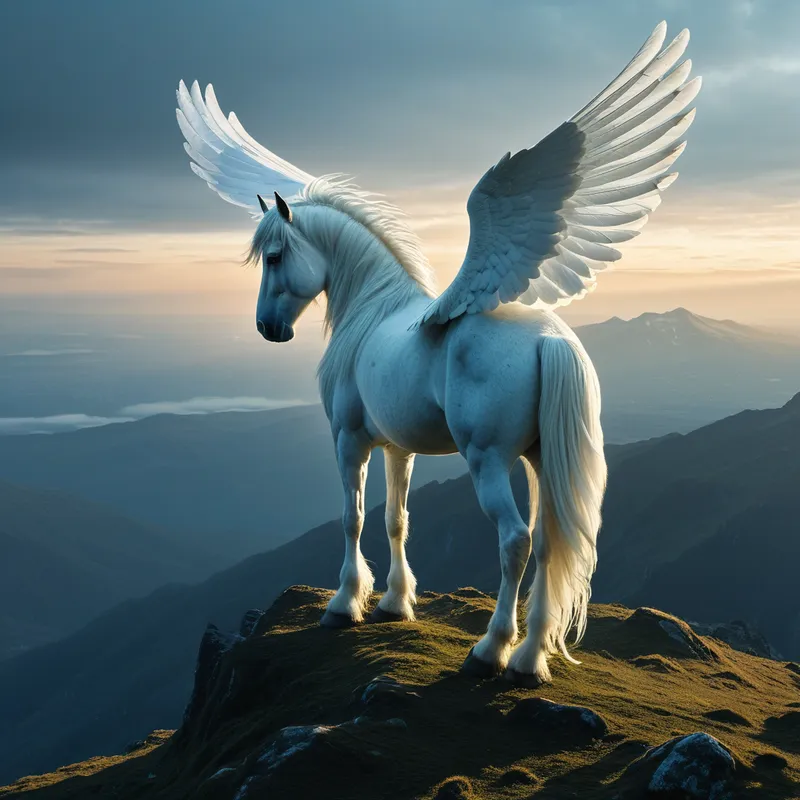
Listen, and hear the tale not of a man, but of a horse—a horse born of death and divinity. When the hero Perseus, armed with a mirrored shield and a god’s favor, struck the head from the serpent-haired Gorgon Medusa, her blood spilled upon the barren earth of the western ocean’s edge. And from that dark, fallen ichor, mingled with the foam of the sea, life surged forth. With a sound like tearing silk and a flash of blinding light, he emerged: Pegasus, the winged stallion, his coat the white of sun-bleached bone and sea-foam, his wings vast and feathered like an eagle’s, yet bearing the grace of a swan. He did not whinny, but gave a cry that was half-neigh, half-thunderclap, and with one mighty beat of his pinions, he launched himself into the vault of heaven, leaving the scene of his violent birth far below.
For a time, he was a creature of pure, untamed sky, a comet grazing the clouds. His hooves, it is said, never touched the mortal earth until he descended to drink from a spring on the Acrocorinth. It was there that the fates of god and man intertwined. A Corinthian prince, Bellerophon, burdened by a stain of unintended murder, sought purification and a task worthy of a king. The goddess Athena, in her owl-eyed wisdom, appeared to him in a dream as he slept in her temple. She gifted him a golden bridle, gleaming with divine craft. “Go to the spring of Peirene,” her dream-voice whispered. “He who drinks there will be yours.”
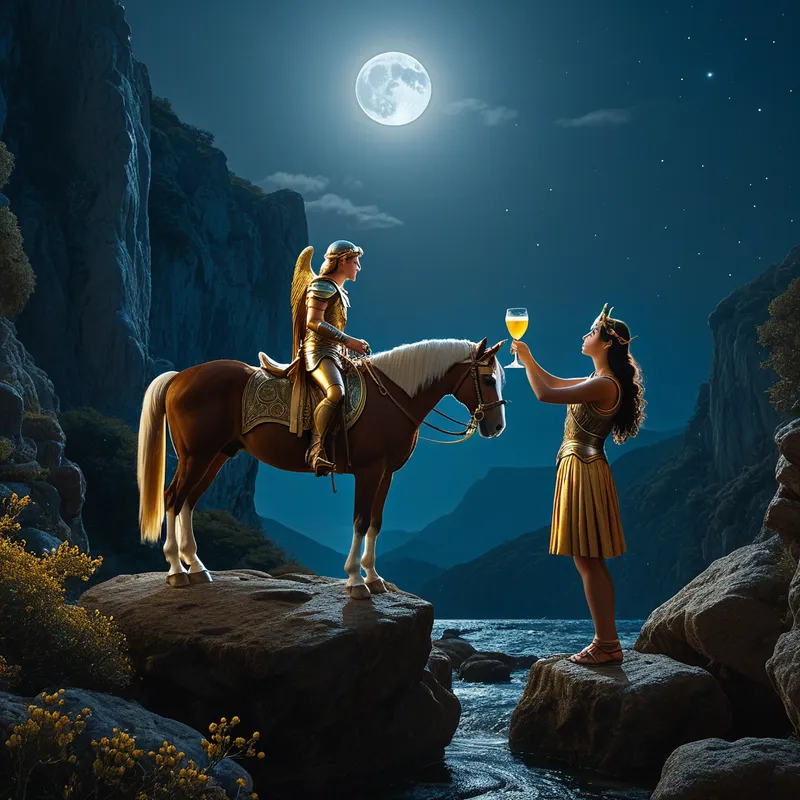
Under a hunter’s moon, Bellerophon found the spring. And there was Pegasus, bowing his magnificent neck to the water, his wings folded like a cloak of moonlight. With a heart pounding louder than the surf, Bellerophon approached. He did not leap to conquer, but offered the bridle with a steady hand. The divine horse, recognizing the artifact of the goddess, allowed the bit to be placed, the straps to be fastened. In that moment of mutual consent, a partnership was forged not of domination, but of sacred alliance.
Together, they undertook impossible labors. Most famed was their battle against the Chimera, a beast of flame and chaos ravaging the land of Lycia. From the safety of the sky, Bellerophon rained down arrows, while Pegasus danced on the thermals of the monster’s own fiery breath, until a final, lead-tipped spear found its mark and the beast was slain. For this, Bellerophon was offered a kingdom. But the seed of hubris had been planted. Believing his partnership with the winged one made him equal to the gods, the prince mounted Pegasus and commanded a flight to the very gates of Olympus itself.
Zeus, lord of the sky, saw this arrogance and sent a gadfly to sting Pegasus mid-ascent. The noble horse reared in shock, and Bellerophon, his mortal grip broken, fell. He plummeted to earth, to wander the world broken and alone. But Pegasus, free of the hubristic weight, continued his flight. He ascended through the tempest, past the realm of clouds, and was welcomed into the stables of Olympus. There, he was given his eternal duty: to carry the thunderbolts of Zeus, the very essence of celestial power and divine will. And from one beat of his hoof upon Mount Helicon, a spring of inspiration—the Hippocrene—burst forth, a gift to the Muses and all who seek the waters of poetry and art.
Cultural Origins & Context
The myth of Pegasus is a quintessential product of the Greek imagination, first crystallized in the epic poetry of Hesiod’s Theogony in the 8th century BCE. It is a myth that traveled not on foot, but on the wings of story, told and retold by bards, depicted on pottery, and later elaborated by poets like Pindar and mythographers. Its societal function was multifaceted. On one level, it was an aetiological myth, explaining the creation of the Hippocrene spring, a real site sacred to the Muses. On another, it served as a powerful narrative about the proper relationship between mortals and the divine. Pegasus himself is a liminal figure, born from a monstrous, chthonic being (Medusa) and the god of the sea (Poseidon), yet destined for the Olympian heights. His story encapsulates the Greek understanding of inspiration (enthousiasmos—literally, “the god within”) as a dangerous, divine force that can elevate the worthy poet or hero, but will violently reject the arrogant.
Symbolic Architecture
Pegasus is not merely a fantastical steed; he is a living symbol of the soul’s potential for transcendence. Born from the blood of a beheaded Medusa, he represents the astonishing creative and spiritual energy that can be liberated when we consciously confront and “behead” our deepest fears and petrifying traumas. The Gorgon’s stare turns consciousness to stone—it is the paralyzing power of unintegrated shadow. From the death of this state emerges the capacity for flight.
The wing is born from the wound. The very substance of our deepest trauma, when alchemized by consciousness, becomes the fuel for our most sublime ascent.
His partnership with Bellerophon symbolizes the necessary alliance between the disciplined, directed consciousness of the ego (the hero with the golden bridle) and the wild, intuitive, soaring power of the unconscious (the winged horse). The golden bridle, a gift from Athena, represents the logos—the guiding principle of wisdom, craft, and conscious form that must be applied to harness raw, instinctual power without breaking its spirit. The catastrophic fall of Bellerophon is a classic mythic warning: the ego that identifies with the numinous power it has accessed, believing the flight is its own achievement, is doomed to a crippling inflation and a devastating fall back into alienation.
The Dreamer’s Resonance
When Pegasus canters into the modern dreamscape, he heralds a profound somatic and psychological process: the awakening of the capacity for sublimation. To dream of trying to catch or ride Pegasus often coincides with a period where creative or spiritual energies are stirring but feel unmanageable, thrilling yet terrifying. The body may register this as restlessness, a feeling of being “wired,” or somatic anxiety centered in the chest and shoulders—the very place where wings would sprout.
To dream of successfully riding Pegasus, especially in flight, signals a moment of integration. The dreamer is experiencing a harmonious flow between conscious intention and unconscious inspiration. Conversely, a dream of falling from Pegasus, or of the horse throwing the dreamer, is a crucial corrective from the psyche. It is a somatic metaphor for a real-life situation where ambition has outpaced integrity, where one is “flying too high” on borrowed or misappropriated power, risking a painful crash. The psyche is insisting on a return to humility, to re-establish the sacred contract with the inner source of power.
Alchemical Translation
The myth of Pegasus provides a precise map for the alchemical process of psychic transmutation, or individuation. The prima materia, the base matter, is the traumatic, chaotic blood of Medusa—our unprocessed pain, shame, or rage. The “beheading” is the act of conscious confrontation, separating the paralyzing narrative (the head) from the vital life-force (the blood). From this mortificatio (death) comes the coniunctio (sacred marriage): the union of the sea (Poseidon, the unconscious depths) and the spilled life-force, which gives birth to the avis hermeticus—the hermetic bird, the winged spirit.
The journey to Olympus is not an escape from the earth, but the carrying of earthly experience into a higher order of meaning.
The labor with Bellerophon represents the opus, the great work. We must harness this new-born spirit with the golden bridle of conscious discipline (dedicated practice, therapy, ritual) to confront our inner Chimeras—the composite beasts of our complexes. The final, crucial stage is the ascensio: the release of the spirit. Bellerophon’s fall is the necessary dissolution of the ego’s claim to ownership. For the modern individual, this translates to the realization that our greatest inspirations, our most transcendent states, are not “ours” to possess, but are energies that flow through us. The ultimate goal is not to become a god, but to become a faithful servant of the thunderbolt—a clear conduit for meaning, creativity, and transformative power, allowing the Pegasus within to take its rightful place in the service of something greater than the personal self.
Associated Symbols
Explore related symbols from the CaleaDream lexicon: