Pearly Gates Myth Meaning & Symbolism
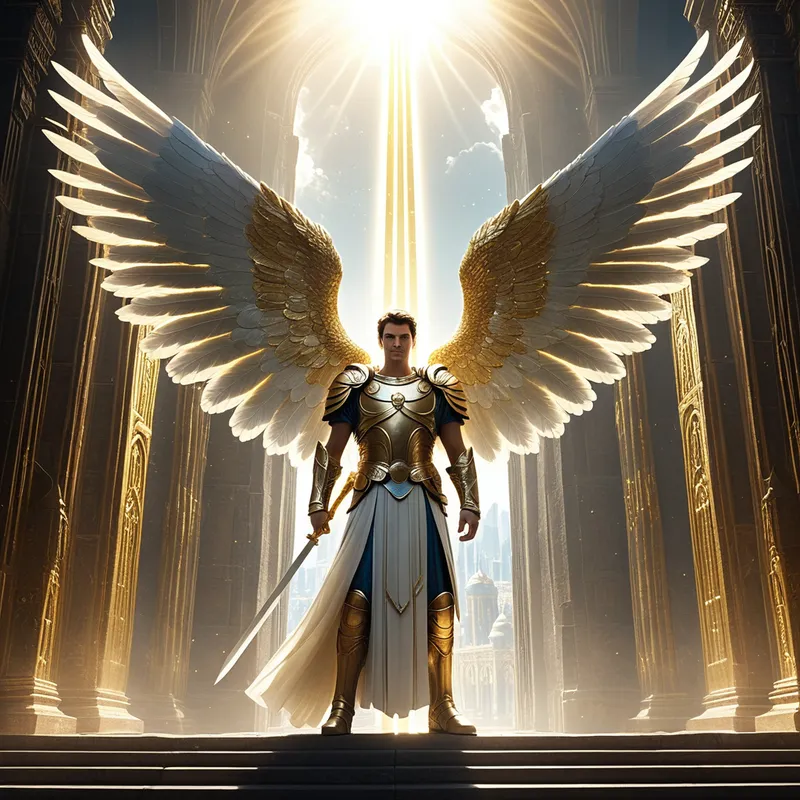
A celestial gate of pearl, guarded by an archangel, marking the ultimate threshold between the mortal world and the divine, eternal city of New Jerusalem.
The Tale of the Pearly Gates
Let me tell you of the final wall, the last veil, the one door through which every story must pass to find its ending or its true beginning.
Beyond the tumult of history, beyond the silent expanse of the star-strewn heavens, there lies a city. Not a city built by human hands, worn by time and war, but a city descending, a holy New Jerusalem, coming down out of heaven from God. Its light is like a jasper stone, clear as crystal. Its streets are pure gold, like transparent glass. And its wall is great and high, with twelve gates.
But one gate stands above all in the song of the seer. The eastern gate, the gate of the dawn, the gate of beginning. It is not forged of iron or bronze, not carved from cedar or oak. It is a single pearl. A pearl of such magnitude and radiance that to name it merely “pearl” is to call the sun a candle. It is the Pearly Gate.
And at this gate stands a figure who is both warrior and scribe, a being of flame and stillness. He is Michael, or perhaps Gabriel, in the oldest tales his name shifts like light on water. His wings are vast canvases of storm and serenity. In his hand is not a sword for battle, but a scroll. A scroll of names.
The drama is not one of clashing armies here, though armies have clashed to reach this place. The drama is in the approach. A soul, weightless yet heavy with memory, stands before the luminescent barrier. The conflict is internal, a final reckoning written in the heart’s own script. The gate does not judge; it reveals. Its pearlescent surface, formed from a grain of sand transformed by relentless pressure and time, mirrors the essence of the one who approaches.
The rising action is the silent conversation between the soul and the gate, witnessed by the impassive angel. The soul presents its life—not in words, but in substance, in the quality of its light. The gate, a testament to transformation, responds. It is the resolution of a cosmic tension: the journey versus the destination, the struggle versus the peace. And then, if the name is found, if the essence aligns with the light of the city… the gate swings open. Not with a creak of hinge, but with the sound of a single, perfect note resolving a symphony. The mortal journey ends. The eternal story begins.

Cultural Origins & Context
This vision springs from the apocalyptic soil of the Book of Revelation, attributed to a figure named John exiled on the island of Patmos. Written during a period of intense persecution of early Christians under the Roman Empire, its language is not literal geography but a coded, symbolic resistance. It is a literature of hope and vindication for a marginalized community.
The image of the pearly gate is a single, breathtaking detail in a vast tapestry of cosmic renewal—the New Creation. It was not a myth told around campfires but a secret, potent hope passed on scrolls and in whispers. Its societal function was dual: to provide an unshakeable promise of divine justice and a glorious future for the faithful, and to establish a stark symbolic boundary between the corrupt world of Empire (the “whore of Babylon”) and the pure community of God.
The pearl itself was a known symbol of immense value and beauty in the ancient Near Eastern and Mediterranean world. For a persecuted sect, the notion that their ultimate home was guarded by a substance more precious than any Roman treasure was a profound theological and psychological rebuttal to their earthly poverty and suffering.
Symbolic Architecture
The Pearly Gates are not merely a location; they are the ultimate symbol of the Threshold. They represent the critical juncture between two states of being: the profane and the sacred, the fragmented and the whole, the temporal and the eternal.
The gate is not a barrier to keep out, but a lens to focus. It does not deny entry; it demands coherence.
The Pearl is the core symbol. Formed in the hidden depths, within the soft flesh of a living creature around an irritant—a wound, a grain of sand—it symbolizes beauty born from adversity, value created through sustained pressure and secretion. Psychologically, it represents the Self, the precious, cohesive center of the personality formed through a lifetime of enduring and transforming psychic irritants.
The Angel-Gatekeeper embodies the principle of discernment and consciousness. He is not a punisher but a witness to the authenticity of the life presented. He represents the internalized moral and spiritual conscience, the part of the psyche that holds the “scroll” of our true actions and intentions, separate from our ego’s narratives.
Together, they model the final stage of psychic integration: to stand before the mirror of one’s own deepest, most transformed essence (the pearl) and be recognized by one’s own discerning consciousness (the angel).
The Dreamer’s Resonance
When the image of a magnificent or even a simple glowing gate appears in modern dreams, it rarely signifies a literal religious belief. Instead, it marks a profound psychological process. The dreamer is approaching a major inner threshold.
Somatically, one might feel a tightening in the chest, a holding of breath—the body knows it is at a precipice. Psychologically, this is the moment before a significant life transition: the end of a career, the commitment of a marriage, the confrontation of a deep-seated fear, or the integration of a shadow aspect. The gate represents the point of no return. The anxiety in the dream is the ego’s resistance to death—the death of an old identity, an old way of being.
The condition of the gate in the dream is crucial. Is it shining and open, rusted shut, or barely visible? This reflects the dreamer’s unconscious perception of their readiness for this transformation. The figure (or absence of a figure) guarding it represents the internal authority—parental complexes, the superego, or the emerging Self—that must be faced and answered to.

Alchemical Translation
In the alchemy of the soul, the journey to the Pearly Gates is the Rubedo, the reddening, the final stage of illumination and union. The entire opus leads to this gate.
The “grain of sand” is the initial neurosis, the wound, the core complex that irritates the psyche. The “oyster” is the conscious ego, which must envelop this irritant not by expelling it, but by devoting a lifetime of conscious attention (the nacre) to it. Year after year, layer upon layer, the ego secretes understanding, endurance, and meaning around the pain.
Individuation is the slow, patient creation of an inner pearl from the grit of one’s deepest suffering.
The “pressure of the deep” is the unavoidable suffering, conflict, and challenges of life that provide the necessary conditions for this transformation. One does not become a pearl in calm, shallow waters.
Finally, to “stand before the gate” is the act of radical self-confrontation. The angelic gatekeeper asks, “Have you made a pearl of your sand?” The alchemical translation is not about earning a heavenly reward but about achieving psychic integrity. The gate opens not to a city out there, but to the realization that the luminous, golden city of the Self has been within all along, and the pearl was the key to its gate. The triumph is not admission, but the realization that you have, through the long alchemy of living, become someone who can finally come home.
Associated Symbols
Explore related symbols from the CaleaDream lexicon: