Peaches of Immortality Myth Meaning & Symbolism
The myth of Xi Wangmu's celestial peaches, ripening every millennia, which grant immortality to the gods and define the cosmic cycle of time and renewal.
The Tale of the Peaches of Immortality
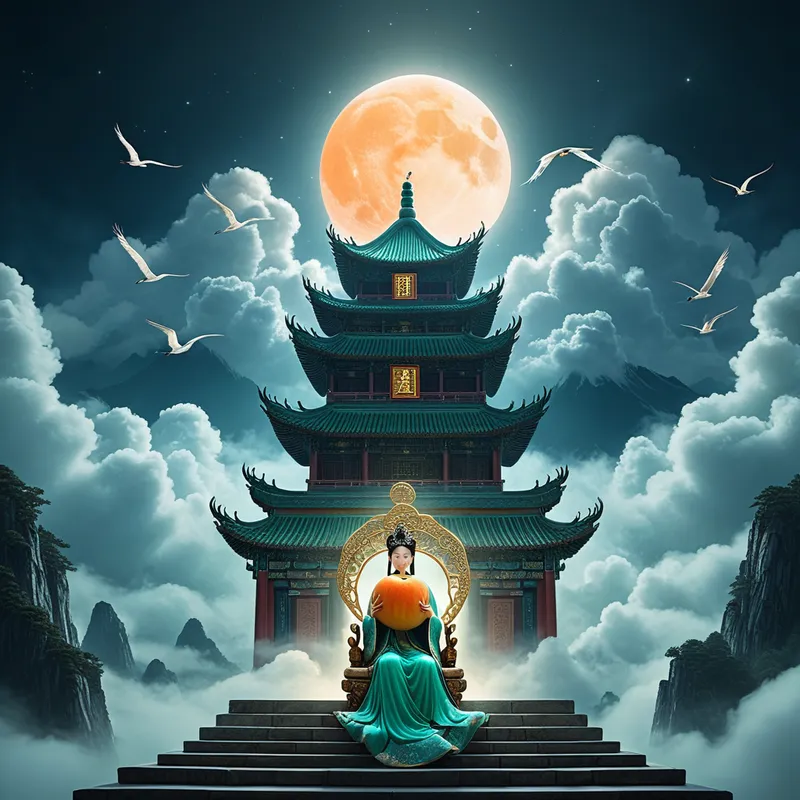
Listen, and let your spirit travel westward, beyond the dusty roads of men, past the whispering deserts and the jagged teeth of the mountains, to where the earth meets the vault of heaven. There lies the Kunlun Mountains, a realm of jade cliffs and mists that taste of eternity. At its heart resides a palace that is not built of stone or wood, but of condensed starlight and intention. This is the abode of Xi Wangmu.
She is the keeper of the boundary, the guardian of the secrets that separate the mortal coil from the endless dance of the cosmos. Her hair is the color of a winter sky at dusk, and her eyes hold the patience of geological epochs. But her greatest treasure is not the pearls in her hair or the phoenixes in her court. It is her orchard.
In this celestial garden, trees grow not from soil, but from the very fabric of time. Their roots drink from the springs of chaos, and their branches cradle the stars. Upon them hang the Peaches of Immortality. These are no ordinary fruit. Their skin holds the blush of a newborn universe, and their scent is the promise of a tomorrow that never fades. But they are bound to a rhythm older than creation itself. The trees of the lowest grade bear fruit every three thousand years; those of the middle grade, every six thousand; and the trees of the highest, most sublime grade only once every nine thousand years. To eat one is to be woven into the eternal tapestry, to become a Xian, free from the wheel of death and rebirth.
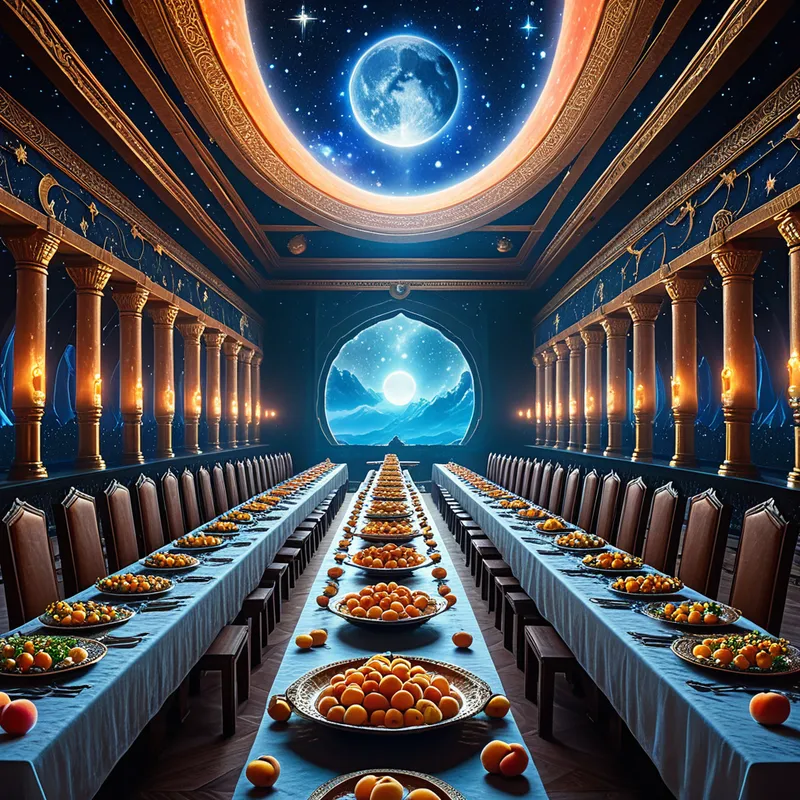
When the appointed millennia have turned, a profound stillness falls over the heavens. The peaches swell with perfected essence, glowing with a soft, internal radiance. This is the signal. Messengers are dispatched across the three realms—to the courts of the Jade Emperor, to the dragon kings of the deep, to the star deities and earthly immortals. The Pantao Hui, the Grand Peach Festival, is convened.
Gods and perfected beings gather in Xi Wangmu’s palace. The air thrums with celestial music, a harmony that stabilizes the cosmos. The peaches are presented, the ultimate sacrament. Each deity partakes, not merely for pleasure, but to renew their divine mandate, to reaffirm their place in the celestial bureaucracy that governs all existence. It is a feast of cosmic maintenance, a ritual that stitches the heavens to the earth and ensures the orderly procession of the seasons and the stars. To be invited is the highest honor; to partake is to have one’s name inscribed in the eternal register. The myth tells of bold mortals and cunning monkeys, like the legendary Sun Wukong, who dared to steal this fruit, unleashing chaos upon the perfect order of the heavens—a story for another telling, but a shadow that always lingers at the edges of this divine celebration.
Cultural Origins & Context
This myth is not a single story from a single book, but a living tapestry woven from threads of ancient shamanism, early Daoist mysticism, and imperial court ideology. Its earliest traces appear in texts from the Shang and Zhou dynasties, where Xi Wangmu begins as a wild, tiger-toothed goddess of plague and salvation. Over centuries, through texts like the Classic of Mountains and Seas and later Daoist jing, she was transformed into the elegant, sovereign keeper of immortality, reflecting the Daoist pursuit of physical and spiritual transcendence.
The myth was perpetuated by Daoist adepts in their quest for elixirs, by court poets allegorizing the emperor’s mandate, and by folk tradition in festivals and operas. The Peach Banquet became a powerful metaphor for imperial power and divine sanction—an emperor’s court was its earthly reflection. The peach itself, long a Chinese symbol of longevity, marriage, and protection, was elevated to this supreme cosmological status. This myth functioned as a societal anchor, explaining the source of divine authority, modeling the rewards of spiritual cultivation, and defining the ultimate, nearly unattainable aspiration for both the individual seeker and the body politic.
Symbolic Architecture
At its core, the myth is a profound meditation on time, order, and the cost of transcendence. The peach is the ultimate symbol of achieved perfection—a fruit that contains the culmination of vast cycles of time. It is not invented or manufactured; it is cultivated through patient, cosmic waiting.
The Peach of Immortality is not a prize to be seized, but a state of being that ripens only when one’s inner nature has become perfectly aligned with the rhythms of the Dao.
The orchard’s three-tiered maturation cycle (3,000, 6,000, 9,000 years) mirrors the hierarchical and orderly structure of the universe and the graded stages of spiritual attainment in Daoist practice. The feast is not a party, but a ritual of renewal. It represents the necessary, periodic realignment of cosmic forces and psychic structures. To eat the peach is to fully internalize this order, to become a sovereign part of the system rather than its subject. The figure of Xi Wangmu is the archetypal Guardian of the Threshold. She does not hoard the peaches out of malice, but embodies the law that the ultimate treasure must be protected by the ultimate boundary. Her role ensures that immortality is not a casual gift, but a earned integration into the cosmic whole.

The Dreamer’s Resonance
When this myth stirs in the modern unconscious, it rarely appears as a straightforward banquet. More likely, the dreamer finds themselves in a vast, silent garden where time feels distorted. They may see a single, luminous fruit on a distant branch, always out of reach, or they may be a silent, uninvited observer at the edge of a glorious feast, filled with a longing that is both spiritual and deeply somatic—a tightness in the chest, a dryness in the throat.
This dream pattern signals a profound confrontation with one’s own potential and its limits. The somatic feeling of “almost-there-yet-unattainable” points to a psyche grappling with a desire for wholeness, for a definitive healing or achievement that feels eternally postponed. It can manifest during life transitions, when one questions their legacy or yearns for a significance that transcends their daily life. The dream asks: What is the “immortality” you seek? Is it creative legacy, psychological integration, or freedom from a specific fear of decay? The forbidden or unreachable fruit confronts the dreamer with the internal and external boundaries—the “Xi Wangmu” within—that they must acknowledge and respectfully engage with, rather than simply rage against or steal from.
Alchemical Translation
The individuation journey modeled here is not one of heroic conquest, but of ritualized cultivation and earned participation. The modern seeker is not Sun Wukong, storming the heavens in rebellion. They are, ideally, a patient gardener of their own soul, learning the long rhythms of growth.
The first alchemical stage is Planting in Kunlun: Withdrawing psychic energy from chaotic, scattered pursuits (the mundane world) and establishing a “mountain” of inner stability and practice (meditation, introspection, creative discipline). The second is Tending the Millennial Cycles: Embracing the frustrating, non-linear timeline of deep psychological work. True transformation operates on “mythic time,” not quarterly goals. It requires enduring the winters where no growth is visible. The third is Receiving the Invitation: This is the moment of synchronicity or grace, where the internal cultivation aligns with an external opportunity for integration. It is not self-aggrandizement, but a humble recognition that one’s small work is part of a larger order. Finally, Partaking at the Feast: This is the conscious integration of the achieved “immortality”—not literal endless life, but the realization of one’s timeless, essential Self. It is the moment when the ego-self willingly sits at the table of the larger psyche, partaking of the fruit of its own long labor, and in doing so, renewing its commitment to the ongoing order of the soul.
The ultimate alchemy is the slow transformation of the seeker into a guardian of their own sacred orchard, understanding that the fruit is both the goal and the seed for the next great cycle of becoming.
Associated Symbols
Explore related symbols from the CaleaDream lexicon: