Púca Myth Meaning & Symbolism
A shape-shifting spirit of the liminal spaces, the Púca offers terrifying rides and prophetic gifts, embodying the untamed psyche and the price of wisdom.
The Tale of Púca
Listen, and let the peat-smoke carry you. It is Samhain night, when the veil is thinnest, a threadbare cloth between what is and what might be. The wind does not blow; it whispers old names. In such an hour, on the shoulder of a hill where the hawthorn grows twisted, you might meet him.
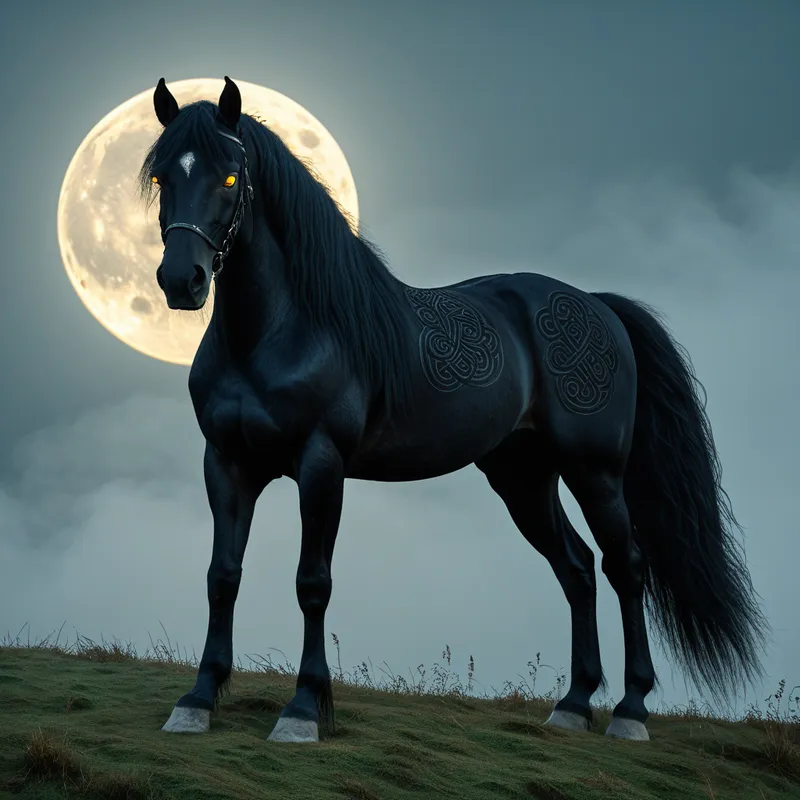
He is the Púca. This night, he wears the form of a great stallion, darker than a hole in the earth, with a coat that drinks the moonlight and eyes that burn like captured marsh-lights. He is not evil, but he is not tame. He is the breath of the wild places that press against your tidy field walls.
A young man, Seán, bold with the folly of youth and the warmth of stolen ale, dares the lonely road home. He feels the silence first—a thick, woolen quiet that smothers the crickets’ song. Then, the scent of wet earth and cold stone. And then, he sees the shape, monumental and still, blocking the path.
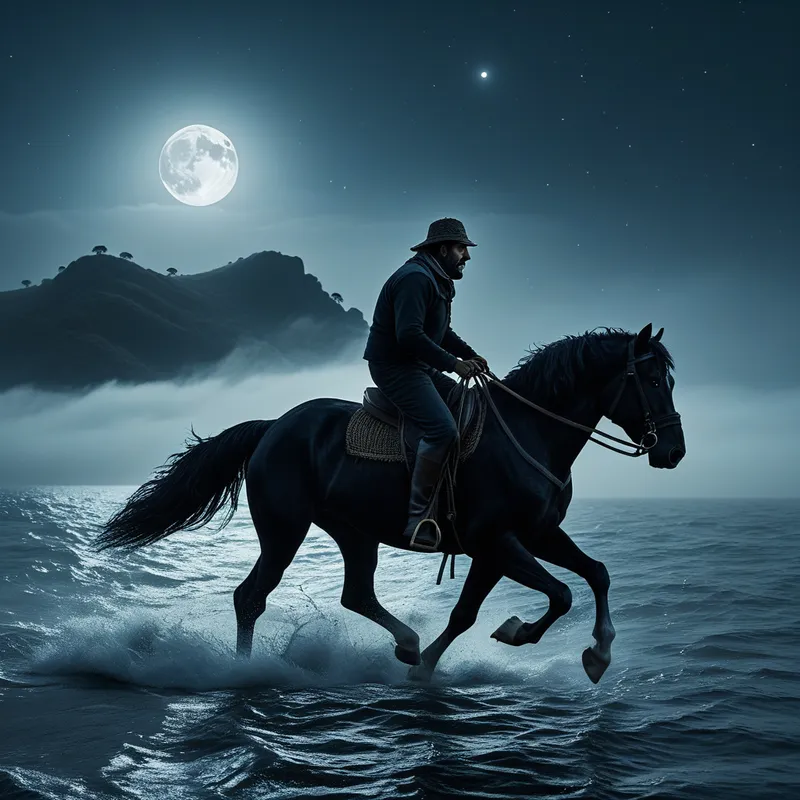
“A fine night for a ride,” the Púca’s voice is not a sound but a vibration in the marrow, a thought placed directly in the mind. Before Seán can cry out or run, he is seized, not by hands, but by a force like the wind itself, and flung onto the beast’s back. The world becomes a blur of terror. The Púca does not gallop; he unfolds the landscape beneath them. They tear across fields, not touching the grass, leap chasms that were not there at dusk, and race along the crests of waves in the black sea, salt spray stinging like ice.
Seán clings, his heart a frantic bird in his throat, his mind shattered by the impossible speed. He sees visions in the streaking dark: the faces of ancestors in the rocks, the sorrows of the land in the twisted trees. He is not being taken to a place, but through the very membrane of the known world. Just as his soul feels it will tear loose, the ride ceases as suddenly as it began. They stand, trembling, on the same hill where they started. The first grey light of dawn bleeds at the horizon.
The Púca turns its great head. Its breath is frost. “Your courage held,” it murmurs, the voice now weary, ancient. “For that, a gift and a warning.” It nods to the ground. Where its hoof touched, a cluster of perfect blackberries grows, out of season, gleaming with dew. “Eat, and know the year’s turning. Speak of this, and know its curse.” Then, like mist burned by the coming sun, the Púca is gone. Seán stumbles home, the wild ride etched in his bones, the taste of the blackberry—both unbearably sweet and profoundly bitter—forever on his tongue.
Cultural Origins & Context
The Púca (or Pooka, Pwca) is a creature of the Celtic oral tradition, most prominently rooted in Irish, Welsh, and Scottish folklore. Unlike deities of the Mythological Cycle, the Púca belongs to the world of the folk—the stories told by the hearth, not carved in stone. It was a narrative tool used by seanchaí to explain the uncanny, to enforce social boundaries, and to articulate a profound relationship with the land.
Its tales were not recited in grand halls but whispered in cottages, serving as both entertainment and education. The Púca acted as a personification of the untamed, non-human reality of the Celtic world. Farmers left a share of the harvest (the “Púca’s portion”) to appease it, a practice reflecting a worldview of reciprocity with the spirit of the land. Stories of its shape-shifting—into horses, goats, hares, or even human forms—underscored its nature as a being of the liminal zones. It was a guardian of thresholds, a spirit of the betwixt-and-between, teaching that wisdom and danger are two sides of the same coin found only beyond the village fence.
Symbolic Architecture
The Púca is not a monster to be slain, but a psychopomp to be endured. It represents the raw, unintegrated force of the unconscious—what Carl Jung termed the Shadow. It is everything we have civilized out of ourselves: wild instinct, chaotic creativity, primal fear, and untamed vitality.
The ride on the Púca’s back is the terrifying, necessary journey into one’s own depths, where the ego is not in control.
Its classic form, the black horse, is a universal symbol of libido—the fundamental life energy. A tamed horse is useful; a wild horse is devastatingly powerful. The Púca’s ride is a forced confrontation with this power. The gift of the blackberry is equally potent symbolism. The berry is sweet fruit from a thorny bush, representing the nourishment that comes only from engaging with the difficult, “prickly” parts of the psyche. The warning against speaking of the experience mirrors the ineffable, deeply personal nature of true psychological transformation; it cannot be fully communicated, only integrated.
The Dreamer’s Resonance
When the pattern of the Púca myth arises in modern dreams, it signals a profound encounter with the Shadow. The dreamer may not see a literal horse, but the feeling is the same: being taken on a terrifying, involuntary journey. This could manifest as a dream of being chased by a dark, shapeless force, of driving a car that will not obey, or of falling through endless space.
Somatically, the dreamer might awaken with a racing heart, a sense of awe, or the lingering taste of something strange. Psychologically, they are in the grip of a process that the conscious mind has resisted. The ego’s orderly world is being dismantled by a surge from the unconscious. This is not a nightmare to be dismissed, but a call to attention. The dream-Púca appears when life has become too rigid, too safe, or too inauthentic, and the wild psyche demands recognition. The ride, however frightening, is moving the dreamer towards a crucial revelation, a bitter-sweet truth (the blackberry) that they have been avoiding.
Alchemical Translation
The alchemical process mirrored in the Púca myth is Nigredo, the blackening. This is the first, darkest stage of psychic transmutation, where the base material of the self is broken down. The conscious personality (Seán on his safe road) is forcibly taken by the unconscious (the Púca) and subjected to a disorienting, chaotic journey. The old, comfortable identity is shattered.
The gift after the ordeal is the Albedo—the moment of clarity, the silver insight found in the blackness.
For the modern individual seeking individuation, the Púca models a crucial lesson: we do not conquer our inner wildness; we learn to ride it. The goal is not to kill the black horse, but to develop the courage to mount it, to endure its chaotic sprint through our hidden landscapes, and to receive its paradoxical gift. The sweet-bitter blackberry is the insight, the piece of wisdom, or the acceptance of a painful truth that becomes available only after we have faced our own darkness. We return to our daily hill at dawn, forever changed, carrying a nourishment that is also a solemn responsibility. The Púca’s ultimate teaching is that our wholeness depends on making peace with the wild, shape-shifting stranger within.
Associated Symbols
Explore related symbols from the CaleaDream lexicon: