Paul's Damascus Road Myth Meaning & Symbolism
A zealous persecutor is struck blind by a divine light, hears a voice, and is utterly transformed, becoming the architect of a new faith.
The Tale of Paul’s Damascus Road
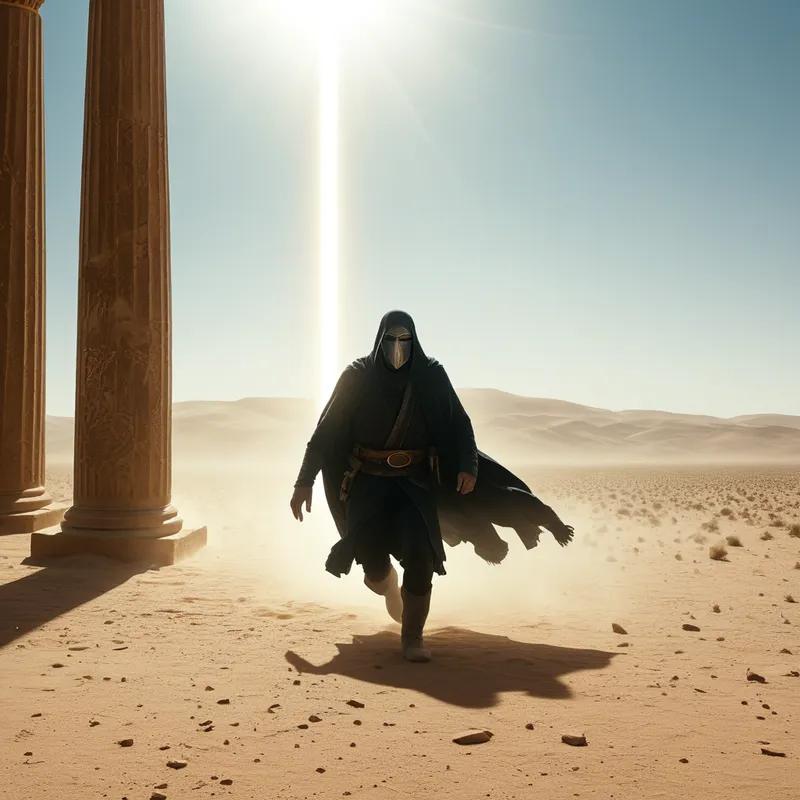
The sun was a merciless bronze disc, hammering the road from [Jerusalem](/myths/jerusalem “Myth from Biblical culture.”/) to Damascus into a ribbon of white dust and shimmering heat. Among the travelers was a man of iron conviction, Saul. His robes were stained with the purpose of his journey: in his possession were letters, warrants of authority to bind and drag back any who called upon the name of the crucified Nazarene. His heart was a fortress, its walls built of scripture and zeal, its gates sealed against doubt. He was not a man in conflict, but a weapon of pure, directed certainty.
Then, at the zenith of day, [the world](/myths/the-world “Myth from Tarot culture.”/) cracked.
It began not as sound, but as a pressure—a sudden, silent weight that pressed the very air from the road. The light, already fierce, did not brighten so much as it concentrated. It poured down from directly overhead, not like sunlight, but like a solid, searing column, a waterfall of pure incandescence. It struck Saul with physical force, throwing him from his feet onto the stony ground. His companions stumbled back, crying out, shielding their eyes from the impossible noon.
In that light was a presence. And from that presence, a voice. It was not a sound heard with ears, but one felt in the marrow of the bones, vibrating the dust on the road.
“Saul, Saul, why do you persecute me?”
Blinded, crushed by the weight of glory, the man gasped into the dirt. “Who are you, Lord?”
The voice filled the universe. “I am [Jesus](/myths/jesus “Myth from Christian culture.”/), whom you are persecuting.”
The words were a key that turned in the lock of his soul. Every act of righteous fury, every consent to the stoning of a believer like Stephen, every confident stride on this very road—all of it was suddenly, horrifyingly, revealed in its true shape. He was not serving God. He was making war on God. The foundation of his world dissolved into ash. The light did not fade; it poured inside, scouring every dark corner of his certainty. When his companions dared to approach, they found him not wounded, but undone. He who had led them was now blind, trembling, led by the hand into Damascus, a prisoner of the revelation that had shattered his jail.
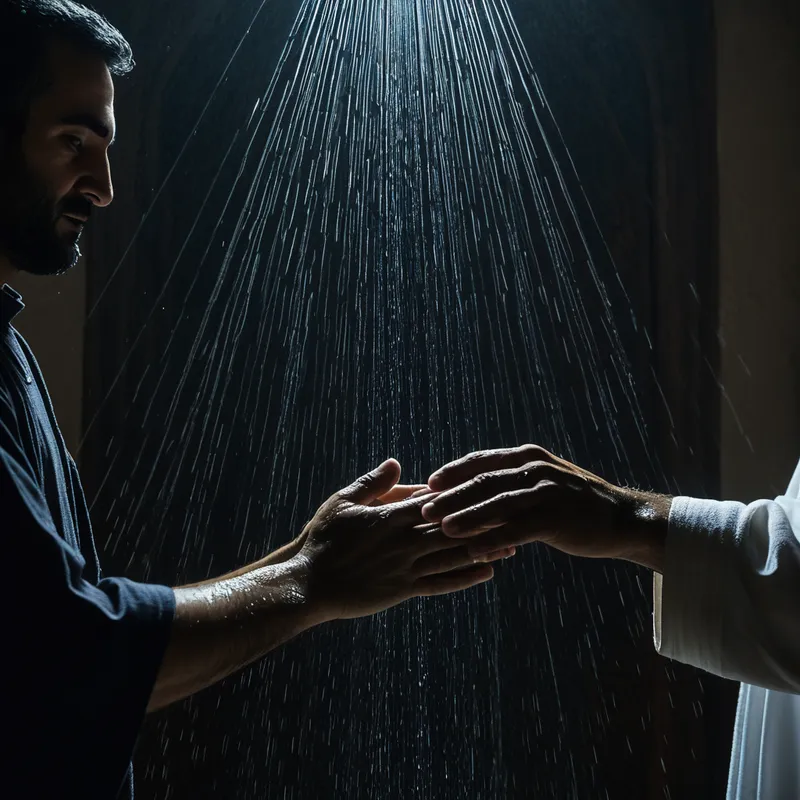
For three days, in a house on Straight Street, he sat in absolute darkness. He neither ate nor drank. The external blindness was but a mirror of the internal cataclysm. The man called Saul was dying in that dark room. Then, a disciple named Ananias, obeying a vision of his own, came to him. He laid hands upon him. “Brother Saul,” he said, “the Lord—Jesus, who appeared to you on the road—has sent me so that you may see again and be filled with the [Holy Spirit](/myths/holy-spirit “Myth from Christian culture.”/).”
Something like scales fell from his eyes. The light returned, but it was a different light. It illuminated a different man. He arose, was baptized, and broke his fast. The weapon had been melted down in the furnace of encounter. From its metal, a new tool was being forged. Saul, the persecutor, was gone. In his place stood Paul.
Cultural Origins & Context
This myth originates in the earliest strata of the Christian movement, recorded in the Acts of the Apostles and attested to in Paul’s own letters. It functions as the foundational conversion narrative, the “origin story” for the faith’s most prolific and influential theologian. Culturally, it served multiple vital purposes. For a marginalized and persecuted sect, it was a potent propaganda tool: the story of their chief enemy not merely defeated, but recruited and transformed into their greatest champion. It validated the movement’s legitimacy through direct, divine intervention.
The tale was told and retold as oral testimony before being codified in scripture, serving as a template for conversion itself. It moved the center of religious authority from external law and lineage to internal, revelatory experience. Societally, it modeled the possibility of radical change, offering a narrative where the most entrenched opposition could become the most passionate advocate, thus implicitly arguing for the universality of the Christian message. It was a myth for outsiders, proving that no one was beyond the reach of grace.
Symbolic Architecture
At its core, the Damascus Road is an archetypal [drama](/symbols/drama “Symbol: Drama signifies narratives, emotional expression, and the exploration of human experiences.”/) of enantiodromia—the [emergence](/symbols/emergence “Symbol: A process of coming into being, rising from obscurity, or breaking through a barrier, often representing birth, transformation, or revelation.”/) of the unconscious opposite. Saul represents the [psyche](/myths/psyche “Myth from Greek culture.”/) in a state of absolute, identified certainty. His zeal is a form of psychological rigidity, where the conscious [attitude](/symbols/attitude “Symbol: Attitude symbolizes one’s mental state, perception, and posture towards life, influencing emotions and actions significantly.”/) ([persona](/symbols/persona “Symbol: The social mask or outward identity one presents to the world, often concealing the true self.”/) of the righteous Pharisee) is so over-inflated that it completely suppresses its [shadow](/symbols/shadow “Symbol: The ‘shadow’ embodies the unconscious, repressed aspects of the self and often represents fears or hidden emotions.”/). [The shadow](/myths/the-shadow “Myth from Jungian culture.”/), in this [case](/symbols/case “Symbol: A case often signifies containment, protection of personal matters, and the need for organization in one’s life.”/), is everything he denies: the validity of the new [faith](/symbols/faith “Symbol: A profound trust or belief in something beyond empirical proof, often tied to spiritual conviction or deep-seated confidence in people, ideas, or outcomes.”/), his own [capacity](/symbols/capacity “Symbol: A measure of one’s potential, limits, or ability to contain, process, or achieve something, often reflecting self-assessment or external demands.”/) for [error](/symbols/error “Symbol: A dream symbol representing internal conflict, perceived failure, or a mismatch between expectations and reality.”/), the voice of the vulnerable.
The blinding light is the irruption of [the Self](/myths/the-self “Myth from Jungian culture.”/)—the total, archetypal psyche—into this fragile conscious [arrangement](/symbols/arrangement “Symbol: An arrangement symbolizes organization, intention, and the systematic structure in one’s life or surroundings.”/). It does not argue; it annihilates.
The most profound truths are not learned, but endured. They arrive not as ideas, but as events that dismantle the one who receives them.
The voice’s question, “Why do you persecute me?” is the critical symbolic pivot. It identifies the persecuted other as the divine center. Psychologically, this reveals that the outer [enemy](/symbols/enemy “Symbol: An enemy in dreams often symbolizes an internal conflict, self-doubt, or an aspect of oneself that one struggles to accept.”/)—the heretics Saul hunts—is a [projection](/symbols/projection “Symbol: The unconscious act of attributing one’s own internal qualities, emotions, or shadow aspects onto external entities, people, or situations.”/) of his own disowned inner [reality](/symbols/reality “Symbol: Reality signifies the state of existence and perception, often reflecting one’s understanding of truth and life experiences.”/), his own latent wholeness. To persecute them is to wage war on his own [soul](/symbols/soul “Symbol: The soul represents the essence of a person, encompassing their spirit, identity, and connection to the universe.”/). The three days of [blindness](/symbols/blindness “Symbol: Represents a lack of awareness, insight, or refusal to see truth, often tied to emotional avoidance or spiritual ignorance.”/) are a necessary nekyia, a gestational [period](/symbols/period “Symbol: Periods in dreams can symbolize cyclical patterns, renewal, and the associated emotions of loss or change throughout life.”/) in the dark [womb](/symbols/womb “Symbol: A symbol of origin, potential, and profound transformation, representing the beginning of life’s journey and the unconscious source of creation.”/) of the psyche where the old [identity](/symbols/identity “Symbol: Identity represents the sense of self, encompassing personal beliefs, cultural background, and social roles.”/) is dissolved so the new one can coalesce. Ananias represents the mediating function, the compassionate [human](/symbols/human “Symbol: The symbol of a human represents individuality, complexity of emotions, and social relationships.”/) [connection](/symbols/connection “Symbol: Connection symbolizes relationships, communication, and bonds among individuals.”/) required to integrate the shattering numinous experience back into [life](/symbols/life “Symbol: The symbol of ‘Life’ represents a journey of growth, interconnectedness, and existential meaning, encompassing both the joys and challenges that define human experience.”/). The giving of a new name (Paul) ceremonially seals the [death](/symbols/death “Symbol: Symbolizes transformation, endings, and new beginnings; often associated with fear of the unknown.”/) and [rebirth](/symbols/rebirth “Symbol: A profound transformation where old aspects of self or life die, making way for new beginnings, growth, and renewal.”/).

The Dreamer’s Resonance
When this myth stirs in the modern dreamer, it signals a profound crisis of identity and direction. One may dream of being struck by a light, hearing a disembodied voice, or suddenly realizing they are traveling the wrong path. The somatic experience is often one of paralysis, awe, or a feeling of being “seen” in an uncomfortably total way.
Psychologically, this dream pattern emerges when the conscious personality has become tyrannical—over-identified with a career, a dogma, a self-image, or a mission that has grown rigid and life-denying. The psyche’s self-regulating function initiates a corrective. The “light” in the dream is the unconscious truth breaking through the dam of repression. The dreamer is not being punished, but being recalibrated. The process feels violent because [the ego](/myths/the-ego “Myth from Jungian culture.”/) clings fiercely to its constructed world. To dream of this myth is to be in the midst of a psychic revolution, where the very foundation of “who I am” and “what I am doing” is being called into radical question by a voice from the depths.

Alchemical Translation
The alchemical process mirrored here is the [nigredo](/myths/nigredo “Myth from Alchemical culture.”/)—the blackening, the putrefaction, the utter dissolution of the base matter. Saul’s conscious personality, his [prima materia](/myths/prima-materia “Myth from Alchemical culture.”/), is the rigid, leaden state of the ego identified solely with law and persecution. The divine light is the application of the aqua permanens, the divine [water](/myths/water “Myth from Chinese culture.”/) or spirit, which dissolves this rigid structure. The three days of blindness are the sealed vessel of the alchemical retort, where the matter stews in its own darkness, breaking down into chaotic massa confusa.
The goal of the work is not to improve the old form, but to allow it to die so that the new form, latent within it, may be born.
Ananias performs the role of [the alchemist](/myths/the-alchemist “Myth from Various culture.”/), introducing the mediating agent (the laying on of hands, [the word](/myths/the-word “Myth from Biblical culture.”/), the water of baptism) that begins the coagulation of the new substance. The emergence of Paul is the albedo—the whitening, the dawn of a new consciousness. The shattered sword of the persecutor becomes the pen of the apostle. The energy that was once used to destroy the new life is now used to articulate and build it.
For the modern individual, this myth does not advocate for a theistic conversion, but for a psychological one. It models the necessity, and the trauma, of true individuation. We are all, at times, Saul on the [road to Damascus](/myths/road-to-damascus “Myth from Christian culture.”/), fiercely committed to a path that is ultimately a rejection of our deeper calling. The myth instructs us that transformation often requires a catastrophic rupture—a failure, a loss, a stunning insight—that blinds us to our old way of being. The courage lies not in avoiding the light, but in consenting to be led, blind and helpless, into the unknown city, to sit in the darkness, and to allow a new name, a new purpose, to be given. It is the archetypal journey from the tyranny of the absolute ego to the service of the greater Self.
Associated Symbols
Explore related symbols from the CaleaDream lexicon: