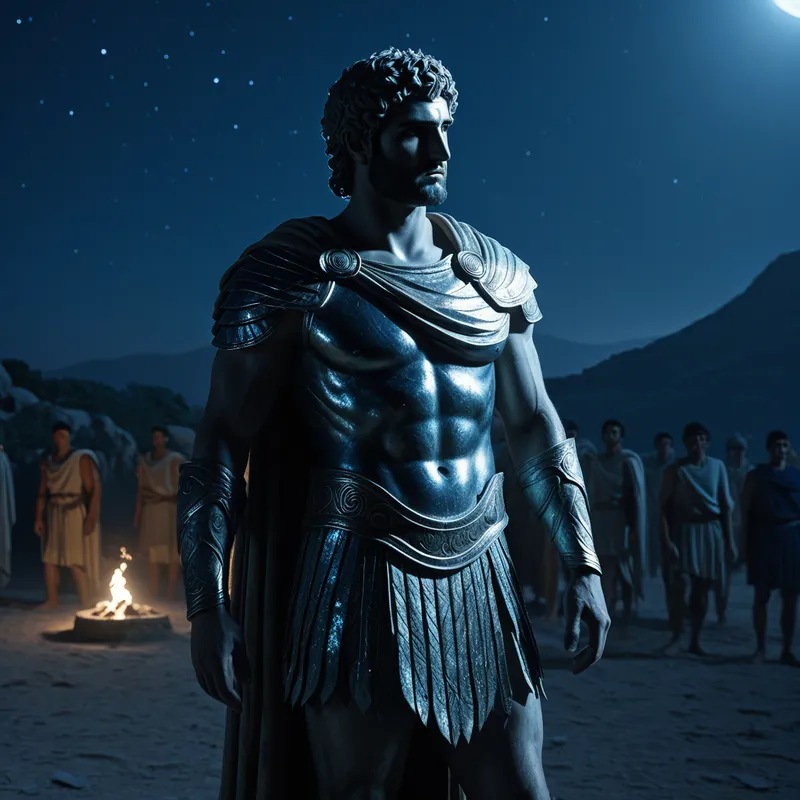
Patroclus' Shade Myth Meaning & Symbolism
The ghost of Achilles' beloved companion appears, demanding proper burial and revealing the soul's torment when denied its final rites.
The Tale of Patroclus’ Shade
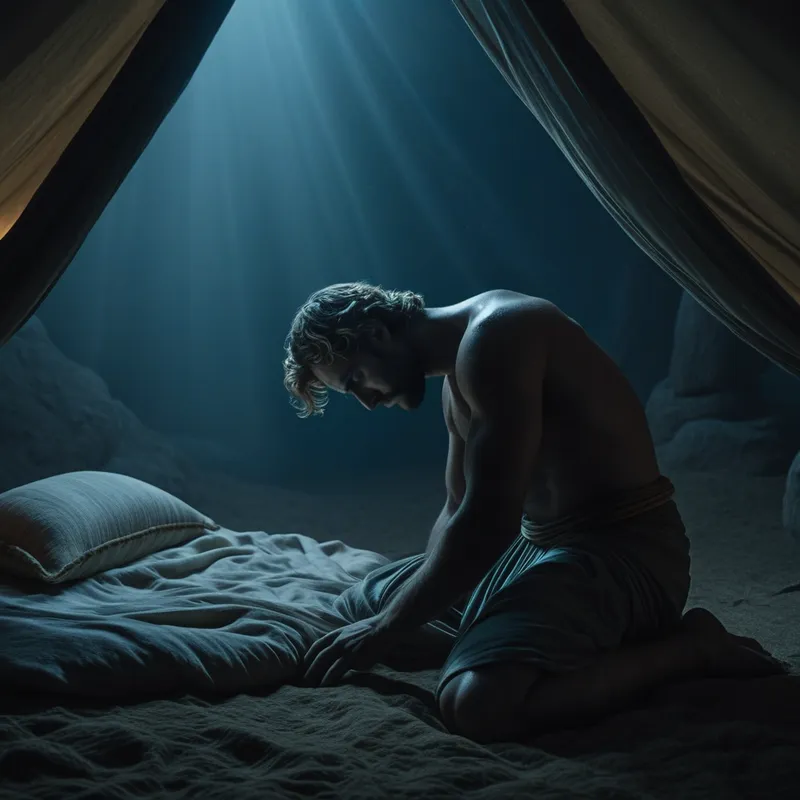
The war was a beast that fed on sunlight and screamed through the night. For days, the great Achilles, a storm of wrath made flesh, had raged upon the plain of Scamander, hewing a red harvest in his grief. Now, exhaustion, that quiet cousin of death, finally pulled him down. In his tent, amidst the scent of sweat, blood, and oiled leather, he slept—a sleep not of peace, but of collapse.
And into that heavy stillness, it came.
Not with a sound, but with a chill that did not stir the air. Not with a form, but with a presence that pressed upon the soul. The shade of Patroclus stood at the head of the bed. He wore the very likeness of the living man, yet he was as a breath upon a cold mirror—there, and not there. His eyes held the vast, hollow silence of the house of [Hades](/myths/hades “Myth from Greek culture.”/).
He spoke, and his voice was the whisper of wind through cypress trees at a tomb. “You sleep, Achilles, but I cannot. You have forgotten me.”
Achilles stirred, his warrior’s instincts sensing an intrusion no guard could stop. He reached out, a desperate, yearning gesture, trying to clasp the phantom to his breast—to feel once more the solid warmth of his friend. His arms passed through empty air, and a cry was strangled in his throat. The shade was a dream that would not be held.
“See?” sighed Patroclus. “I am nothing but this. My psychē, my breath-soul, has fled. What stands before you is my eidōlon, my image, a memory given voice. You gave my body to the fire, but you withheld the final rite. My bones lie mingled with yours in the golden urn, unwashed, unhonored, unblessed by libation or lament. Because of this, I am barred. The other dead, the swift shadows, will not let me cross [the river](/myths/the-river “Myth from Buddhist culture.”/). I wander, unwanted, on this barren shore.”
The image of his friend, confused and sorrowing, pierced Achilles deeper than any Trojan spear. “What would you have of me?” he whispered, his own voice raw.
“Burn me. Fully and separately. Raise a mound for me by the roaring Hellespont, so that men will remember. And…” here the shade’s form seemed to flicker, “do not lay my bones with yours. Let me have my own earth. Only then will I find rest.”
Then, with the haunting grace of smoke catching an updraft, the shade of Patroclus was gone. He melted into the darkness, not toward the door, but downward, as if the very earth beneath the tent floor had opened to reclaim him.
Achilles awoke to a dawn stained with a new purpose. His grief, once a wild, destructive fire, now had a channel. He would build a pyre so high it would be seen from [the walls of Troy](/myths/the-walls-of-troy “Myth from Global/Universal culture.”/). He would cut his famous hair, the hair he vowed to offer to the river Spercheios upon his homecoming, and lay it in the cold hand of his friend. He would give twelve noble Trojan youths to the sword, a savage retinue for Patroclus’ journey. He would grant the shade its due, so it might finally pass from the twilight of memory into the peace of oblivion.
Cultural Origins & Context
This profound encounter is recorded in Book XXIII of [Homer](/myths/homer “Myth from Greek culture.”/)‘s Iliad, the foundational epic of ancient Greece. It was not merely literature but a sacred text, performed aloud by bards (rhapsodes) for aristocratic audiences. The tale of Patroclus’ shade served a critical societal function: it codified the ancient Greek funerary customs.
To the Greek mind, the soul was not a unified entity. The psychē was the life-force that departed at death. The eidōlon was the insubstantial but conscious remnant—the ghost—that persisted and required proper care. Without the prescribed rituals—the washing (prothesis), the lamentation, the burial with grave goods—this eidōlon could not complete its journey to the House of Hades. It would be trapped in a liminal state, a fate considered dreadful and polluting. The myth thus served as a powerful, emotional enforcement of social and religious duty, binding the living to the dead with chains of obligation and love.
Symbolic Architecture
At its core, the myth is a masterful depiction of the [psyche](/myths/psyche “Myth from Greek culture.”/) grappling with unresolved [trauma](/symbols/trauma “Symbol: A deeply distressing or disturbing experience that overwhelms the psyche, often manifesting in dreams as unresolved emotional wounds or psychological injury.”/) and the [weight](/symbols/weight “Symbol: Weight symbolizes burdens, responsibilities, and emotional loads one carries in life.”/) of [obligation](/symbols/obligation “Symbol: A perceived duty or responsibility imposed by social norms, relationships, or internalized expectations, often involving a sense of being bound to act.”/). Patroclus’ shade is not the man, but the unfinished [business](/symbols/business “Symbol: Dreaming of ‘business’ often symbolizes the dreamer’s ambitions, desires for success, and management of resources in their waking life.”/) of the [relationship](/symbols/relationship “Symbol: A representation of connections we have with others in our lives, often reflecting our emotional state.”/). He represents the part of a profound [connection](/symbols/connection “Symbol: Connection symbolizes relationships, communication, and bonds among individuals.”/) that has been severed violently but not ceremoniously concluded.
The ghost is the embodied conscience of the living, a psychic artifact that manifests when duty to memory has been forsaken for the passions of the present.
Achilles’ attempt to embrace the shade symbolizes the futile desire to return to a past state, to grasp a [reality](/symbols/reality “Symbol: Reality signifies the state of existence and perception, often reflecting one’s understanding of truth and life experiences.”/) that is already transformed by [death](/symbols/death “Symbol: Symbolizes transformation, endings, and new beginnings; often associated with fear of the unknown.”/). The shade’s refusal to be held is the cold [truth](/symbols/truth “Symbol: Truth represents authenticity, honesty, and the quest for knowledge beyond mere appearances.”/) of irreversible change. Its demands are not cruel, but instructional: the work of [grief](/symbols/grief “Symbol: A profound emotional response to loss, often manifesting as deep sorrow, yearning, and a sense of emptiness.”/) is not internal rage, but external, ritualized [action](/symbols/action “Symbol: Action in dreams represents the drive for agency, motivation, and the ability to take control of situations in waking life.”/). The separate [burial mound](/symbols/burial-mound “Symbol: A burial mound represents the passage of life and the transition into the afterlife, serving as a powerful symbol of memory, reverence, and ancestral connection.”/) is crucial—it signifies the necessary [differentiation](/symbols/differentiation “Symbol: The process of distinguishing or separating parts of the self, emotions, or identity from a whole, often marking a developmental or psychological milestone.”/) of [the self](/myths/the-self “Myth from Jungian culture.”/) from the lost other. To mingle their bones forever would be a kind of psychic [death](/symbols/death “Symbol: Symbolizes transformation, endings, and new beginnings; often associated with fear of the unknown.”/) for Achilles, a permanent identification with the lost object. The shade demands its own [identity](/symbols/identity “Symbol: Identity represents the sense of self, encompassing personal beliefs, cultural background, and social roles.”/) in [death](/symbols/death “Symbol: Symbolizes transformation, endings, and new beginnings; often associated with fear of the unknown.”/), thereby freeing the living to eventually reclaim theirs.
The Dreamer’s Resonance
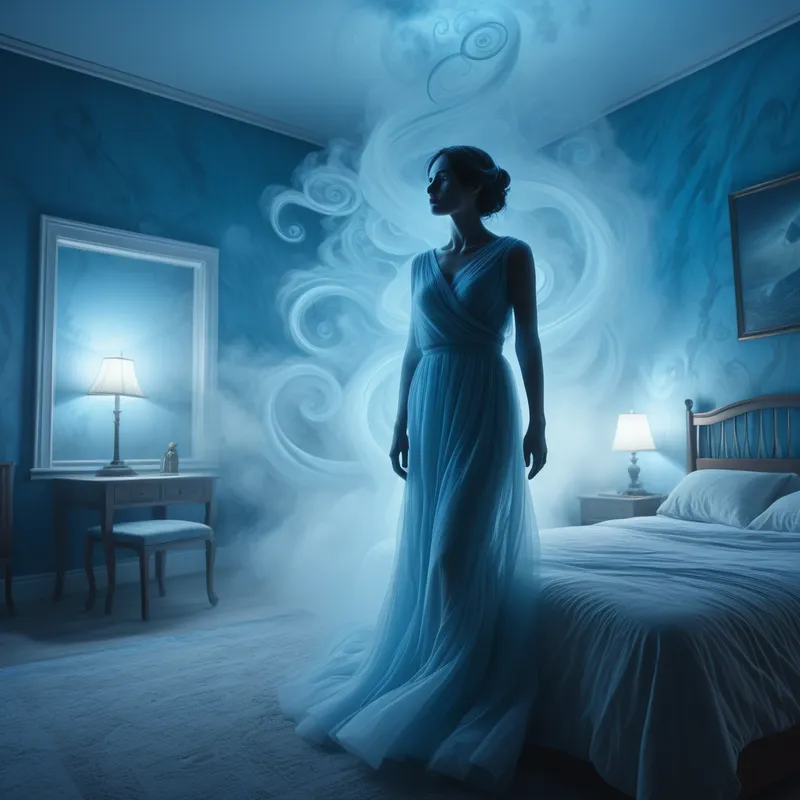
When this mythic pattern stirs in the modern unconscious, it rarely appears as a classical ghost. Instead, one might dream of a forgotten room in a house, a locked box whose contents are urgently needed, or a familiar person who stands just out of reach, silently compelling the dreamer to follow. The somatic sensation is often one of coldness, stillness, and a profound, anxious urgency—the body sensing a psychic system left incomplete.
This is the psyche signaling an un-mourned loss. The “loss” may not be a physical death, but the end of a relationship, a career, an identity, or a personal dream. The “shade” is the psychic energy still bound to that lost [thing](/myths/thing “Myth from Norse culture.”/), unable to be recycled into new life because it was never properly “buried”—never acknowledged, honored, and released through conscious process. The dreamer is in the role of Achilles, confronted by the part of themselves that is stuck in the past, demanding ritual attention.
Alchemical Translation
The alchemical journey here is one of separation and coagulation. Achilles begins in a state of [nigredo](/myths/nigredo “Myth from Alchemical culture.”/)—the blackening, represented by his destructive grief and the black ashes of the initial, insufficient pyre. The shade’s visit is the stirring of the [prima materia](/myths/prima-materia “Myth from Alchemical culture.”/), the raw, troubled substance of the soul that must be worked.
The ghost is the catalyst that transforms passive suffering into active, symbolic labor—the alchemical fire that must be tended not to destroy, but to refine.
Achilles’ subsequent actions—building the pyre, conducting the games, raising the mound—are the arduous stages of albedo (whitening) and citrinitas (yellowing). He moves from identification (“we are one, our bones mingled”) to separation (“here is your earth, here is mine”). This is the individuation process: acknowledging a deep attachment, working through the complex duty it entails, and ultimately differentiating the self from the archetypal grip of the “other.” The final peace of the shade signifies the [rubedo](/myths/rubedo “Myth from Alchemical culture.”/) (reddening)—the integration of the experience into the psyche’s tapestry. The loss becomes a sacred memory, a mound on the landscape of the self, rather than a wandering, haunting ghost that blocks the passage to new life. The living hero, having performed the rites, is not free of pain, but is free to continue his own story.
Associated Symbols
Explore related symbols from the CaleaDream lexicon: