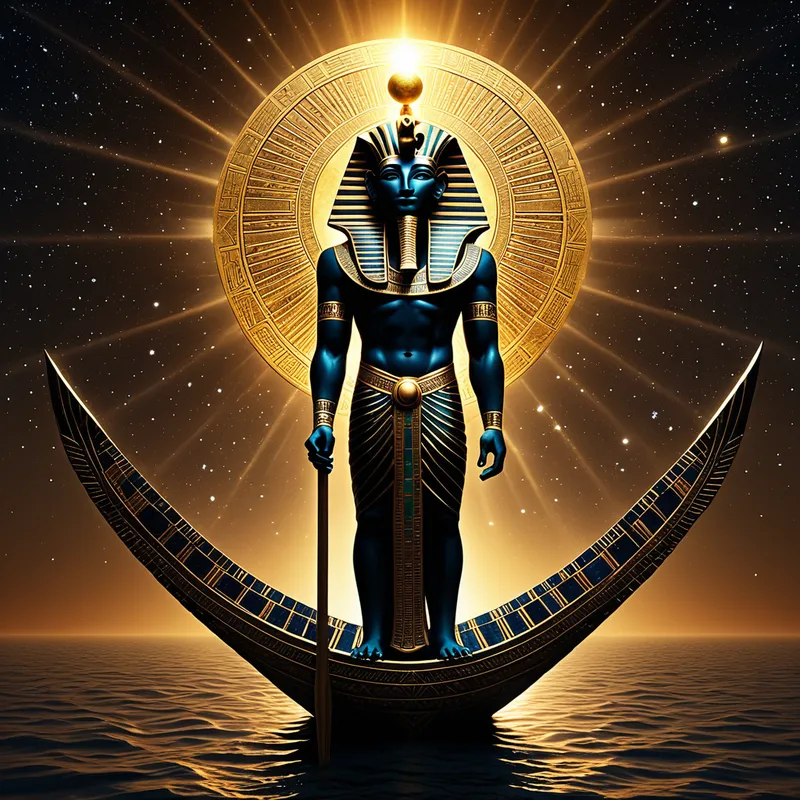
Path of Ra Myth Meaning & Symbolism
The sun god Ra's perilous nightly voyage through the underworld, battling chaos to be reborn at dawn, symbolizing the soul's eternal cycle.
The Tale of Path of Ra
Hear now the tale that is sung not at dawn, but in the deep, silent heart of the night. The tale of the Ra, who is mighty at noon but must become vulnerable at midnight. For even the sun must set. Even the king must sleep.
As the last crimson blush of day bleeds into the western hills, the great god enters his golden barque, the Mandjet. But this is not the vessel of day. That ship is left behind, a memory of light. Now, Ra descends to the river that has no water, the Duat. The gates of the horizon groan shut behind him. He is old here. His golden limbs are heavy; his radiant face is lined with the fatigue of a cosmos upheld. He is no longer the untouchable disk in the sky, but a pharaoh navigating the tomb of the world.
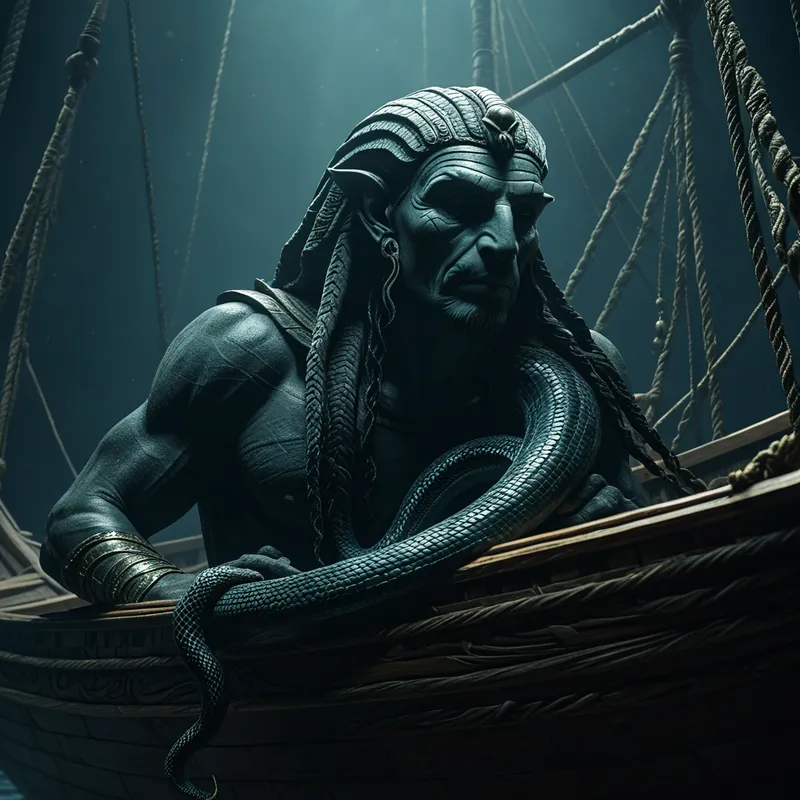
The Duat is not empty. It is a cavernous belly, ribbed with treacherous geography—lakes of fire, deserts of darkness, fields of silent reeds. And in these depths, the eternal enemy waits: Apep</ab title=“A primordial serpent deity embodying chaos, disorder, and the unknown”>p, the serpent of dissolution. His coils are as vast as the night, his maw a vortex that seeks to swallow the sun whole, to return all of creation to the formless, silent waters of Nun. Ra’s journey is a siege. At every hour of the night, Apep attacks. The serpent rears, his scales the black of oblivion, to choke the river and drag the barque into non-existence.
But Ra does not travel alone. In the barque stands a company of defenders. The warrior god Set, with his red hair and chaotic strength, stands at the prow, his spear aimed at the serpent’s head. The magician Thoth chants spells of binding, his words becoming nets of light. The loyal serpent-goddess Mehen wraps her body around the cabin, a living shield. And Ra himself, though aged, raises the Was-scepter, his will a beacon that holds the chaos at bay. The battle is cosmic, violent, and eternal. Spears thrust. Spells crackle. Apep is stabbed, bound, and cast down—but never destroyed. He will return tomorrow night.
Through this gauntlet of peril, the barque sails on. It passes through twelve gates, corresponding to the twelve hours of night. At each, Ra is recognized by the blessed dead, who sing his praises and receive his light, thriving in his wake. He merges with Osiris, lord of the Duat, in a mystical union of solar power and chthonic mystery. The sun god is infused with the potency of resurrection.
And then, in the deepest hour, a miracle of weariness occurs. The old god is reborn. As the barque approaches the eastern mountain, the scarab god Khepri—the becoming one—pushes the solar disk from the underworld’s womb. Ra is renewed, young, and radiant once more. The gates of dawn burst open. The Mesektet barque rises into the sky, and light floods the world once more. The Path is complete. For now.
Cultural Origins & Context
This narrative, often called the “Books of the Underworld” such as the Amduat or the Book of Gates, was not public folklore but sacred, secret knowledge. It was inscribed in the tombs of pharaohs within the Valley of the Kings, on the walls of their burial chambers, and on papyri placed with the elite dead. Its primary function was funerary and regenerative.
The myth served as a divine map and a script for the soul. The pharaoh, and later other privileged deceased, was identified with Ra in his journey. By knowing the names of the gates, the demons, and the correct spells, the soul could navigate the Duat safely, overcome the chaos of death, and be reborn with the sun. The nightly journey of Ra was the cosmic template for all journeys through the afterlife. It was a state-sponsored, theological assurance that the fundamental order of the universe—Maat—was actively maintained by the gods, even in the realm of death, and that this order could be accessed by the righteous soul.
Symbolic Architecture
At its core, the Path of Ra is the archetypal journey of consciousness through the unconscious. The sun god represents the light of the ego, the conscious self, and the life principle. His journey is the necessary descent of that conscious light into the dark, watery, serpentine realm of the psyche—the personal and collective unconscious.
The sun must know the night to appreciate the day; the self must know the shadow to become whole.
The Duat is not merely a place of punishment, but the womb of transformation. Its monsters, like Apep, symbolize the formless, devouring aspects of the unconscious: repressed traumas, existential dread, and the primal fear of annihilation. The battle is not for destruction, but for containment and integration. The defenders in the barque—Set (aggression), Thoth (knowledge), Mehen (protection)—represent the necessary psychic functions the ego must assemble to undertake this perilous inner work.
The union with Osiris is pivotal. Osiris is the god who has been dismembered and reconstituted, the lord of the dead. He represents the hidden, static structure of the unconscious self. Ra’s merging with him signifies the crucial alchemy: the conscious ego (Ra) must integrate the wisdom and pattern of the deeper, often wounded, self (Osiris) to be renewed. The rebirth as Khepri is the emergence of a new, more complete consciousness from this profound inner marriage.
The Dreamer’s Resonance
When this myth stirs in the modern psyche, it often manifests in dreams of perilous nocturnal journeys. One may dream of traveling in a vehicle (the modern barque) through a terrifying, labyrinthine landscape—a dark highway, a subway tunnel that never ends, a basement that descends infinitely. There is a palpable sense of being hunted or of facing an immense, overwhelming obstacle (the serpent). The dreamer often feels aged, weary, and burdened.
Somatically, this can correlate with periods of depression, existential crisis, or deep psychological transition—the “dark night of the soul.” The dream is not a prophecy of doom, but a map of the process. The terrifying figures are the unintegrated contents of the shadow. The journey, though frightening, is purposeful. The dream ego, like Ra, is being forced to confront what it has spent a lifetime in the “daylight” avoiding. To dream of such a journey is to be on the Path itself, whether one is consciously ready or not. The psyche is initiating its own necessary voyage through the Duat.
Alchemical Translation
For the individual, the Path of Ra models the process of individuation. It begins with the sunset: a conscious defeat, a depression, a failure, or simply the weariness of maintaining a persona. This is the ego’s forced descent from its solitary height.
The alchemical work happens in the boat—the vessel of the process, which is the totality of the psyche holding the conflict. Here, one must recruit inner resources. The aggressive drive (Set) to face the truth; the intellectual and intuitive capacity (Thoth) to name and understand the inner demons; the capacity for self-care and boundaries (Mehen). The battle with Apep is the daily, hourly struggle to not be consumed by negativity, despair, or regression.
Rebirth is not an escape from the dark, but the direct result of having fully traveled through it.
The crucial, transformative stage is the “midnight” union—the confrontation and integration of one’s own “Osirian” nature. This is the buried self, the patterns of injury, the family and cultural complexes that feel static and dead. To merge with this is to accept one’s full history and inherent structure. From this profound acceptance, the new form emerges: the Khepri-self. This is not the old ego restored, but a transformed consciousness, capable of bearing its own light without denying its acquaintance with the dark. One rises at their own dawn, not innocent, but initiated, having walked the Path of Ra and earned the right to shine again.
Associated Symbols
Explore related symbols from the CaleaDream lexicon: