Paradise Gardens Myth Meaning & Symbolism
A myth of a celestial garden of perfect order, its shattering, and the eternal human quest to remember and rebuild its harmony within.
The Tale of Paradise Gardens
Listen, and let your soul travel back to a time before time was counted. In the beginning, there was not darkness, but a boundless, gentle light. From the breath of Ahura Mazda, the first thought took form: a garden. Not a garden of earth, but of essence. A realm of pure, harmonious being called Pairidaeza.
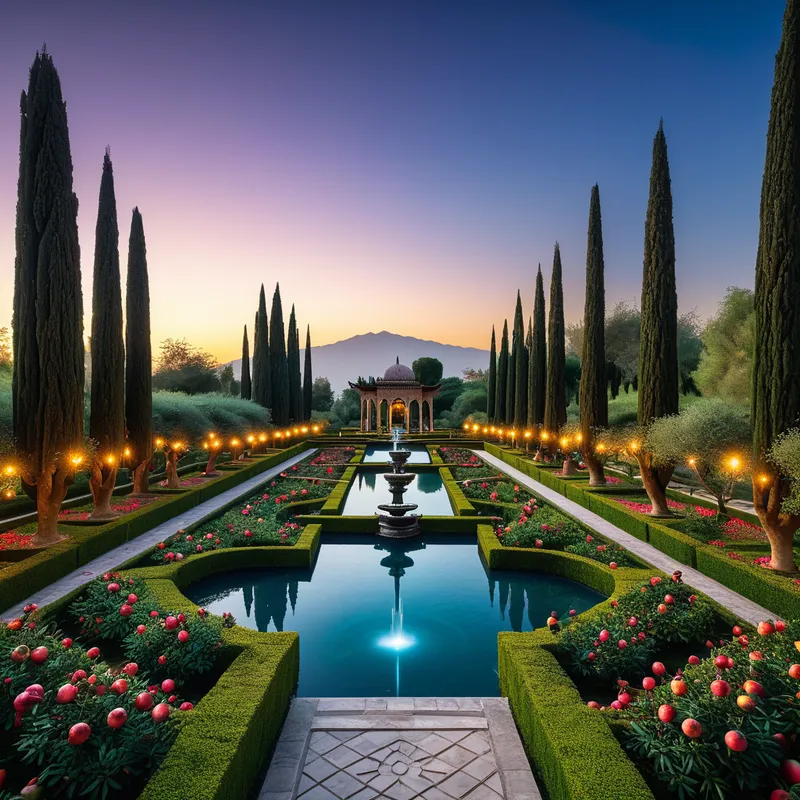
Imagine a space enclosed by walls of shimmering crystal, not to keep souls in, but to hold perfection intact. Within, the air was the scent of eternal roses and ripe pomegranates. Four great rivers, flowing not with [water](/myths/water “Myth from Chinese culture.”/) but with the liquids of life—milk, honey, wine, and water—sprang from a central, radiant fountain. They divided the garden into four perfect quarters, the Chahar Bagh, a map of the cosmos itself. Cypress trees stood as sentinels of eternity, their tips brushing a sky of perpetual, soft twilight. Peacocks with tails like a thousand eyes fanned the air, and nightingales sang a melody that stilled the heart. Here, there was no hunger, no thirst, no decay, no shadow. Every plant grew in its appointed place; every creature lived in effortless accord. This was the divine blueprint, the first and perfect thought of the Wise Lord.
But a thought can be opposed. From [the void](/myths/the-void “Myth from Buddhist culture.”/) of non-being, a counter-whisper arose. Angra Mainyu, the Lie, beheld the garden’s flawless order and felt only a seething, creative envy. It could not create, so it would corrupt. It slithered, not over the walls, but through the very fabric of the idea. It did not bring a storm or a beast, but a single, subtle seed of doubt—a longing for something other than perfection.
This seed took root in the heart of the first man, Gayomard, and the first bovine, the primordial ox. It whispered of a world beyond the wall, of experiences unknown, of a freedom that was, in truth, a forgetting. The perfect harmony developed a faint dissonance, a barely perceptible tremor in the song of the nightingales. The crystalline walls, reflecting this inner fracture, did not shatter, but began to dissolve. The four rivers muddied; the geometric pathways blurred.
The garden did not fall in a day. It faded, like a magnificent dream upon waking. Its essence scattered into the raw, unformed world—the seeds of its roses blew into barren fields, the echo of its fountain’s splash became the source of all earthly springs, the blueprint of its Chahar Bagh was etched into the memory of stones and soil. Paradise was not destroyed; it was dispersed. Its perfection was broken into a thousand fragments and sown across the realm of time and struggle, Getig, awaiting recollection.
Cultural Origins & Context
This myth of the primordial, lost garden is woven deep into the Persian cultural tapestry, finding its most profound expressions in the sacred texts of Avesta and later in the epic poetry of Ferdowsi and the mystical verses of Rumi. It was not merely a story of the past, but a living cosmological map. The concept of Pairidaeza (from which [the word](/myths/the-word “Myth from Biblical culture.”/) “paradise” derives) provided the literal and spiritual blueprint for Persian architecture, from the grand imperial gardens of Darius at Pasargadae to the courtyard gardens of humble homes.
The myth was told by priests (Magi) to explain the origin of [the world](/myths/the-world “Myth from Tarot culture.”/)’s imperfection and to define the human condition: we are beings born into a fractured world, yet carrying within us a memory of wholeness. Its societal function was dual. It established a theodicy—explaining the presence of suffering and evil through the corrosive action of Angra Mainyu. More importantly, it issued a call to action. Humanity’s purpose, embedded in the myth, became Frashokereti—the final renovation of [the world](/myths/the-world “Myth from Tarot culture.”/). We are not passive exiles, but active gardeners, tasked with recognizing the scattered fragments of the original garden in our world and, through thoughts, words, and deeds of order (Asha), helping to reassemble them.
Symbolic Architecture
At its [heart](/symbols/heart “Symbol: The heart symbolizes love, emotion, and the core of one’s existence, representing deep connections with others and self.”/), the [Paradise](/symbols/paradise “Symbol: A perfect, blissful place or state of being, often representing ultimate fulfillment, harmony, and transcendence beyond ordinary reality.”/) Garden is not a [location](/symbols/location “Symbol: The symbol of ‘Location’ signifies a sense of place, context, and the environment in which experiences unfold.”/), but a state of [consciousness](/symbols/consciousness “Symbol: Consciousness represents the state of awareness and perception, encompassing thoughts, feelings, and experiences.”/). It represents the original, undifferentiated unity of the [psyche](/myths/psyche “Myth from Greek culture.”/)—[the Self](/myths/the-self “Myth from Jungian culture.”/) in its pristine, pre-conscious form. The four rivers and the Chahar Bagh symbolize the fundamental, balanced [structure](/symbols/structure “Symbol: Structure in dreams often symbolizes stability, organization, and the framework of one’s life, reflecting how one perceives their environment and personal life.”/) of the [cosmos](/symbols/cosmos “Symbol: The entire universe as an ordered, harmonious system, often representing the totality of existence, spiritual connection, and the unknown.”/) and the [psyche](/myths/psyche “Myth from Greek culture.”/): [the four elements](/myths/the-four-elements “Myth from Greek culture.”/), the four functions of [consciousness](/symbols/consciousness “Symbol: Consciousness represents the state of awareness and perception, encompassing thoughts, feelings, and experiences.”/) (thinking, feeling, [sensation](/symbols/sensation “Symbol: Sensation in dreams often represents the emotional and physical feelings experienced in waking life, highlighting one’s intuition or awareness.”/), [intuition](/symbols/intuition “Symbol: The immediate, non-rational understanding of truth or insight, often described as a ‘gut feeling’ or inner knowing that bypasses conscious reasoning.”/)), the four seasons.
The wall is the boundary of the known self; the garden within is the soul’s innate, perfect pattern before it meets the world.
The shattering of the garden is the necessary [trauma](/symbols/trauma “Symbol: A deeply distressing or disturbing experience that overwhelms the psyche, often manifesting in dreams as unresolved emotional wounds or psychological injury.”/) of individuation. The encounter with Angra Mainyu—the psychic counterpart of the [shadow](/symbols/shadow “Symbol: The ‘shadow’ embodies the unconscious, repressed aspects of the self and often represents fears or hidden emotions.”/), doubt, or the disruptive unconscious—is what breaks the [static](/symbols/static “Symbol: Static represents interference, disruption, and the breakdown of clear communication or signal, often evoking feelings of frustration and disconnection.”/) perfection of unconscious wholeness. This “fall” is not into sin, but into experience, into the duality of time, [choice](/symbols/choice “Symbol: The concept of choice often embodies decision-making, freedom, and the multitude of paths available in life.”/), and [effort](/symbols/effort “Symbol: Effort signifies the physical, mental, and emotional energy invested toward achieving goals and personal growth.”/). The dispersed fragments are the archetypal potentials and latent perfections now buried within the complexities of our personal and collective lives, waiting to be realized.

The Dreamer’s Resonance
When this myth stirs in the modern dreamer, it often manifests not as a literal Persian garden, but as a profound sense of recognition. One might dream of discovering a hidden, perfectly organized room in a chaotic house; of finding a pristine, forgotten fountain in an urban wasteland; or of a sudden, overwhelming feeling of peace and “rightness” in a familiar yet transfigured landscape.
These dreams signal a somatic and psychological process of recollection. The psyche is attempting to re-member—to put back together—a sense of inner order that has been fragmented by life’s demands, trauma, or alienation. The feeling upon waking is often a poignant mixture of deep longing and profound comfort. The longing is for the lost wholeness; the comfort is the knowledge that its blueprint still exists within. The dream is the soul’s way of irrigating the parched landscapes of the conscious mind with waters from that original, inner fountain.
Alchemical Translation
The myth of Paradise Gardens models the entire alchemical process of psychic transmutation, or individuation. We begin in the unconscious unity of the garden (the massa confusa of the alchemists, but here it is ordered). The corrosive influence of [the shadow](/myths/the-shadow “Myth from Jungian culture.”/) (Angra Mainyu) initiates the [separatio](/myths/separatio “Myth from Alchemical culture.”/), the necessary fragmentation that allows for examination and growth.
The work is not to return to the unconscious garden, but to consciously rebuild it in the full light of day, having integrated the shadow.
Our life’s journey then becomes the opus: the slow, deliberate work of gathering the dispersa membra—the scattered members—of our soul. Every act of integrity is a recovered stone for the wall. Every moment of authentic love is a replanted rose. Every insight that brings order to inner chaos is a canal redirected to its proper course. The final goal, Frashokereti, is the psychological state of the fully integrated Self. It is not a regression to a childlike innocence (the Gayomard in the garden), but the hard-won “innocent” archetype of the sage who, having seen and integrated all fragmentation, consciously embodies a new, more resilient wholeness. We become the gardeners of our own being, and in tending our inner Pairidaeza, we contribute a fragment to the restoration of the world.
Associated Symbols
Explore related symbols from the CaleaDream lexicon: