Parable of the Wise and Foolish Builders Myth Meaning & Symbolism
A teaching on the necessity of building one's life upon the unshakable foundation of wisdom, contrasted with the peril of superficial construction.
The Tale of the Wise and Foolish Builders
Listen. The wind carries a story older than stone, a whisper from a teacher who walked dusty roads. He spoke not of distant kings or cosmic battles, but of the ground beneath your feet and the house of your life.
Two souls set out to build. The first was a man of deep seeing. He did not rush to raise his walls. He walked the land, his eyes reading the scripture of the earth. He sought not convenience, but truth. He came to a place where the land fell away, revealing the bones of the world—a great shelf of living rock, ancient and unyielding. The work was brutal. His hands bled as he chiseled, his back ached as he cleared. Sweat and patience mixed with the dust. He laid his foundation in that stone, a covenant between his will and the eternal. Only then did he raise his house, timber and stone fitting together, a sanctuary born of toil and time.
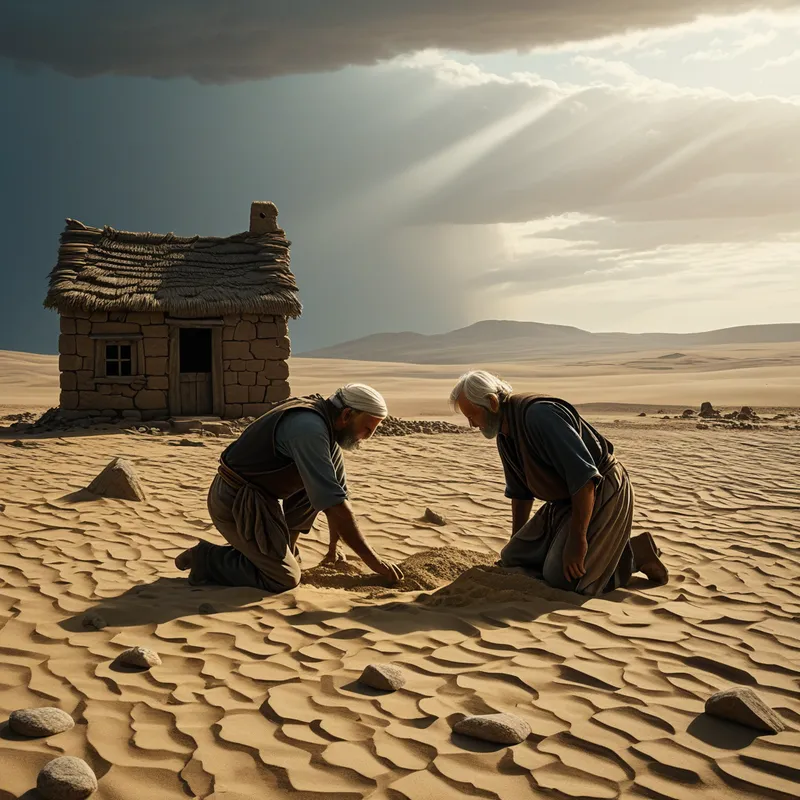
The second builder was a man of the surface. He saw a broad, pleasant plain, smooth and inviting. No hard outcroppings marred its ease. "Here," he said, "the work will be swift." He did not probe the earth with a pick or question the ground with a spade. He built upon the sand, for it offered no resistance. His house sprang up quickly, a handsome structure that caught the sun. He rested in its shade, pleased with his efficiency.
Then, the sky changed.
It began as a sigh in the high places, a gathering of grey. The wind awoke, not as a breeze, but as a howling breath. It drove the rain before it, not as a blessing, but as a torrent. The rivers, once gentle, swelled and roared, clawing at the banks. The storm tested every foundation.
On the rock, the house stood. The wind screamed against its walls, the rain lashed its roof, the floodwaters surged and broke against its unmoving base. It groaned, it shuddered, but it held. It was founded upon the deep things.
On the sand, the house knew a different fate. The pleasant plain became a trap. The waters came not just from above, but from below, seeping, softening, dissolving. The sand, so agreeable, began to shift and run. The foundation, which was no foundation at all, melted away. With a great and terrible crash, the handsome house fell. Its ruin was total. Not a stone remained upon another. All that swift work returned to the chaos from which it came.
And the rain fell, and the floods came, and the winds blew and beat upon that house.

Cultural Origins & Context
This story is a parable, attributed to Jesus of Nazareth as recorded in the Gospel of Matthew. It was not a myth of distant antiquity for its first hearers, but a living, urgent teaching delivered to a people under Roman occupation, where societal and religious foundations felt precarious. It was spoken in the open air, to crowds of peasants, fishermen, and the spiritually hungry—people intimately familiar with the practical realities of building and the deadly threat of seasonal flash floods in the wadis.
Its function was profoundly pedagogical and subversive. In a culture rich with Mosaic Law and prophetic tradition, Jesus was redirecting the concept of "foundation." The true foundation was not merely ethnic identity or ritual compliance, but the embodied practice of his teachings—the "hearing and doing" of the words. It was a call to a radical, internal architecture. Passed down orally before being codified in scripture, this parable served as a stark, memorable criterion for discernment in a time of many competing voices and messianic hopes.
Symbolic Architecture
The parable is a masterclass in elemental symbolism. The house represents the total structure of a human life: one's identity, relationships, beliefs, and accomplishments. It is the edifice of the ego and the persona presented to the world.
The storm does not create the weakness; it reveals the foundation you chose in the calm.
The rock symbolizes the transcendent, the non-negotiable, the bedrock of reality that exists independently of our wishes. Psychologically, it is the Self, as opposed to the ego. It is the core of integrity, deep wisdom, or authentic principle upon which a coherent psyche can be built. Building on it requires the hard, conscious work of excavation—facing shadow, enduring uncertainty, and sacrificing easy answers.
The sand symbolizes the provisional, the pleasurable, the collectively approved, and the ephemeral. It is the shifting ground of external validation, unexamined convention, material security alone, or intellectual fashion. It is building life upon the persona, upon the expectations of others, or upon a spirituality of comfort alone. It offers immediate gratification but contains a fatal porosity.
The rain, floods, and winds are the inevitable crises of existence: loss, failure, illness, betrayal, mortality. These are not punishments, but universal conditions. The parable’s genius is that it grants both builders the same storm. The cataclysm is impartial; it is the foundation that determines the fate.

The Dreamer's Resonance
When this mythic pattern stirs in the modern unconscious, it often manifests in dreams of architectural anxiety. To dream of a beautiful house with cracks spreading up the walls, or of adding a new room to a structure that feels ominously hollow, is to feel this parable somatically. The dreamer may be at a life stage where a previously sufficient identity—built on career success, a relationship, or a borrowed ideology—is being tested by an inner or outer "storm."
The somatic sensation is often one of sinking, of ground giving way. Psychologically, this is the process of the ego confronting its own insufficient foundation. It is a terrifying but necessary dissolution. The dream is not forecasting literal doom, but sounding an alarm from the collective unconscious: "What you have built upon is sand. The storm is coming, or is already here. Attend to your foundation." The dream invites a crisis of discernment, urging the dreamer to ask: "Upon what have I truly built my life?"

Alchemical Translation
The parable maps perfectly onto the individuation process. The foolish builder represents the first half of life, often spent building a competent persona on the sand of adaptation—achieving, acquiring, and pleasing. This is not "evil," but a necessary, if provisional, stage.
The storm is the catalytic agent of alchemy, the nigredo or dark night. It is the encounter with limit, suffering, or meaninglessness that reduces the ego's sandcastle to rubble. This is the necessary dissolution, the humbling without which no deeper work can begin.
The wise builder is not the one who avoids the storm, but the one who, having endured the ruin of sand, picks up the tools to quarry rock.
The wise builder symbolizes the one who engages in the second half of life's task: the construction of the true, rock-founded Self. This is the albedo and rubedo—the washing and the igniting. The "rock" is discovered through introspective work: confronting the shadow, engaging with dreams, enduring the tension of opposites, and committing to a practice (whether artistic, relational, spiritual, or intellectual) that connects one to something enduring and real.
The "hearing and doing" of the parable is the alchemical solve et coagula—dissolve and coagulate. You must dissolve the assumptions of the sand (the solve), and actively coagulate, or integrate, the insights into a new, rock-solid structure of being (the coagula). The finished house on the rock is not a static monument, but a living, resilient psyche capable of sheltering the full spectrum of human experience—able to withstand the storms because it is founded upon the deep, unshakable truth of its own authentic existence.
Associated Symbols
Explore related symbols from the CaleaDream lexicon: