
Papyrus Myth Meaning & Symbolism
The myth of the primordial papyrus thicket, a chaotic realm of potential where the sun god emerges to create order, language, and the physical scroll of existence.
The Tale of Papyrus
Before the first word was spoken, before the first name was known, there was only the dark, silent, and endless water. Nun. From its cold depths, a desire stirred—not a thought, but a yearning for form. And from that yearning, a mound of fertile, black earth rose, breaking the surface of the void. But this was no barren hill. It was the first thicket, a tangled, whispering forest of papyrus reeds, their green stalks crowned with feathery plumes, their roots drinking deep from the watery chaos.
This was the Island of Flame, a place of seething, wet potential. In its heart, hidden within the impenetrable green, a secret bud swelled. The air grew heavy with the scent of damp earth and green growth. Then, a sound—a single, resonant note that was neither bird nor wind. The bud unfurled.
From within the sacred blue lotus that bloomed upon the papyrus stalk, a light was born. It was Ra, the self-created, emerging as a golden child, his first cry piercing the silence of Nun. His light fell upon the papyrus stalks, and where it touched, the chaotic thicket began to make sense. Stalks became columns; spaces between them became halls. The marsh organized itself into a sanctuary, a divine palace woven from living reeds.
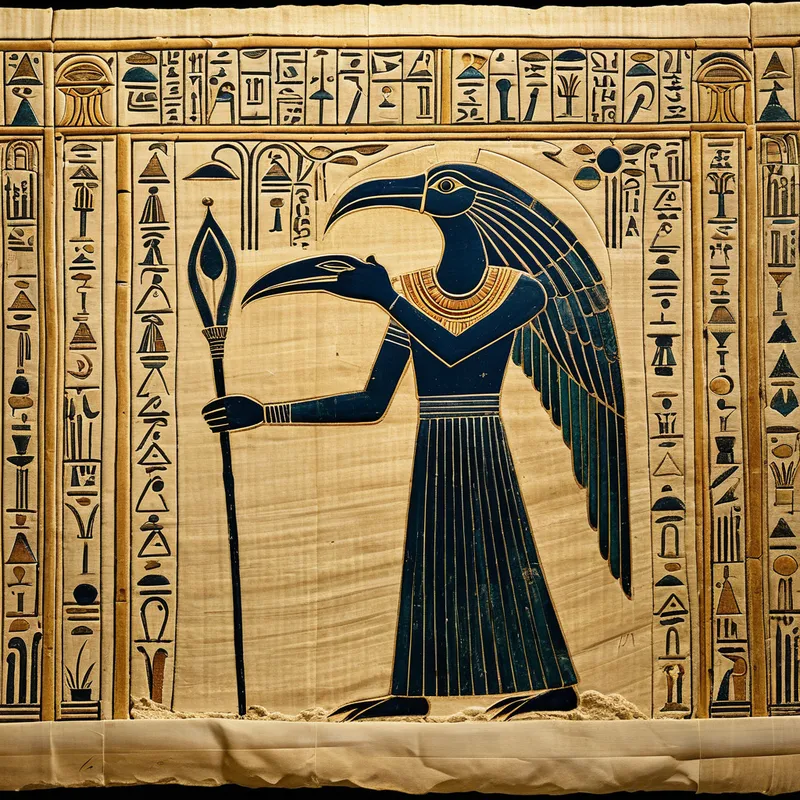
But Ra saw that his light alone was not enough. The world was still mute, its forms nameless and therefore unreal. He needed a tongue to speak it into being, a mind to hold its measure. So, from his own essence, he summoned Thoth, the ibis-headed, the baboon of the horizon. “Go into the thicket,” Ra commanded, his voice the sound of light striking water. “Take the body of the marsh and make it remember.”
Thoth waded into the primordial swamp. He did not cut the reeds down; he communed with them. He saw the triangular stalk, the pith within, the crisscrossing fibers. With a divine thought, he flattened, layered, and pressed. The sap of the plant became its own adhesive; the chaotic fibers knit themselves into a smooth, pale sheet. It was the first page, a rectangle of ordered potential torn from the womb of chaos.
Then, Thoth took a sharpened reed. He dipped it not in ink, but in the very black water of Nun itself. And he began to write. The first hieroglyph was a papyrus stalk. The second was the sun. The third was water. With each sign, the world became more solid, more true. The papyrus was no longer just a plant; it was the substance upon which creation was recorded. The scroll was born, and with it, memory. The chaos of Nun was forever bound between its fibers, transformed into a story that could be held in the hand.
Cultural Origins & Context
The myth of the papyrus is not a single, codified story but a profound cosmological motif woven into the very fabric of Egyptian thought. It finds its roots in the Heliopolitan creation myth, where the first land, the benben, is often depicted as emerging from Nun and quickly associated with lush papyrus marshes. This was not mere poetry but a reflection of lived reality. The Nile Delta, with its vast, life-giving papyrus swamps (Ta-Mehu, the land of the papyrus plant), was the literal cradle of civilization—a place of abundant life, but also of hidden dangers and impenetrable confusion.
The myth was passed down through temple rituals and royal iconography. Pharaohs were depicted hunting in papyrus thickets, symbolically mastering the chaotic forces of nature to maintain ma’at. The act of making papyrus paper itself was a sacred, secretive craft, a technological magic that physically replicated the god’s act of creating order from chaos. Scribes, the disciples of Thoth, were not mere clerks but priests of the written word, their very tools—the reed pen, the papyrus sheet—being direct descendants of the primordial creative act. The myth functioned as a societal anchor, explaining why writing was sacred, why order was divine, and why their civilization, born from a swamp, was a direct expression of cosmic will.
Symbolic Architecture
At its core, the papyrus myth is a master symbol of the psyche’s journey from undifferentiated potential to conscious articulation. The primordial marsh represents the unconscious in its raw, fertile, and terrifying state—a soup of possibilities, memories, and instincts where everything is connected but nothing is distinct.
The papyrus plant is the archetype of the mediating substance, the liminal membrane where the formless takes form.
The emerging mound is the first stirring of ego-consciousness, the “I” that dares to differentiate itself from the oceanic unconscious. Ra, the light of consciousness, cannot create alone. He requires Thoth, the archetype of the transcendent function. Thoth is the intellect, the logos, the capacity for symbolic thought. His creation of the papyrus sheet is the creation of the psychic surface—the mind’s ability to reflect, to record, to make linear and sequential the simultaneous, swirling contents of the deep.
The hieroglyph, written with the waters of Nun, is the ultimate alchemical symbol. It is the fixed, eternal form given to the flowing, chaotic essence. Writing, in this context, is not merely communication; it is an act of psychic binding, of making the unconscious conscious and giving it a durable, shareable body. The papyrus scroll, therefore, becomes the symbol of the individual’s life-record, the “Book of One’s Own Becoming,” woven from the raw material of one’s inner chaos.
The Dreamer’s Resonance
When this myth stirs in the modern soul, it often manifests in dreams of tangled, wet places—overgrown gardens, flooded basements, or dense, pathless forests. These are dreams of being overwhelmed by unprocessed emotional or creative potential. The dreamer may feel stuck in the “marsh,” unable to find solid ground or clarity.
A dream of finding a blank scroll or sheet of papyrus signals a readiness for a new phase of self-definition. It is an invitation from the inner Thoth to begin the work of articulation. Conversely, dreaming of writing illegible symbols or watching ink bloom and blot on papyrus points to a frustration in this process—the conscious mind struggling to translate the deep, symbolic language of the unconscious into coherent narrative.
Somatically, this myth resonates with the feeling of a “knot in the stomach” or a “foggy head”—the physical sensation of chaotic, unformed content pressing for recognition. The resolution offered by the myth is not escape from the swamp, but the sacred act of weaving the swamp into paper. It is the process of taking that knotted, foggy feeling and patiently, respectfully, drawing out a single thread of meaning.

Alchemical Translation
The individuation process modeled by the papyrus myth is not a heroic battle but a patient, creative act of recording. The first stage is to acknowledge and even immerse oneself in the inner Nun—to accept the chaotic, emotional, and instinctual material without premature judgment. This is the “sitting in the swamp” phase, where one must tolerate ambiguity and darkness.
The second stage is the emergence of the “mound,” a point of focus—a nagging question, a recurring dream image, a persistent emotion. This becomes the focal point for the light of attention (Ra). The third and crucial alchemical stage is the invocation of the inner Thoth: the conscious, mediating function that does not fight the chaos but works its material.
Individuation is the craft of making the scroll of the self from the reeds of one’s own experience.
This involves the daily, disciplined work of “pressing papyrus”: journaling, active imagination, artistic expression, or mindful reflection. It is the layering of experience, the pressing out of old sap (emotional reactivity), and the creation of a smooth, receptive surface upon which the soul’s hieroglyphs can appear. The final triumph is not perfection, but the creation of a durable record—a coherent, though ever-expanding, narrative of the self. You become both the swamp, the reed, the scribe, and the sacred text. The chaos is not defeated; it is forever transformed into the very substance of your story, giving it depth, fertility, and enduring life.
Associated Symbols
Explore related symbols from the CaleaDream lexicon: