Pantheon Myth Meaning & Symbolism
The Pantheon is the sacred architecture of the Roman cosmos, a divine assembly where each god holds a domain, modeling a unified yet diverse psychic totality.
The Tale of Pantheon
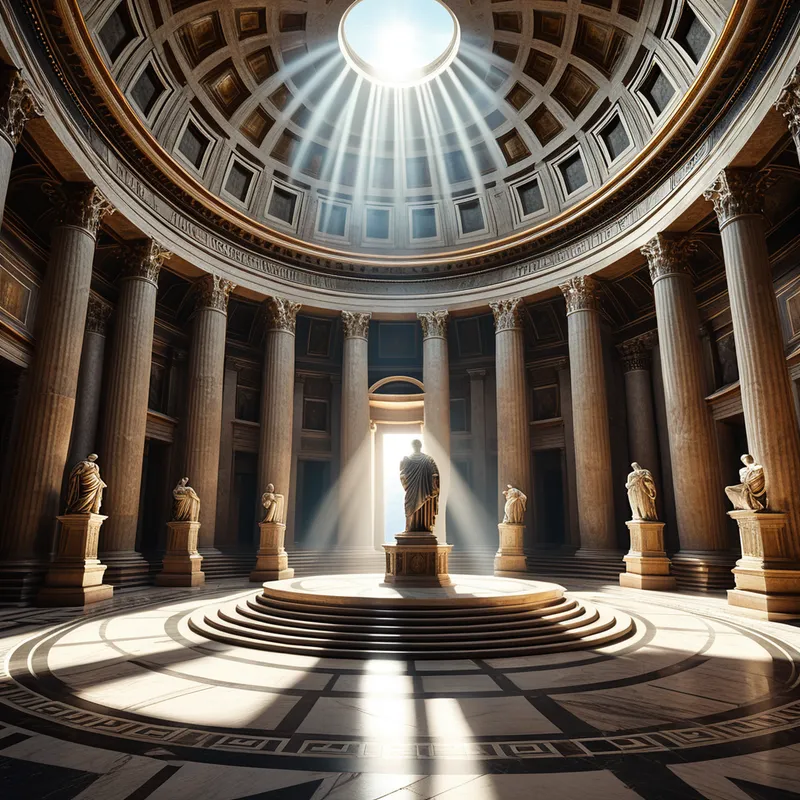
Hear now, not of one hero, but of the House of All Gods. Breathe the incense-laden air of the great city, where the river Tiber flows like time itself. Look up. There, against the sky of mortals, stands a temple unlike any other. It is not a tomb, nor a palace for a single, jealous deity. It is a cosmos in stone, a vaulted heaven turned earthward—the Pantheon.
Within its bronze doors, a silence hums with presence. The light does not merely enter; it is born from the great eye in the dome, the oculus, a circle of pure sky. That beam, a solid pillar of gold and dust, marches across the patterned floor, which is a map of the conquered world and the ordered heavens. It touches first the niche of Jupiter Optimus Maximus, and his marble gaze holds the authority of storms and oaths. The light moves, and now it warms the stern brow of Juno, her presence the very essence of sacred bond and fierce protection.
As the sun-wheel turns, the luminous finger points to each divine resident. Here is Minerva, owl-eyed, her wisdom a cool, sharp thing. There, Mars stands in polished armor, not yet raging, but in perfect, dreadful readiness. Neptune’s trident seems to ripple with unseen waters, and Venus’s form holds the promise of creation itself. Janus looks both inward and outward, seeing all comings and goings. Vesta’s eternal flame flickers in reflection on the marble.
This is the divine council that never adjourns. There is no single conflict here, no monster to slay. The drama is the eternal, tense, and glorious balance they maintain. The rising action is the daily journey of the sun-spot, connecting each god to the celestial source in turn. The resolution is the harmony achieved—not through sameness, but through the precise, sacred placement of difference. When storm clouds gather beyond the walls, the light within dims but does not die, for the order remains. The temple holds. The Pantheon breathes. It is the world in miniature, a pact between heaven and empire, stone and soul, witnessed in a single, silent, everlasting breath.
Cultural Origins & Context
The Roman Pantheon, as both architectural marvel and theological concept, was less a single, bard-told myth and more a living, breathing principle of statecraft and identity. Its most famous physical incarnation, the temple rebuilt by Emperor Hadrian around 126 AD, was the culmination of centuries of religious syncretism and political genius. The Roman mind was profoundly practical and legalistic; their religion was a contract (do ut des—“I give so that you might give”) with the divine forces that governed every aspect of life, from the threshold of a home to the fate of the empire.
The “myth” of the Pantheon was enacted, not narrated. It was performed by the Pontifices and the state priests in elaborate, precise rituals designed to maintain the pax deorum (the peace of the gods). The temple itself functioned as the ultimate symbol of Roman inclusivity and authority. As the empire expanded, it often absorbed the gods of conquered peoples, placing them within this metaphorical “pantheon,” thereby legitimizing foreign deities while subsuming them under the Roman cosmic order. This was religious diplomacy of the highest order. The Pantheon declared that Rome was not just a city, but a microcosm of the universe, with a place for every divine power—as long as it acknowledged the supreme governing structure embodied by Jupiter and, by extension, the Emperor.
Symbolic Architecture
The symbolic power of the Pantheon lies in its architecture as a perfect model of the psyche and the cosmos. It is a mandala of wholeness.
The dome is the vault of the heavens, the oculus the puncturing point of the transcendent, and the floor the grounded reality of the human world. The individual gods are the archetypal complexes that govern different spheres of life.
Each deity in its niche represents a distinct, powerful archetypal energy: the sovereign authority of Jupiter, the relational bonds of Juno, the intellectual clarity of Minerva, the passionate drive of Mars. Crucially, none is erased or dominant at the expense of the others. They exist in a state of tensioned harmony, held within the unifying structure of the rotunda. This is the symbol of the integrated Self, where the disparate and often conflicting parts of the personality are acknowledged, given their due respect, and organized into a functioning totality. The oculus is perhaps the most profound symbol. It is the opening to the unknown, the source of light (consciousness) that illuminates the interior in a constantly moving, changing pattern. It admits rain and weather—the uncontrollable elements of fate and the unconscious—into the most sacred, ordered space, implying that true wholeness does not exclude chaos, but makes a place for it.
The Dreamer’s Resonance
To dream of the Pantheon is to dream of psychic order in the making. One might dream of wandering a vast, circular building with many doors or alcoves, each containing a figure representing a different aspect of their life: a stern parent (Jupiter), a creative passion (Venus), a disciplined skill (Minerva), a buried anger (Mars). The dreamer may feel awe or overwhelming anxiety at the task of acknowledging them all.
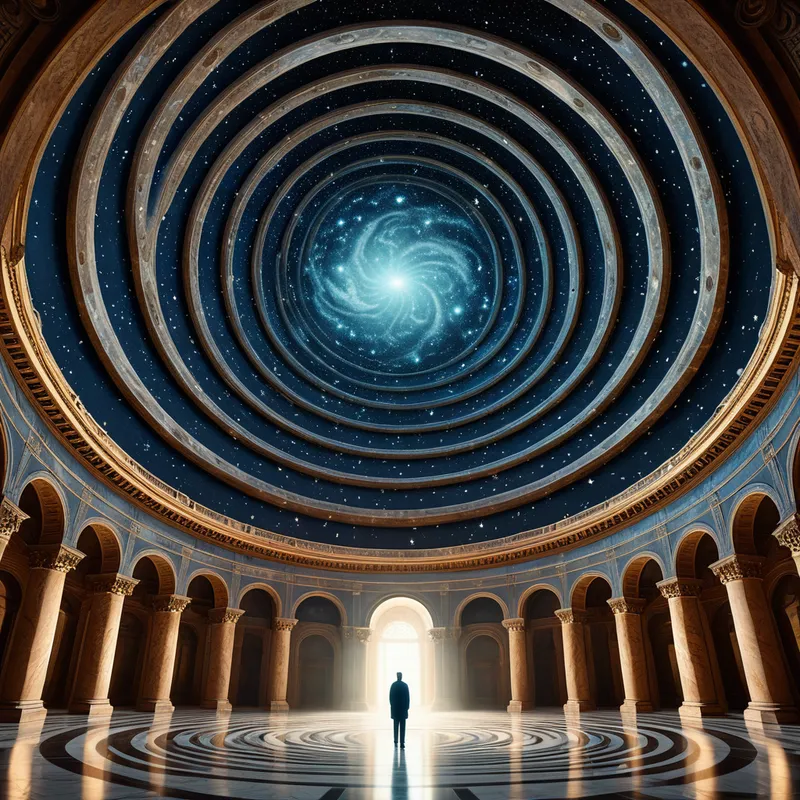
The somatic experience is often one of being a small figure at the center, looking up at a breathtaking, domed ceiling that induces both vertigo and wonder. The light from above may feel illuminating or exposing. This dream pattern surfaces during life transitions that demand integration—a career change, a relational shift, a midlife reevaluation. The psyche is attempting to architect itself, to build an inner structure capable of housing its full complexity. The conflict in the dream is the tension between the desire for a single, simple identity and the daunting, majestic call to become a pantheon unto oneself.
Alchemical Translation
The individuation process, the alchemical journey toward psychic wholeness, is mirrored perfectly in the Pantheon’s principle. Initially, the psyche is a chaotic landscape of competing impulses and identifications. The alchemical opus begins with discretio—discernment. This is the mapping of the inner niches: identifying the inner ruler, the inner critic, the orphaned child, the passionate lover.
The great work is not to crown one archetype as king and banish the rest to the shadows. It is to construct the sacred rotunda—a conscious, resilient structure of the ego—that can contain them all.
This is the coniunctio oppositorum, the conjunction of opposites, on a grand scale. The warrior (Mars) and the peacemaker, the logical mind and the intuitive heart, must all find their honored place. The oculus represents the crucial, ongoing connection to the transcendent function, the Self, which pours in new light and perspective, constantly reconfiguring the internal landscape. The final stage is not a static achievement but a dynamic, living system. One becomes both the architect and the temple, the supplicant and the divine assembly. The peace achieved is the pax deorum of the soul—a hard-won, sacred treaty between all parts of one’s being, allowing the light of consciousness to move freely through the totality of who you are.
Associated Symbols
Explore related symbols from the CaleaDream lexicon: