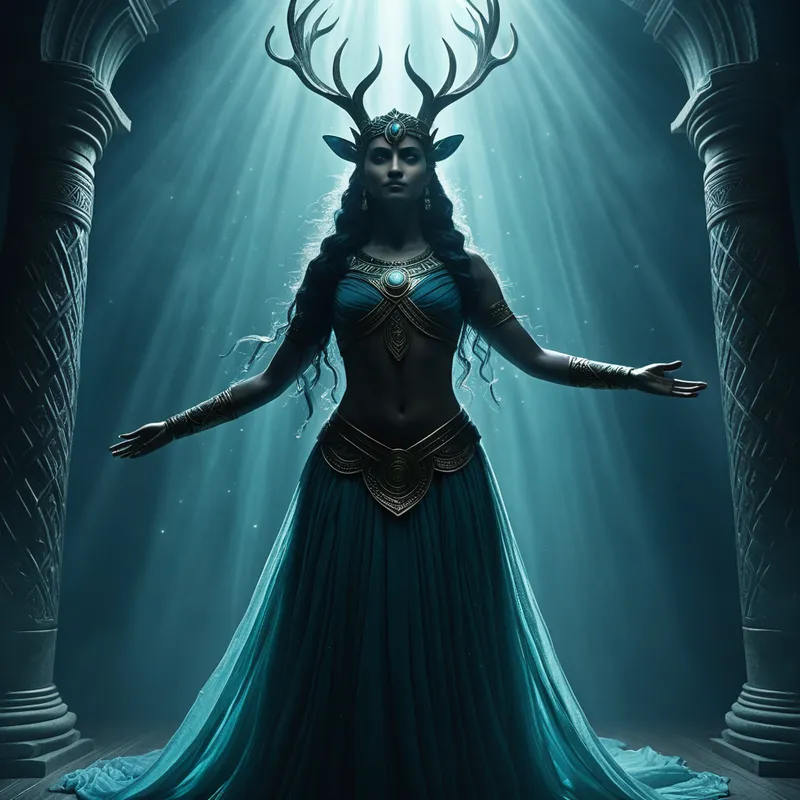
Pangu Creates the World
The primordial giant Pangu emerges from chaos, sacrificing his body to form the heavens, earth, and all natural phenomena in Taoist creation mythology.
The Tale of Pangu Creates the World
In the beginning, there was no beginning. There was only a formless, undifferentiated unity—a vast, swirling, silent [chaos](/myths/chaos “Myth from Greek culture.”/) known as [Hundun](/myths/hundun “Myth from Chinese culture.”/). Within this boundless, egg-shaped potential, the essence of all that could be coalesced and slept. For eighteen thousand years, the primordial giant [Pangu](/myths/pangu “Myth from Chinese culture.”/) dreamed within this [cosmic egg](/myths/cosmic-egg “Myth from Greek culture.”/), his form curled in perfect, unconscious harmony with the unmanifest whole.
Then, a stirring. A first, profound intention. Pangu awoke. Finding himself confined within the dark shell of chaos, he stretched his immense limbs. With a roar that was the first sound, he swung a great axe—some say it was born of his own will, a manifestation of the principle of differentiation—and cleaved the egg asunder. All that was light and pure, the Yang principle, floated upward to become the heavens. All that was heavy and dense, the Yin principle, sank downward to become [the earth](/myths/the-earth “Myth from Hindu culture.”/). Pangu, fearing the two would collapse back into each other, placed himself between them. He planted his feet upon the newly formed earth and pushed [the sky](/myths/the-sky “Myth from Persian culture.”/) upward with his hands.
And so he stood. Each day, the sky rose ten feet higher, the earth grew ten feet thicker, and Pangu grew ten feet taller to maintain the separation. For another eighteen thousand years, he labored in this cosmic stance, a living pillar between the realms, his body the axis of a universe slowly defining itself. His breath became [the wind](/myths/the-wind “Myth from Various culture.”/) and clouds. His voice became the rolling thunder. His left eye, blazing with Yang, ascended to become the sun. His right eye, cool with Yin, became [the moon](/myths/the-moon “Myth from Tarot culture.”/). The sweat of his brow fell as nourishing rain. The hair of his head and beard scattered across the sky to become the stars.
When his great work was complete, and heaven and earth were firmly, eternally fixed, Pangu was spent. The giant who had nurtured creation with his own being could sustain himself no longer. With a final, weary sigh, he laid himself down upon the earth he had helped to form. In his [death](/myths/death “Myth from Tarot culture.”/), he gave one last, ultimate gift: his body became [the world](/myths/the-world “Myth from Tarot culture.”/) itself. His flesh dissolved into the rich soil of the plains. His bones transformed into the jagged mountains and precious stones beneath them. His marrow became jade and minerals. His blood flowed out to form the great rivers and vast oceans. His veins became the paths and roads. His muscles turned to fertile land. The hair upon his skin became the grasses, flowers, and forests. His teeth and bones scattered to become metals and rocks. His sweat, once rain, now became [the dew](/myths/the-dew “Myth from Alchemical culture.”/) and mist. And the parasites upon his body, touched by his divine essence, were transformed into the myriad peoples of the world.
Thus, from a single, self-sacrificing being, the entire cosmos—with all its landscapes, celestial bodies, weather, and humanity—was born. Pangu did not rule his creation; he became it, his consciousness dispersing into every rock, river, and living [thing](/myths/thing “Myth from Norse culture.”/), a sacred presence immanent within the world.
Cultural Origins & Context
The myth of Pangu is a foundational narrative within Chinese cosmogony, though its integration into the Taoist philosophical framework is a later development. The earliest known written account appears in the Sanwu Liji (Records of Cycles of Three and Five) by the Three Kingdoms period Daoist scholar Xu Zheng, around the 3rd [century](/myths/century “Myth from Biblical culture.”/) CE. This places the myth’s formal recording well after the core Taoist texts like the Daodejing and the [Zhuangzi](/myths/zhuangzi “Myth from Chinese culture.”/), which speak of creation in more abstract, metaphysical terms (e.g., “[The Tao](/myths/the-tao “Myth from Taoist culture.”/) produced the One; the One produced the Two…”). Pangu’s story provided a vivid, anthropomorphic narrative that could embody these principles.
The myth likely synthesized earlier, fragmented folk beliefs about a world-creating giant with the systematic [Yin-Yang](/myths/yin-yang “Myth from Taoist culture.”/) and Wuxing (Five Phases) cosmology. It served to explain not just the origin of things, but their intrinsic nature. The story is less about a god acting upon inert matter, and more about the spontaneous, self-unfolding process of the Tao, using Pangu as its agent and substance. His body’s transformation directly maps to the Five Phases: bones (Metal), blood ([Water](/myths/water “Myth from Chinese culture.”/)), flesh (Earth), breath (Wood/Wind), and voice/light (Fire). In this, the myth became a powerful tool for Taoist thinkers and alchemists, offering a map of a universe that is fundamentally interconnected and sacred, born from a single, sacrificial act of differentiation.
Symbolic Architecture
At its [heart](/symbols/heart “Symbol: The heart symbolizes love, emotion, and the core of one’s existence, representing deep connections with others and self.”/), the Pangu myth is a profound [allegory](/symbols/allegory “Symbol: A narrative device where characters, events, or settings represent abstract ideas or moral qualities, conveying deeper meanings through symbolic storytelling.”/) for the [emergence](/symbols/emergence “Symbol: A process of coming into being, rising from obscurity, or breaking through a barrier, often representing birth, transformation, or revelation.”/) of [consciousness](/symbols/consciousness “Symbol: Consciousness represents the state of awareness and perception, encompassing thoughts, feelings, and experiences.”/) from the unconscious, and of order from [chaos](/symbols/chaos “Symbol: In Arts & Music, chaos represents raw creative potential, uncontrolled expression, and the breakdown of order to forge new artistic forms.”/). The [cosmic egg](/symbols/cosmic-egg “Symbol: The cosmic egg symbolizes the potential for creation, the universe’s beginnings, and the interconnectedness of all existence.”/) represents the [prima materia](/myths/prima-materia “Myth from Alchemical culture.”/), the undifferentiated state of pure potential—the Tao in its nameless, unmanifest [aspect](/symbols/aspect “Symbol: A distinct feature, quality, or perspective of something, often representing a partial view of a larger whole.”/). Pangu’s awakening is the first [movement](/symbols/movement “Symbol: Movement symbolizes change, progress, and the dynamics of personal growth, reflecting an individual’s desire or need to transform their circumstances.”/) of consciousness, the initial spark of intent that necessitates [separation](/symbols/separation “Symbol: A spiritual or mythic division between realms, states of being, or consciousness, often marking a transition or loss of connection.”/) and definition.
The act of separating heaven and earth is the primordial act of cognition: to know something, one must distinguish it from something else. Pangu is the psyche itself, forcing apart the unified field of experience into the binaries of self/other, light/dark, above/below, which are the necessary conditions for a world to be perceived and lived in.
His sustained [effort](/symbols/effort “Symbol: Effort signifies the physical, mental, and emotional energy invested toward achieving goals and personal growth.”/) over millennia symbolizes the immense, continuous psychic [energy](/symbols/energy “Symbol: Energy symbolizes vitality, motivation, and the drive that fuels actions and ambitions.”/) required to maintain the structures of [reality](/symbols/reality “Symbol: Reality signifies the state of existence and perception, often reflecting one’s understanding of truth and life experiences.”/) and [identity](/symbols/identity “Symbol: Identity represents the sense of self, encompassing personal beliefs, cultural background, and social roles.”/). The final, willing [dissolution](/symbols/dissolution “Symbol: The process of breaking down, dispersing, or losing form, often representing transformation, release, or the end of a state of being.”/) of his individual form is the ultimate Taoist ideal: the return to the Tao not through annihilation, but through compassionate [diffusion](/symbols/diffusion “Symbol: The spreading or blending of substances, energies, or emotions, often representing a loss of boundaries or integration.”/). He achieves [Wu Wei](/myths/wu-wei “Myth from Taoist culture.”/) by ceasing to resist; his “[death](/symbols/death “Symbol: Symbolizes transformation, endings, and new beginnings; often associated with fear of the unknown.”/)” is the act of fully yielding his particular form to serve the greater, interconnected [pattern](/symbols/pattern “Symbol: A ‘Pattern’ in dreams often signifies the underlying structure of experiences and thoughts, representing both order and the repetitiveness of life’s situations.”/). He becomes the embodiment of the cycle: from unity (Hundun), through [differentiation](/symbols/differentiation “Symbol: The process of distinguishing or separating parts of the self, emotions, or identity from a whole, often marking a developmental or psychological milestone.”/) (his [life](/symbols/life “Symbol: The symbol of ‘Life’ represents a journey of growth, interconnectedness, and existential meaning, encompassing both the joys and challenges that define human experience.”/)), back to a new, complex unity (the world-[body](/symbols/body “Symbol: The body in dreams often symbolizes the dreamer’s self-identity, personal health, and the relationship they have with their physical existence.”/)).
The Dreamer’s Resonance
For the modern [psyche](/myths/psyche “Myth from Greek culture.”/), Pangu’s tale resonates on multiple levels. It speaks to the monumental, often exhausting labor of building and maintaining a coherent self—pushing against the chaos of internal and external pressures to create a stable “heaven” of ideals and a solid “earth” of grounded reality. His story validates the profound fatigue that can accompany this lifelong act of world-building.
Psychologically, his sacrifice mirrors the necessary “deaths” of ego required for growth. To create something new—a relationship, a work of art, a wiser perspective—parts of our old self must be offered up. Our rigid beliefs (bones) may become the enduring structure (mountains) of our character. Our passions and pains (blood) must flow outward to become the connecting, life-giving rivers of empathy. The myth suggests that wholeness is found not in holding [the self](/myths/the-self “Myth from Jungian culture.”/) apart, but in recognizing its fundamental continuity with all that is. In our deepest moments of burnout or dissolution, Pangu’s fate offers a paradoxical comfort: that in letting go of the desperate hold on a separate identity, we may find ourselves more truly, and widely, alive as part of a living cosmos.
Alchemical Translation
In Taoist alchemy, the myth is a literal guide for inner transformation. [The adept](/myths/the-adept “Myth from Alchemical culture.”/)’s body is the microcosm, the “cosmic egg” containing the undifferentiated energies of Jing (essence), Qi (vital energy), and Shen (spirit). The practice is the conscious awakening of the inner Pangu—the true, primordial self—to perform the same creative act within.
The meditative work of separating “clear” and “turbid” energies within the body, of circulating Qi along specific pathways, and of refining the base elements of the physical form into a spiritualized “immortal embryo” is a direct re-enactment of Pangu’s labor. The goal is not to escape the body, but to follow Pangu’s example: to transmute it, through sustained inner work and ultimate surrender, into a luminous, integrated world—a body of light and spirit that mirrors the perfected macrocosm.
The eighteen thousand years symbolize the long, patient discipline required. The final “death” of Pangu corresponds to [the alchemist](/myths/the-alchemist “Myth from Various culture.”/)’s transcendence of the ordinary, egoic self, resulting in a state where one’s consciousness is no longer confined to the physical skull but is experienced as co-extensive with the environment. The adept becomes, like the world formed from Pangu, a sacred landscape where heaven and earth—spirit and matter—are in harmonious, stable communion.
Associated Symbols
Explore related symbols from the CaleaDream lexicon:
- Egg — The primordial unity, the cosmic womb containing all potential before the differentiation of consciousness and the birth of the manifest world.
- Chaos — The formless, undifferentiated state (Hundun) that precedes and underlies all order; the fertile void from which all things emerge.
- Sacrifice — The voluntary dissolution of the individual form for the creation and sustenance of a greater, interconnected whole; the foundational act of cosmic generosity.
- Mountain — The enduring, skeletal structure of the created world, born from the bones of the primordial being; a symbol of stability, ascent, and the axis connecting earth and heaven.
- River — The vital, circulating life-force of the world, originating from the sacred blood of the creator; representing flow, connection, and the nourishment of the manifested realm.
- Sun & Moon — The celestial eyes of the creator, embodying the fundamental principles of Yang (active, bright) and Yin (receptive, reflective) that govern the cosmic order.
- Tree — The flourishing, organic life that springs from the body of the divine, symbolizing the interconnectedness of all living things and their rootedness in a single, sacred source.
- Circle — [The cosmic egg](/myths/the-cosmic-egg “Myth from Global culture.”/) itself, representing wholeness, eternity, and the cyclical process of emergence from and return to the undifferentiated Tao.
- [Dragon](/myths/dragon “Myth from Chinese culture.”/) — An ancient Chinese symbol of primordial power, transformation, and the vital, unseen forces (Qi) that course through the landscape Pangu became; often associated with creative energy.
- Taoist Alchemy — The internal practice of recreating Pangu’s cosmogony within the self, aiming to refine the base elements of body and mind into an integrated, spiritualized state of being.
- Spirit World — The immanent sacredness of the natural world, as every rock, stream, and breeze is infused with the dispersed consciousness and substance of the primordial being.
- Rebirth — The transformation of death into an act of creation; the end of one form of existence as the necessary beginning of a more complex, abundant, and interconnected life.