Pangu Myth Meaning & Symbolism
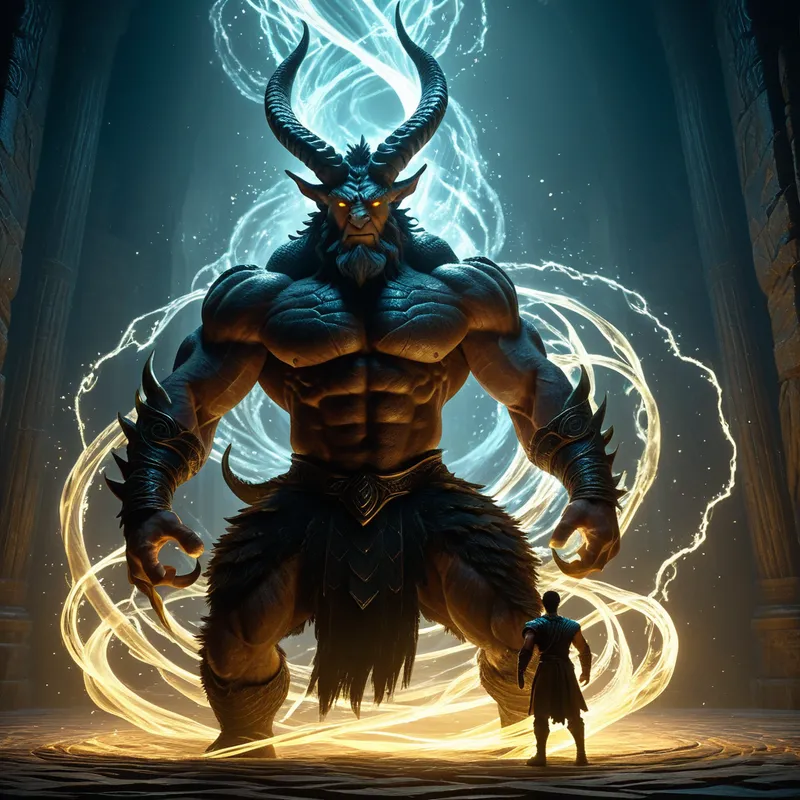
From primordial chaos, the giant Pangu awakens. He separates heaven and earth, holding them apart for eons before his body becomes the world itself.
The Tale of Pangu
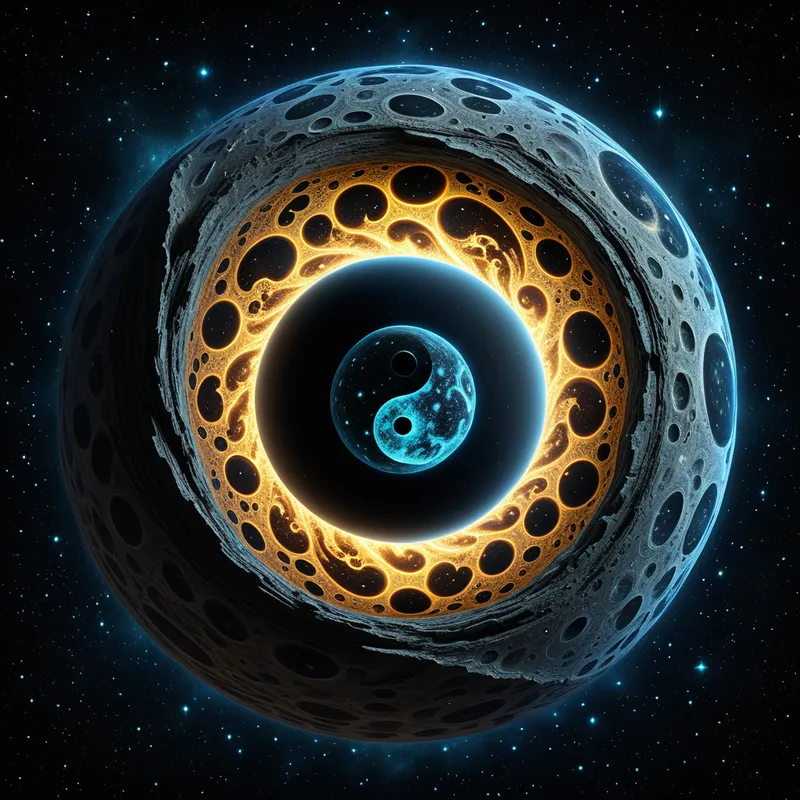
In the beginning, there was no beginning. There was only the Hundun, a vast, silent, and perfect egg of swirling chaos. Within it, all opposites slept as one: light and dark, hard and soft, heaven and earth, Yin and Yang. They were not yet separate, but a single, dreaming potential.
And within this egg, a being took form. For eighteen thousand years, he grew in the deep, silent dark. He was Pangu. He did not think, for there was nothing to think about. He did not feel, for there was nothing to feel against. He simply was, a sleeping giant curled in the womb of all-that-is-and-is-not.
Then, a stirring. A first, primal impulse toward distinction. Pangu awoke. He stretched his colossal limbs in the boundless dark, and with a movement that was both birth and cataclysm, he cracked the shell of the Hundun. What was light, being pure and bright, drifted upwards with a sigh. What was heavy and dark, being of the earth, sank downwards with a groan. Heaven and earth were born from that first division.
But they were newborn, fragile. They yearned to collapse back into each other, to return to the blissful, undifferentiated sleep of the egg. Pangu saw this. And so, placing his feet upon the dark, sinking earth and setting his hands against the light, ascending heaven, he pushed. He held them apart. His body became the pillar between them.
There he stood, for another eighteen thousand years. Each day, heaven rose ten feet higher, and earth grew ten feet thicker, and Pangu grew ten feet taller to keep them separate. He was the living axis of the world, the sole witness to the slow, agonizing birth of space and time. He knew only the immense pressure above and below, the endless strain of preventing a return to nothingness.
Finally, the universe was stable. Heaven was firmly aloft; earth was solid below. His great task was complete. And with a final, weary breath, the giant Pangu laid himself down upon the earth he had nurtured.
But his end was a beginning. His breath became the wind and clouds. His voice became the rolling thunder. His left eye, radiant, rose into the sky as the sun. His right eye, gentle, became the moon. His blood poured out to form the great rivers and oceans. His veins became the roads and paths. His muscles turned to fertile land. His hair and beard scattered as stars across the heavens. His bones became the jewels and minerals deep within the earth. His marrow transformed into sacred jade and pearls. The sweat from his body fell as the nourishing rain and dew. And the fleas upon his fur were carried by the wind, becoming the people of the world.
From his sacrifice, the living, breathing world was fashioned. The giant did not vanish; he became the very substance of reality.
Cultural Origins & Context
The myth of Pangu is a relatively late arrival to the corpus of Chinese mythology, first appearing in written texts during the Three Kingdoms period. It is not found in the ancient Confucian classics, which focus on humanistic order, nor in the earliest Daoist texts, which speak of the Dao in abstract terms. Scholars suggest the tale may have southern Chinese origins, possibly integrating elements from indigenous creation narratives.
It was preserved and popularized by texts like the Sanwu Liji and later, the Wuyun Linian Ji. Unlike state-sanctioned imperial mythology, which served to legitimize dynastic rule, the Pangu story functioned as a popular, cosmological answer to the fundamental human question: “How did all this come to be?” It provided a poetic, visceral, and profoundly somatic origin story that resonated with a culture deeply attuned to the interconnectedness of nature and humanity. It told people they were not merely on the earth, but were literally born from it—the children of a cosmic act of sacrifice.
Symbolic Architecture
At its core, the Pangu myth is a grand allegory for the emergence of consciousness from the unconscious. The Hundun egg represents the primordial, unconscious state of the psyche—a state of potential containing all possibilities but no distinctions. It is the blissful, ignorant womb of pre-individuation.
The first act of consciousness is not thought, but separation. It is the painful, necessary violence that creates the space for experience.
Pangu’s awakening is the first spark of ego-consciousness stirring within the unconscious. The cracking of the egg is the traumatic, yet vital, moment of differentiation—the separation of subject and object, self and world, light and dark (Yang and Yin). His ensuing struggle, holding heaven and earth apart, symbolizes the immense and continuous psychic energy required to maintain consciousness. It is the effort of sustaining a coherent sense of self and an ordered perception of reality against the constant, gravitational pull back into undifferentiated chaos (psychosis, dissolution, or mere sleep).
His final transformation is the ultimate symbolic act: the dissolution of the separate ego into the created world. This is not an annihilation, but a participation mystique on a cosmic scale. The conscious principle (Pangu) does not rule over nature but becomes nature, suggesting that true creation is an act of self-sacrificial unity. The world is not an external object, but the embodied dream of the psyche.
The Dreamer’s Resonance
When this mythic pattern stirs in the modern dreamer, it often signals a profound process of psychic (re)structuring. To dream of being trapped in a tight, dark space that one must break out of mirrors Pangu in the egg. It speaks of a nascent aspect of the self—a new consciousness, talent, or perspective—struggling to be born from a confining situation or an old, outgrown identity.
Dreams of holding immense weight, of being a pillar or support against collapsing skies, directly reflect Pangu’s central ordeal. This is the somatic experience of carrying a tremendous psychological burden—perhaps holding a family, a career, or one’s own mental stability together against immense pressure. The body in the dream feels the strain of preventing a psychic collapse.
Most powerfully, dreams where one’s body transforms into landscape—where a bleeding wound becomes a river, or rising anger feels like a volcano forming in the chest—are the direct resonance of Pangu’s final act. These are not nightmares of disintegration, but visions of profound, albeit terrifying, integration. They indicate that a dominant conscious attitude is dying so that its energy can be recycled into the very fabric of the dreamer’s soul, creating new, living inner resources from what was once a singular, struggling identity.

Alchemical Translation
The individuation journey modeled by Pangu is not one of heroic conquest, but of sacred endurance and ultimate dissolution into one’s own creation. The modern seeker begins in their personal Hundun: a state of confusion, depression, or aimlessness where all inner opposites are fused in conflict. The first, crucial step is the “awakening”—the often painful decision to differentiate, to say “this is me, and that is not,” to begin the labor of separating one’s own values from familial or societal expectations (heaven from earth).
The long middle passage is Pangu’s stand. This is the daily, grinding work of psychological maintenance—holding the tension between spirit and instinct, ideal and reality, conscious intention and unconscious impulse. It is the recognition that consciousness is not a given, but a continuous achievement.
The goal is not to remain the pillar forever, but to become the world the pillar makes possible.
The alchemical climax is the “death” of Pangu. In psychological terms, this is the sacrifice of the ego’s illusion of separateness and control. It is the moment when one realizes that true creativity and wholeness come not from holding oneself apart from one’s inner and outer nature, but from surrendering to it. The ego-consciousness, having done its heroic work of creating order, must now “die” and be redistributed. Its energy transforms into the sun of sustained insight, the rivers of emotional flow, the fertile ground of new potential. The individual no longer has a psyche; they are the psyche, in its full, embodied, and world-creating majesty. They become, like the world from Pangu, a living testament to the creative power of sacrificial unity.
Associated Symbols
Explore related symbols from the CaleaDream lexicon: