Pandora's Boxin Gree Myth Meaning & Symbolism
A being opens a forbidden vessel, unleashing all woes upon the world, yet finds a final, transformative gift hidden within the depths of despair.
The Tale of Pandora’s Boxin Gree
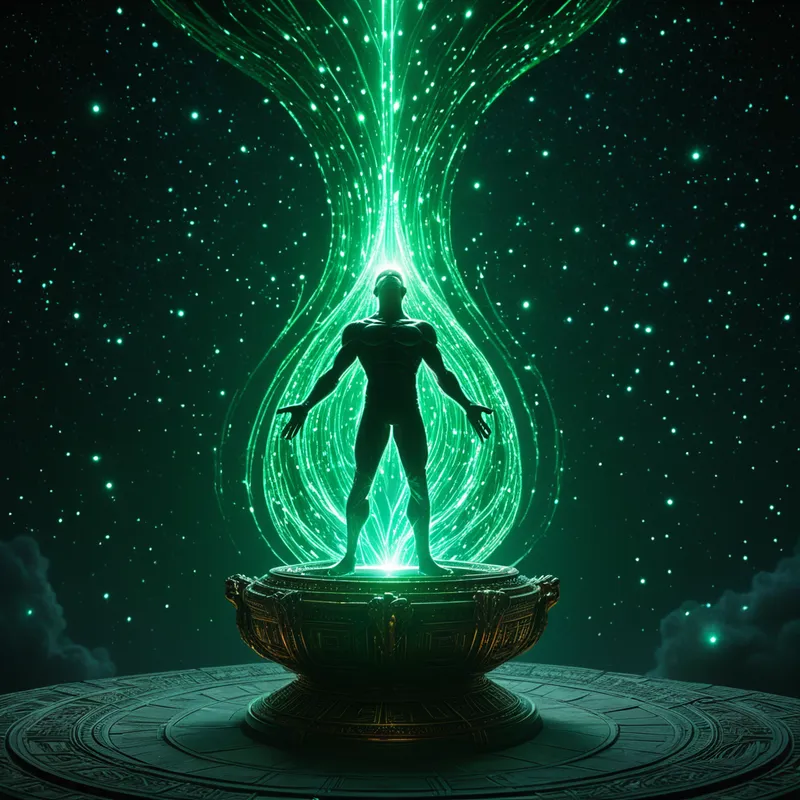
Listen. Before the worlds were named, in the silent, shimmering expanse of the First Dream, there existed a being of pure potential. They called it the Boxin Gree. It was not a god of thunder or a goddess of harvest, but a custodian of the Unopened, a guardian of the space between what is and what could be. Its form was like starlight given sentience, and its sole charge was a vessel. Not a box of wood or gold, but a Soma-Urn, a perfect sphere of crystalline silence that held within it every whisper of experience not yet born into the worlds.
The cosmos was quiet, orderly, and static. The stars traced their perfect, endless paths. The Boxin Gree felt a stillness that was not peace, but a profound loneliness. A question began to hum in its core, a vibration that disturbed the perfect silence: What lies within? The Urn pulsed in response, a low, magnetic thrum. The decree from the Archai had been absolute: “The seal must not be broken. The balance is delicate.”
But the thrum became a song. The song became an ache. The Boxin Gree watched the unchanging heavens and felt the Urn’s pull as a physical weight in its hands. One fateful moment, as the cosmic clockwork reached a point of perfect tension, curiosity overcame covenant. With fingers that shone with tremulous light, the being touched the seam of the Soma-Urn.
There was no crack, but a dissolution. The surface became a doorway.
What poured forth was not wind or fire, but the very textures of reality untamed. First came the Sharpnesses—Ponos and [Lethe](/myths/lethe “Myth from Greek culture.”/)—twisting through [the void](/myths/the-void “Myth from Buddhist culture.”/) like serpents of shadow. Then the Mournings—Penthos and Himeros—their cries etching lines of sorrow into the fabric of space. Plagues of doubt, armies of envy, the chilling mists of despair—all the children of potential, now born as afflictions, streamed out in a silent, terrifying cataract. They scattered to the nascent worlds, seeding themselves into the very laws of existence.
The Boxin Gree recoiled, its light dimmed by the horror of its act. The beautiful order was now a tapestry of chaos and suffering, all by its hand. It moved to seal the Urn, its heart a cinder of regret. But as it gazed into the seemingly empty, dark interior, a final flicker remained. Not a fleeing spirit, but a gentle, resilient ember. It was Elpis—not mere hope, but the active, enduring capacity to look forward. This, it did not release into the wild chaos. This, the Boxin Gree cradled within [the vessel](/myths/the-vessel “Myth from Alchemical culture.”/), and within its own shattered being, as it closed the lid upon a forever-changed cosmos.
Cultural Origins & Context
The myth of the Boxin Gree is a foundational narrative strain found in [the collective unconscious](/myths/the-collective-unconscious “Myth from Jungian culture.”/), a story so fundamental it appears in countless cultural guises. While the Greek version with [Pandora](/myths/pandora “Myth from Greek culture.”/) is its most famous articulation, the core pattern—a forbidden container, a catastrophic opening, and a residual hope—echoes globally. We see it in the Norse Andvari’s Hoard, in the many “calabash of diseases” stories across Africa, and in the biblical narrative of [the Fall](/myths/the-fall “Myth from Biblical culture.”/). It is a myth of etiology, explaining the human condition: why does suffering exist alongside our capacity to endure it?
It was never a story told to children for simple moralizing. It was recited by shamans, philosophers, and elders at liminal times—during initiations, at the winter solstice, or when a community faced great suffering. Its function was not to assign blame, but to frame the human predicament. It provided a cosmic reason for pain, moving it from arbitrary cruelty to a consequence of a primordial, perhaps inevitable, act of seeking knowledge. The story made suffering meaningful by linking it to curiosity, and offered the fragile but crucial gift of Elpis as the tool for navigating [the world](/myths/the-world “Myth from Tarot culture.”/) it helped create.
Symbolic Architecture
The Boxin Gree is the [archetype](/symbols/archetype “Symbol: A universal, primordial pattern or prototype in the collective unconscious that shapes human experience, behavior, and creative expression.”/) of nascent [consciousness](/symbols/consciousness “Symbol: Consciousness represents the state of awareness and perception, encompassing thoughts, feelings, and experiences.”/) itself. It represents the [moment](/symbols/moment “Symbol: The symbol of a ‘moment’ embodies the significance of transient experiences that encapsulate emotional depth or pivotal transformations in life.”/) the [psyche](/myths/psyche “Myth from Greek culture.”/) awakens from the unconscious, unified [bliss](/symbols/bliss “Symbol: A state of profound happiness and spiritual contentment, often representing fulfillment of desires or alignment with one’s true self.”/) of [paradise](/symbols/paradise “Symbol: A perfect, blissful place or state of being, often representing ultimate fulfillment, harmony, and transcendence beyond ordinary reality.”/) and chooses to know, even if that [knowledge](/symbols/knowledge “Symbol: Knowledge symbolizes learning, understanding, and wisdom, embodying the acquisition of information and enlightenment.”/) brings pain. The being is the first “[orphan](/symbols/orphan “Symbol: Represents spiritual abandonment, primal vulnerability, and the quest for belonging beyond biological ties. Often signifies a soul’s journey toward self-reliance.”/),” cast out from the [security](/symbols/security “Symbol: Security denotes safety, stability, and protection in one’s personal and emotional life.”/) of ignorance by its own [action](/symbols/action “Symbol: Action in dreams represents the drive for agency, motivation, and the ability to take control of situations in waking life.”/).
The vessel is not a box of evils, but the unconscious itself. To open it is to undertake the perilous, necessary journey of bringing its contents into the light of awareness.
The Soma-Urn symbolizes the totality of the psyche’s unlived potentials—both creative and destructive. The “evils” released are the autonomous complexes, the [shadow](/symbols/shadow “Symbol: The ‘shadow’ embodies the unconscious, repressed aspects of the self and often represents fears or hidden emotions.”/) aspects, the raw and untamed emotions that, when repressed, rule us from the darkness. Their release is not a [punishment](/symbols/punishment “Symbol: A dream symbol representing consequences for actions, often tied to guilt, societal rules, or internal moral conflicts.”/), but the inevitable [chaos](/symbols/chaos “Symbol: In Arts & Music, chaos represents raw creative potential, uncontrolled expression, and the breakdown of order to forge new artistic forms.”/) of psychic [integration](/symbols/integration “Symbol: The process of unifying disparate parts of the self or experience into a cohesive whole, often representing psychological wholeness or resolution of internal conflict.”/). Elpis, remaining inside, is the [symbol](/symbols/symbol “Symbol: A symbol can represent an idea, concept, or belief, serving as a powerful tool for communication and understanding.”/) of the transcendent function—the psyche’s innate [capacity](/symbols/capacity “Symbol: A measure of one’s potential, limits, or ability to contain, process, or achieve something, often reflecting self-assessment or external demands.”/) to generate new meaning and forward [movement](/symbols/movement “Symbol: Movement symbolizes change, progress, and the dynamics of personal growth, reflecting an individual’s desire or need to transform their circumstances.”/) from the conflict of opposites. It is not a guarantee of happiness, but the will to continue the process.
The Dreamer’s Resonance
When this myth activates in the modern dreamer, it signals a profound psychological threshold. Dreaming of a forbidden box, chest, or room one feels compelled to open indicates that contents of the personal or collective unconscious are demanding recognition. The somatic feeling is often one of intense anxiety mixed with irresistible curiosity—a tightness in the chest, a trembling in the hands.
The subsequent release of creatures, insects, darkness, or chaotic forces in the dream mirrors the waking experience of a “breakdown”—where repressed grief, rage, or fear finally erupt into conscious life. The dreamer is the Boxin Gree in this moment, experiencing the terrifying consequences of their own depth. The process, though painful, is one of necessary disillusionment. The static, “perfect” but sterile state of defended innocence is ending. The dreamer is being initiated into a more complex, real, and difficult world of embodied experience.

Alchemical Translation
The alchemical journey modeled by this myth is the [Nigredo](/myths/nigredo “Myth from Alchemical culture.”/), the blackening. It is the first, essential stage of individuation where the lead of the unexamined life must be confronted and dissolved. The act of opening the vessel is the courageous, if fateful, decision to engage in shadow work.
The catastrophe is not the end of the work, but its true beginning. Hope is not found by avoiding the darkness, but is discovered, still alive, at its very center.
The modern individual undergoes this when they consciously choose to explore their trauma, their dysfunctional patterns, their deepest fears—to “open the box” of their personal history. The ensuing emotional chaos—the depression, the anxiety, the relational strife—is the equivalent of the plagues being released. It feels like a curse. Yet, if one can stay with the process, not flee back into repression, they eventually find Elpis. This is the dawn of self-knowledge, the resilient core of the psyche that can now hold suffering with awareness. The vessel, once a container of unknown terror, becomes the [vas Hermeticum](/myths/vas-hermeticum “Myth from Alchemical culture.”/)—the sacred container of one’s own transformative journey. The individual is no longer a passive victim of a primordial curse, but an active participant in the alchemy of turning suffering into consciousness, completing the work the Boxin Gree began for us all.
Associated Symbols
Explore related symbols from the CaleaDream lexicon: