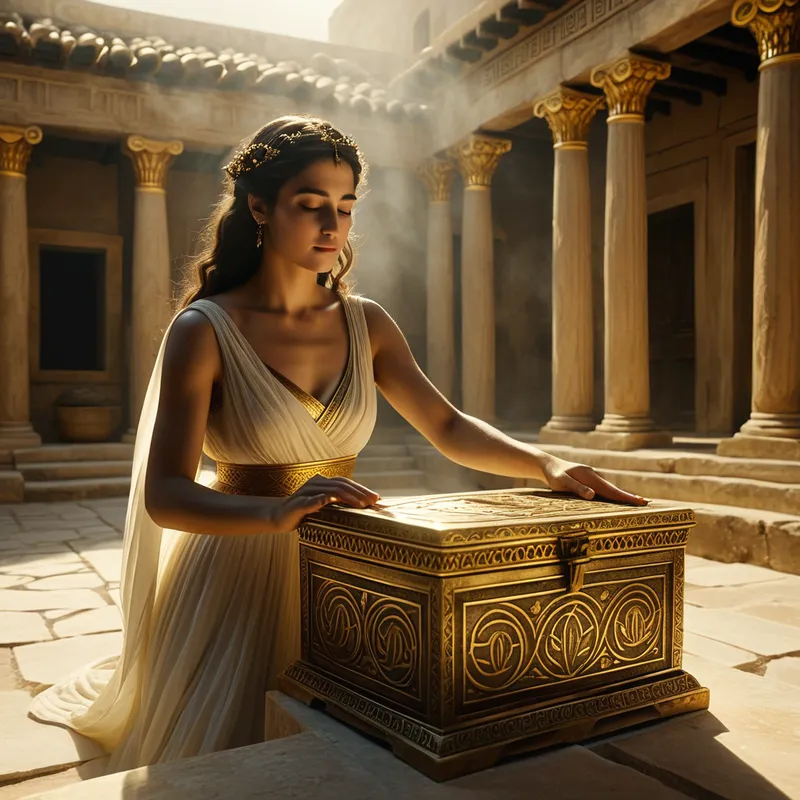
Pandora's Box - the accidental Myth Meaning & Symbolism
A divine punishment crafted as a gift, an act of forbidden curiosity, and the eternal, ambiguous legacy of hope left in the wake of unleashed chaos.
The Tale of Pandora’s Box - the accidental
Hear now of the first woman, and the vessel that changed the world.
The air on Olympus was thick with the silence of a grudge held too long. Zeus, whose brow was a gathering storm, brooded over the theft of fire. The cunning Prometheus had stolen the sun’s spark for clay-formed mortals, lifting them from the mire. For this defiance, a punishment was devised—not of thunderbolts, but of exquisite, devastating craft.
The gods themselves became artisans of vengeance. Hephaestus mixed earth and water, shaping not a weapon, but a being of breathtaking life. Aphrodite breathed over her the grace that makes knees weak and hearts foolish. Athena clothed her in silvery raiment and taught her skilled hands. Hermes placed in her breast a dog’s curiosity and a thief’s cunning tongue. They named her Pandora—“All-Gifted”—for each deity had bestowed a seed of both blessing and ruin.
She was sent not to Prometheus, who was wise to tricks, but to his simpler brother, Epimetheus. He saw her standing at his threshold, a vision under the mortal sun, and despite his brother’s warnings, he welcomed her. For she came with a dowry: a great jar (a pithos, later mistranslated as a box). It was heavy, sealed with divine wax, and accompanied by a single, resonant command: Never open it.
Time passed in the new world of men. The jar sat in a corner of their home. It was not ominous, but present. It hummed with a silent frequency. Pandora’s eyes, gifted with divine sight, would catch on its contours in the firelight. Hermes’s gift—that restless, piercing curiosity—grew within her like a vine, tightening around her reason. What treasure did the gods truly entrust to her? What secret was so precious it must be forever hidden?
One day, the silence of the vessel became a scream only she could hear. The compulsion was a physical pull. Her fingers, skilled by Athena, found the seal. It was not a violent act, but a slow, inevitable yielding. The wax gave way with a soft sigh.
What erupted was not fire or beast, but a sigh of the cosmos made tangible. A dark, howling mist poured forth, thick and cold, taking shapes as it swirled: Ponos (Toil), Lethe (Forgetfulness), and Geras (Old Age). Limos (Starvation) and Makhai (Quarrels) flew out like sharp-beaked birds. Every sorrow, every sickness, every secret malice that lurks in the heart of life was released into the clear air, scattering to the four winds to find a home in the world of men. Pandora stumbled back, her hands flying to her mouth, as the beautiful world grew shadows it had never known.
Terrified, she slammed the lid shut. The storm ceased. In the sudden, deafening quiet, she heard it—a faint, fragile sound from within the now-closed jar. A soft, persistent tapping. One thing had not escaped. With trembling hands, she lifted the lid once more. From the depths, something gentle and warm emerged, fluttering against the lingering gloom. It was Elpis—Hope. And it remained with humanity, inside the vessel and within their hearts, a final, ambiguous gift from the gods.

Cultural Origins & Context
The myth of Pandora is a foundational story from ancient Greece, most comprehensively told by the poet Hesiod in his works Theogony and Works and Days (c. 700 BCE). It is not a folk tale but a theogonic myth, explaining the origin of human suffering and the nature of the human condition. Hesiod’s telling is deeply patriarchal and reflective of a peasant society’s hardships; Pandora is framed as a “beautiful evil,” the price for Prometheus’s defiance, and the source of all trouble for mankind. The story served as a divine justification for a world filled with toil, disease, and strife, while also encoding a profound warning about the dangers of unchecked curiosity and the acceptance of gifts from powerful, potentially duplicitous, authorities (the gods). It was a myth passed down not merely for entertainment, but as a sacred explanation for why life is hard, positioning woman as the vessel of both allure and calamity—a potent cultural narrative that has echoed for millennia.
Symbolic Architecture
Pandora is not merely a character; she is an archetypal event. She represents the moment consciousness encounters the forbidden, the hidden, the complex truth behind a simple prohibition. The “box” (jar) is the ultimate symbol of the unconscious itself—a sealed container holding the totality of latent psychic contents, both destructive and salvific.
The vessel does not contain evils, but potentials. Suffering is not released; it is actualized through the act of witnessing.
Pandora’s curiosity is the impulse of the evolving psyche toward consciousness, however painful that awakening may be. The unleashed “evils” symbolize the unavoidable psychological burdens of existence: anxiety, grief, conflict, and mortality. They are the shadows cast by the light of self-awareness. Yet, the myth’s genius lies in its final, crucial detail: Hope (Elpis) remains. This is not naive optimism, but the capacity for meaning-making, endurance, and the forward gaze that allows humanity to bear the very sufferings her act unleashed. Hope is the compensatory, balancing force the psyche retains inside the vessel—the symbol that the source of our suffering is also the source of our resilience.
The Dreamer’s Resonance
To dream of opening a forbidden box, chest, or door is to stand in Pandora’s sandals. The dreamer is at a threshold where a long-contained aspect of the psyche demands recognition. The somatic feeling is often one of irresistible compulsion mixed with dread—a knowing that one must look, even if it destroys a previous innocence.
This dream pattern signals a psychological process of confronting the “shadow box”—the repository of repressed emotions, traumatic memories, or denied potentials that have been sealed away by the ego for its own protection. The act of opening in the dream is the unconscious itself initiating a crisis necessary for growth. The terrifying contents that fly out represent these repressed elements now erupting into conscious life, perhaps as sudden anger, inexplicable grief, or disruptive life changes. The dream may or may not reveal the “hope” left inside; that is the task of the waking integration. The dream is the opening. The work is to find what remains to be built with what escaped.

Alchemical Translation
The Pandora myth is a precise map of the individuation process. The initial state is one of naive containment (the sealed jar in Epimetheus’s house), where the psyche lives under a simple prohibition, avoiding its own depths. The alchemical agent is curiosity—Hermes’s gift, the spirit of inquiry that destabilizes the status quo.
The first stage of the Magnum Opus, the Nigredo, is the opening of the jar. It is the descent into the blackness of released shadows, the confrontation with personal and ancestral suffering.
This is a dark, chaotic, but necessary dissolution. The “evils” are the prima materia—the base, painful, raw material of the self that must be acknowledged before it can be transformed. The modern individual undergoing this feels their world darken with released pain, old wounds, and complex emotions.
The alchemical gold, the Elpis, is the treasure retained. It symbolizes the nascent, indestructible core of the Self that is discovered only after and within the confrontation with darkness. It is not a rescue from suffering, but the transformative insight that arises from it: the capacity to hold complexity, to find meaning in pain, and to proceed with a hope that is rooted in reality, not illusion. The integration is complete when one realizes that the box was never purely external; it is the psyche itself. We are both Pandora, the one who opens, and the vessel that contains both the plague and the cure. The goal is not to re-seal the box, but to become the steady space that can hold it all, with Hope anchored firmly at the center.
Associated Symbols
Explore related symbols from the CaleaDream lexicon: