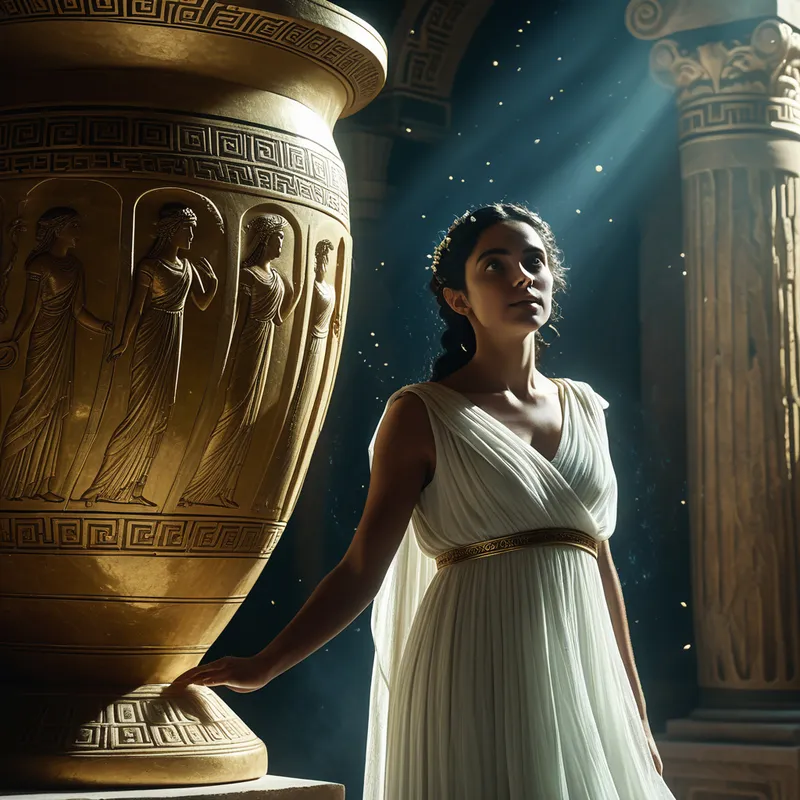
Pandora's Box from Greek mytho Myth Meaning & Symbolism
A divine punishment brings the first woman, Pandora, to mankind. Her curiosity unleashes all evils into the world, leaving only hope trapped within the jar.
The Tale of Pandora’s Box from Greek mytho
Listen, and hear a story of beginnings, a story of the first great wound and the first fragile solace. It begins not with a woman, but with fire.
The great Titan Prometheus had stolen a spark from the chariot of the sun itself, gifting it to the shivering, nascent race of mortals. This act of defiance ignited the wrath of Zeus, whose thunderous anger shook the foundations of Olympus. A theft of divine privilege demanded a punishment of poetic, terrible perfection. Not just for Prometheus, who was bound to a rock for an eagle to feast on his liver for eternity, but for all of humanity, the beneficiaries of his crime.
So Zeus summoned the divine artisans. To Hephaestus, he commanded: “Mix earth and water, and fashion a being with the voice and form of a goddess.” From his forge, Hephaestus molded the first woman, a creature of breathtaking beauty and lifelike grace. Then, Aphrodite breathed upon her, gifting her with devastating charm and longing. Athena clothed her in shimmering silvers and taught her the crafts of the loom. Hermes, the trickster, was given a final, crucial task: to plant in her heart a shameless mind and a deceitful nature, and to name her Pandora—“All-Gifted.”
But the true centerpiece of the scheme was not the woman, but a vessel. A great pithos, a storage jar, was given to her. Into this jar, each Olympian had cast a contribution—not gifts, but burdens. Sickness, toil, sorrow, envy, greed, and all the myriad miseries that flesh is heir to were sealed inside with a heavy, fitted lid. One thing alone was placed within at the last moment: Elpis.
Hermes then delivered Pandora, with the jar as her dowry, to Epimetheus. Though warned by his tormented brother to accept no gift from Zeus, Epimetheus was dazzled. He welcomed her, and with her, the sealed fate of the world.
For a time, the jar sat, a silent, ominous guest in the human home. But the spirit Hermes had placed in Pandora—the restless curiosity, the need to know—grew like a vine. What divine treasures lay inside this magnificent container? What wonders were meant for her, the All-Gifted? The whispering doubt became an irresistible pull. One day, driven by a compulsion she could neither name nor resist, she approached the jar. Her hands, almost of their own volition, found the great lid. With a heave, she lifted it.
It was not a treasure that emerged. It was a sigh, then a shriek, then a roaring, invisible tempest. From the mouth of the jar poured a dark, formless cloud that instantly took shape: Grief with its hollow eyes, Disease with its fevered touch, Envy with its green gaze, and all their countless kin. They spread across the earth, entering every heart and home, forever ending the golden age of innocence. In terror, Pandora slammed the lid back down. But it was too late. The contents had flown, save for one. Trapped beneath the rim, fluttering with a faint, warm light, was Elpis—Hope.
And so the world was made as we know it: a place of toil and suffering, with only the fragile, imprisoned promise of hope remaining at the bottom of the empty jar.
Cultural Origins & Context
This foundational narrative comes to us primarily from the epic poem Works and Days by the Boeotian poet Hesiod (c. 700 BCE). It is a myth of etiology, explaining the origin of human suffering (ponos). In Hesiod’s deeply misogynistic context, the story functioned as a divine justification for the hardship of agrarian life and a cautionary tale about the “deceitful” nature of women, portrayed as a beautiful curse upon mankind. The jar (pithos), a common household object for storing grain or oil, becomes the cosmic container for the human condition. The later linguistic shift from “jar” to “box” in the 16th century, popularized by Erasmus, softened the imagery but cemented the phrase in the global lexicon. Passed down through poets and philosophers, the myth served to articulate a profound theological and existential problem: why do we live in a world of evil, and what, if anything, is left to us?
Symbolic Architecture
The myth’s power lies not in its misogyny, but in its stark, symbolic architecture of the human psyche. Pandora is not merely a woman; she is the incarnate principle of Ananke and unconscious impulse. She is the first human actor, the one who does something, who transitions from passive creation to active, catastrophic agency.
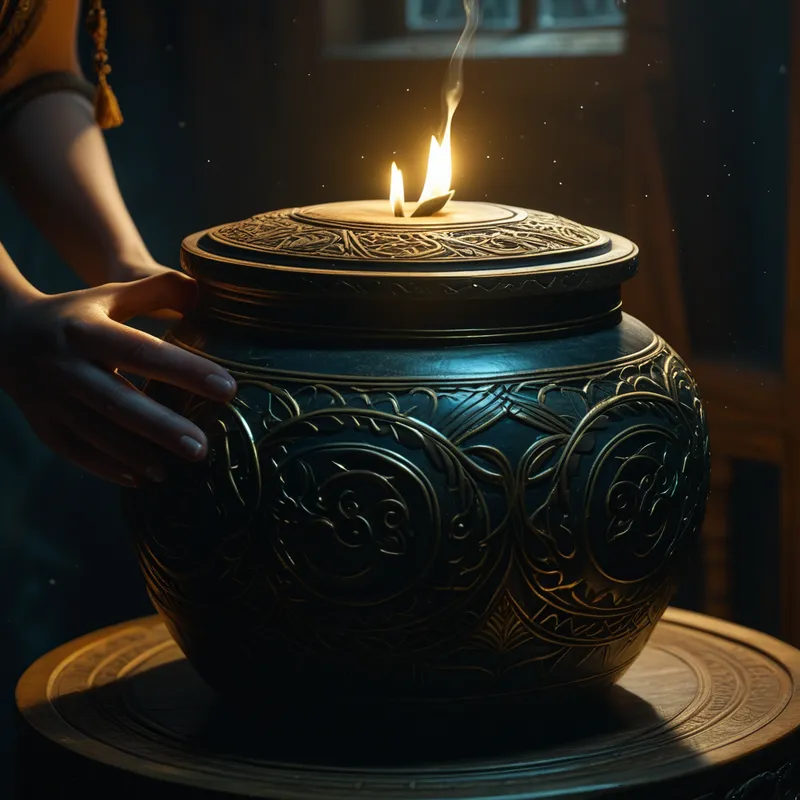
The jar is the ultimate symbol of the forbidden, the unconscious, and the potential. It contains the totality of latent experience—both destructive and salvific.
The vessel does not create its contents; it merely contains what the gods—the archetypal forces—have placed inside. To open it is to make the latent, manifest.
The evils released are not external monsters but internal states: personified psychic realities that now inhabit the inner world. Most critically, Hope (Elpis) is left behind. In Greek thought, Elpis was ambiguous—it could be a blessing, the promise of relief, or a cruel curse, a false expectation that prolongs suffering. Its imprisonment under the lid is the myth’s deepest mystery. Is hope the final, withheld evil? Or is it the one saving grace, preserved so humanity can endure what has been unleashed?

The Dreamer’s Resonance
When this myth stirs in the modern dreamer, it often manifests as dreams of forbidden containers: a locked chest in the attic, a sealed envelope, a mysterious phone, or a door that must not be opened. The somatic feeling is one of intense, compulsive curiosity mixed with dread—a knot in the stomach, a racing heart. Psychologically, this signals a confrontation with the contents of one’s own “jar”: the repressed sufferings, traumas, shames, and griefs that have been carefully sealed away.
The dreamer is Pandora in that moment of lifting the lid. The psyche is initiating a necessary, if terrifying, process of disclosure. It is the unconscious insisting that a contained suffering is now too great to remain buried. The act, though felt as a catastrophic mistake, is a primal step toward wholeness. The dream may end in horror at the release, or it may linger on the container itself, with a faint light still visible within, pointing to the resource—the hope—that remains after the psychic storm.

Alchemical Translation
The alchemical journey modeled here is the Nigredo, the blackening, the necessary descent into the prima materia of suffering. Individuation requires that we open our own personal pithos. We must, like Pandora, succumb to the profound curiosity about our own shadow. The “evils” that fly out—our jealousy, rage, despair, sickness of spirit—are not foreign invaders but our own latent potentials, now made conscious and active.
The transformation begins not when hope is grasped, but when the last of the misery has been fully acknowledged and named as it escapes the jar.
This is the brutal, initial work. Hope (Elpis), remaining at the bottom, is not the starting point but the elusive goal. It represents the Lapis Philosophorum, the philosopher’s stone, discovered only after the long and painful engagement with all that afflicts us. It is not naive optimism, but the enduring, paradoxical capacity to find meaning within the suffering that has been released. The myth instructs that our wholeness depends not on avoiding the jar, but on having the courage to open it, to endure the plague of self-knowledge, and to finally, patiently, reach for the subtle, resilient light that was there all along, waiting at the very source of the wound.
Associated Symbols
Explore related symbols from the CaleaDream lexicon: