Pandora's Box from Greek myth Myth Meaning & Symbolism
A divine punishment, a sealed jar, and a woman's fatal curiosity unleashes all evils upon the world, leaving only hope trapped inside.
The Tale of Pandora’s Box from Greek myth
In the beginning, after the great war with [the Titans](/myths/the-titans “Myth from Greek culture.”/), [the world](/myths/the-world “Myth from Tarot culture.”/) was a place for men alone. They lived without toil, without sickness, without the slow creep of age. But they had stolen fire. They had taken the spark of [Hephaestus](/myths/hephaestus “Myth from Global/Universal culture.”/) and the cunning of [Hermes](/myths/hermes “Myth from Global/Universal culture.”/), and for this, the king of gods would have his vengeance.
Zeus did not send a thunderbolt. He crafted a more subtle punishment. He summoned the smith-god, Hephaestus, and commanded him: “Mix earth and [water](/myths/water “Myth from Chinese culture.”/). Shape it into the likeness of a mortal maiden, but give her a voice like [the immortal](/myths/the-immortal “Myth from Taoist culture.”/) goddesses and a face that brings the dawn to shame.” And so it was done. From the clay, the first woman was formed, a beautiful calamity.
Each Olympian then bestowed upon her a gift—a poisoned blessing. Aphrodite shed grace upon her and cruel longing. Ares gave a heart of turmoil. Athena clothed her in gleaming silvers and taught her weaving, a skill for confinement. Hermes placed in her breast a dog-like mind and a thief’s character, and he named her [Pandora](/myths/pandora “Myth from Greek culture.”/): “All-Gifted.”
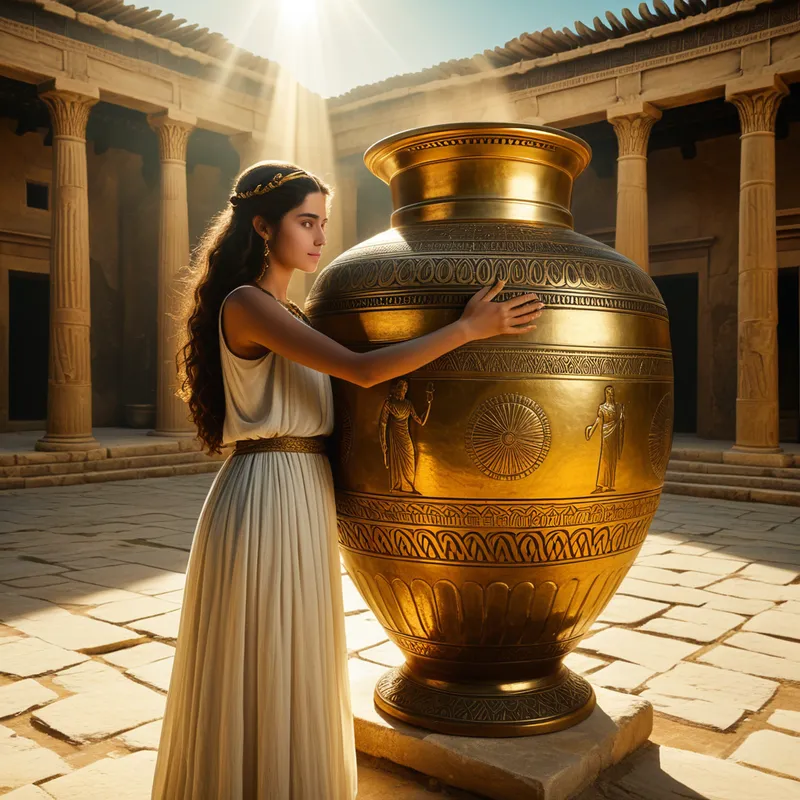
Zeus presented her with a final gift: a great jar, not a box—this was the mistranslation of later poets. It was a pithos, a massive storage vessel of clay or stone, sealed tight with a heavy lid. “Take this to the man who shelters you,” he said, his voice echoing with the weight of unspoken law. “But do not, under any compulsion of heaven or earth, open it.”
Hermes delivered Pandora to Epimetheus, the brother of [Prometheus](/myths/prometheus “Myth from Greek culture.”/), whose name means “Afterthought.” Though [Prometheus](/myths/prometheus “Myth from Greek culture.”/) had warned him to accept no gift from Olympus, Epimetheus was undone by her beauty. He welcomed her, and with her, the jar.
It sat in their dwelling. Days passed. The jar became the center of the room, of her world. It was not curiosity as we know it, but a deep, humming compulsion placed within her by Hermes’ design. It whispered. It called. The “why” of the prohibition became a physical ache in her hands. One day, as the silence of the house pressed upon her, she could bear it no longer. She approached the pithos. Her fingers found the cold, heavy lid. With a gasp of effort and terrible release, she lifted it.
What rushed out was not a [thing](/myths/thing “Myth from Norse culture.”/), but a multitude—a shrieking, formless torrent of darkness. It was Geras and Ponos, Eris and Makhai. It was sickness, famine, envy, greed, and despair. Every misery that gods had kept from humanity now took wing, scattering to the corners of [the earth](/myths/the-earth “Myth from Hindu culture.”/), seeping into the hearts of men.
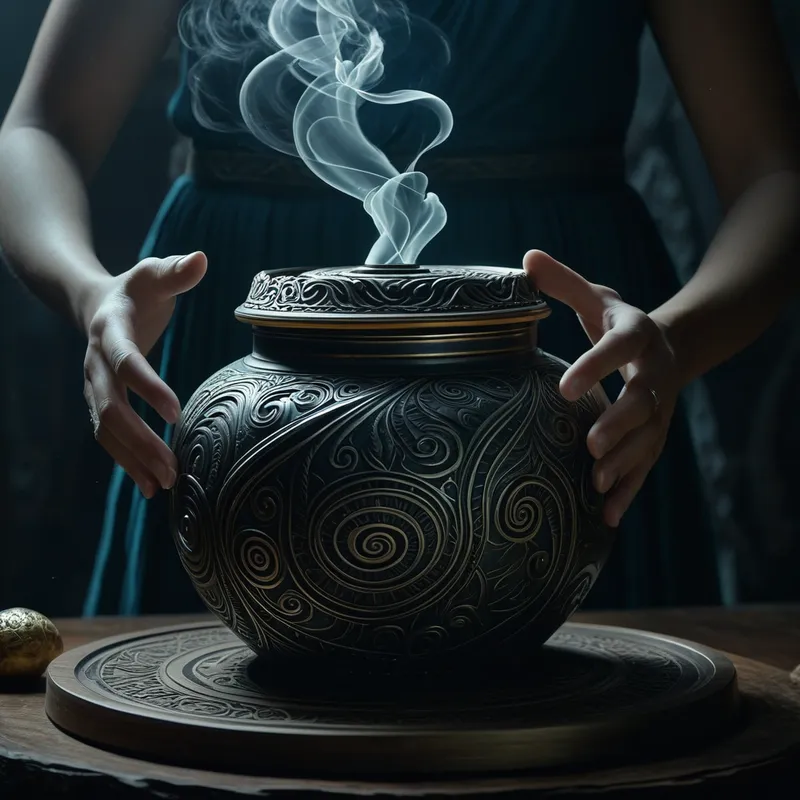
In terror, Pandora slammed the lid back down. The chaos ceased. The air was empty and cold. All that remained inside the jar, trapped beneath the lid she had closed just in time, was a single, fluttering presence: Elpis—Hope.
Cultural Origins & Context
The myth of Pandora is primarily preserved in the epic poetry of Hesiod, written in the 7th century BCE. In his Works and Days, he tells the story as an aetiology—a myth explaining the origin of human suffering. It functions as a foundational theodicy for the ancient Greeks, answering the perennial question: why is life so hard?
Hesiod’s telling is deeply misogynistic, reflecting a patriarchal agrarian society where women were legally and socially dependent. Pandora is not an innocent victim but the instrument of divine retribution, the “beautiful evil” created to punish mankind for Prometheus’s transgression. The myth served to codify a worldview where the presence of women was synonymous with the introduction of toil, sickness, and worry into a previously “golden” male existence. It was a story told to explain and enforce social order, a warning about the dangers of transgression (like stealing fire) and the perceived perils of the feminine.
Symbolic Architecture
The myth’s power transcends its original patriarchal context, revealing a profound symbolic [architecture](/symbols/architecture “Symbol: Architecture in dreams often signifies structure, stability, and the framing of personal identity or life’s journey.”/) about the [human](/symbols/human “Symbol: The symbol of a human represents individuality, complexity of emotions, and social relationships.”/) [condition](/symbols/condition “Symbol: Condition reflects the state of being, often focusing on physical, emotional, or situational aspects of life.”/). Pandora is not merely a woman; she is the first [human](/symbols/human “Symbol: The symbol of a human represents individuality, complexity of emotions, and social relationships.”/) [vessel](/symbols/vessel “Symbol: A container or structure that holds, transports, or protects something essential, representing the self, emotions, or life journey.”/) for [consciousness](/symbols/consciousness “Symbol: Consciousness represents the state of awareness and perception, encompassing thoughts, feelings, and experiences.”/) burdened with [choice](/symbols/choice “Symbol: The concept of choice often embodies decision-making, freedom, and the multitude of paths available in life.”/) and consequence. The jar represents the unconscious, the sealed repository of all latent psychic contents—both destructive and salvific.
The jar does not contain evils from the outside world; it contains the potentialities of the human psyche, both shadow and light, awaiting the catalyst of consciousness to be made real.
Pandora’s [action](/symbols/action “Symbol: Action in dreams represents the drive for agency, motivation, and the ability to take control of situations in waking life.”/) is the primal act of consciousness encountering the forbidden, the repressed. Opening the jar is the inevitable [moment](/symbols/moment “Symbol: The symbol of a ‘moment’ embodies the significance of transient experiences that encapsulate emotional depth or pivotal transformations in life.”/) of awakening, where the illusions of a painless existence ([the Golden Age](/myths/the-golden-age “Myth from Greek culture.”/)) shatter, and the full [spectrum](/symbols/spectrum “Symbol: A continuum of possibilities, representing diversity, transition, and the full range of existence from one extreme to another.”/) of human experience—suffering, conflict, [mortality](/symbols/mortality “Symbol: The awareness of life’s finitude, often representing transitions, impermanence, or existential reflection in dreams.”/)—is acknowledged. This is the [birth](/symbols/birth “Symbol: Birth symbolizes new beginnings, transformation, and the potential for growth and development.”/) of psychological complexity. The “evils” are the necessary shadows that give [depth](/symbols/depth “Symbol: Represents profound layers of consciousness, hidden truths, or the unknown aspects of existence, often symbolizing introspection and existential exploration.”/) and contour to [life](/symbols/life “Symbol: The symbol of ‘Life’ represents a journey of growth, interconnectedness, and existential meaning, encompassing both the joys and challenges that define human experience.”/); without them, there is no growth, no striving, no [story](/symbols/story “Symbol: The symbol of ‘Story’ represents the narrative woven through our lives, embodying experiences, lessons, and emotions that shape our identities.”/).
Most critically, Hope (Elpis) remains inside. This is the myth’s great ambivalence. Is Hope trapped, kept from humanity as a final cruelty? Or is Hope preserved, a sacred resource sealed safely away from the ravages of the very miseries it must counteract? Psychologically, Hope is not naive [optimism](/symbols/optimism “Symbol: A hopeful outlook anticipating positive outcomes, often linked to emotional resilience and forward-thinking attitudes.”/) but the [capacity](/symbols/capacity “Symbol: A measure of one’s potential, limits, or ability to contain, process, or achieve something, often reflecting self-assessment or external demands.”/) for meaning-making, the psychic function that allows us to endure suffering by projecting a possible future. It is the last and most essential gift, the inner resource that makes the burden of consciousness bearable.
The Dreamer’s Resonance
When this myth pattern constellates in the modern dreamer, it often manifests as dreams of forbidden containers: a locked room, a sealed letter, a vibrating box, a closed door in one’s own home. The somatic feeling is one of intense, magnetic dread mixed with irresistible curiosity—a knot in the stomach, a racing heart. The dreamer is at [the threshold](/myths/the-threshold “Myth from Folklore culture.”/) of a profound psychological disclosure.
This is the [psyche](/myths/psyche “Myth from Greek culture.”/) signaling that a period of repression or willful ignorance is ending. The “box” holds the dreamer’s own unintegrated shadows: repressed traumas, denied emotions (like rage or grief), or a burgeoning awareness of a painful truth about one’s life or self. The act of opening it in the dream, however terrifying, represents [the ego](/myths/the-ego “Myth from Jungian culture.”/)’s reluctant but necessary move toward greater wholeness. The subsequent flood of “evils” in the dreamscape mirrors the initial, overwhelming phase of confronting one’s shadow material—a period of depression, anxiety, or chaotic life disruption that follows a major insight or life change.

Alchemical Translation
The alchemical journey modeled by Pandora’s myth is the [nigredo](/myths/nigredo “Myth from Alchemical culture.”/), the necessary descent into darkness that precedes transformation. The comfortable, known world (the simple existence before the jar) must be dissolved. This is initiated by an act that feels like a catastrophic mistake—a failed relationship, a career collapse, a psychological breakdown. In that moment, we are Pandora, horrified by what we have unleashed.
The alchemical vessel is the self. The heat and pressure of suffering work upon the raw matter of the soul to separate the base from the essential.
The process of psychic transmutation begins not by avoiding this flood, but by enduring it. One must allow the “evils”—the grief, the anger, the despair—to circulate, to be fully experienced and metabolized. This is the painful labor of Ponos. Only by moving through this nigredo can one eventually approach the sealed jar again, not with the naive curiosity of the first opening, but with the hard-won consciousness of the survivor.
Then, one lifts the lid a second time, not to release, but to retrieve. This is the movement toward albedo. The hope (Elpis) trapped inside is no longer a vague wish, but the clarified, resilient spark of meaning forged in the fires of suffering. It is the realization that the capacity to hope, to find purpose, to connect, was within you all along, preserved in the very vessel that seemed to contain only ruin. The myth thus completes its alchemical arc: from a pristine, unconscious unity (the sealed jar in a golden world), through a catastrophic division and suffering (the opened jar), to a higher, conscious integration where the individual holds both the memory of suffering and the active power of hope. The orphan of the world becomes the keeper of its most sacred, inner flame.
Associated Symbols
Explore related symbols from the CaleaDream lexicon: