
Pandora Myth Meaning & Symbolism
The first woman, crafted by the gods, opens a forbidden jar, releasing all evils but trapping hope inside—a foundational myth of human suffering and resilience.
The Tale of Pandora
In the beginning, after the great theft, [the world](/myths/the-world “Myth from Tarot culture.”/) was a place of quiet balance. [Prometheus](/myths/prometheus “Myth from Greek culture.”/) had defied the will of Zeus, and the air on Olympus crackled with a cold, silent fury. The Father of Gods and Men brooded, his thunder a low rumble in the distance. Humanity had been gifted fire—warmth, craft, the spark of civilization—and for this act of rebellion, a recompense must be fashioned. Not a punishment of thunderbolts, but a gift. A gift that would be its own undoing.
Zeus summoned the divine artisans. To [Hephaestus](/myths/hephaestus “Myth from Global/Universal culture.”/), the limping smith, he gave the first command: “Mix earth with [water](/myths/water “Myth from Chinese culture.”/). Shape it into the likeness of a modest maiden, but give her a voice and strength like the deathless ones.” [Hephaestus](/myths/hephaestus “Myth from Global/Universal culture.”/) labored, and from the clay emerged a form of breathtaking beauty, a statue given life. Then the other gods were summoned to bestow their gifts. Athena clothed her in a shimmering silvery robe and a finely woven veil, teaching her crafts. The Charites placed necklaces of gold about her, and the Horai crowned her head with spring flowers. Aphrodite shed grace upon her and stirrings of desire. [Hermes](/myths/hermes “Myth from Global/Universal culture.”/), at Zeus’s direct order, planted in her breast a shameless mind and a deceitful nature, and gave her the power of speech, filling it with lies and crafty words. They named her Pandora, “All-Gift,” for each of the Olympians had given something to her making.
She was brought before Epimetheus, whose name means “Afterthought.” Though his brother Prometheus had warned him to accept no gift from Zeus, Epimetheus was struck dumb by her radiance. He forgot the warning, and welcomed her. For a time, they lived in the world as it was. But Pandora had brought with her a dowry, a great jar—some say a pithos—given into her care with one stern, resonant command: You must never open this.
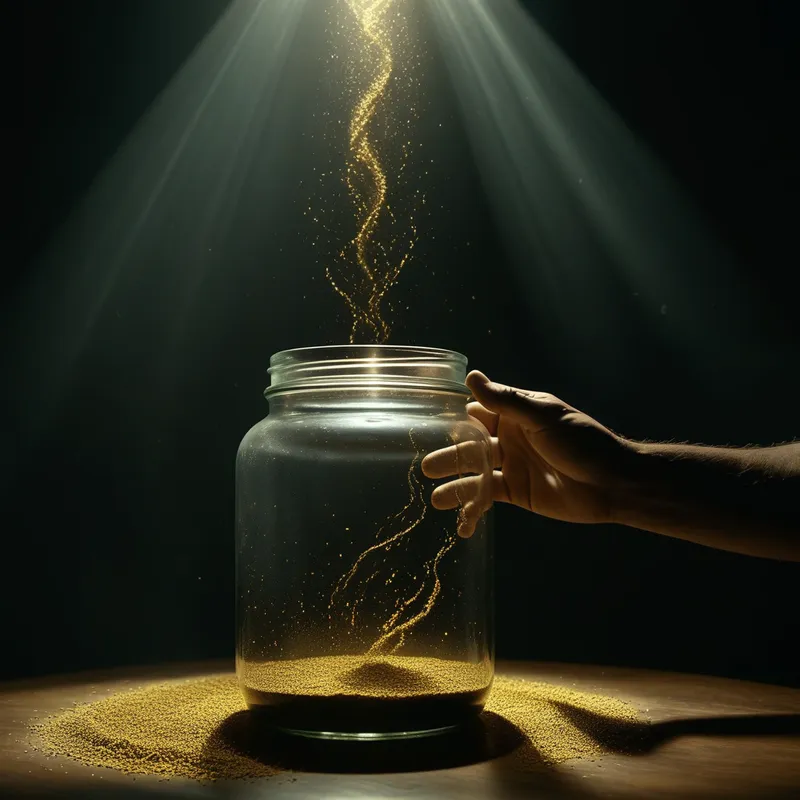
The jar sat in the corner of their dwelling. It was not ugly, but strangely compelling, its surface cool to the touch, its sealed lid a silent question. The command echoed, but Hermes’s gift of a curious and restless mind worked within her. What treasure was so precious it must be forever hidden? What divine secret lay within? The not-knowing became a presence in the room, a whisper that grew louder than the command. One day, driven by a force she could not name, her fingers found the lid. The seal broke with a soft sigh. She leaned over, peering into the dark mouth of [the vessel](/myths/the-vessel “Myth from Alchemical culture.”/).
It was not a treasure. It was a prison.
A horrific, sighing rush erupted from the jar—a torrent of shapeless, shrieking things. Geras and Nosos, Ponos and Ate. Grief, strife, envy, hatred, and all the endless, grinding sorrows of the mortal lot poured forth into the clean air, spreading across [the earth](/myths/the-earth “Myth from Hindu culture.”/) to dwell among humans forever. Pandora, in terror, slammed the lid back down. But she was too late. The evils were free. All that remained inside, trapped beneath the rim by her frantic action, was one final [thing](/myths/thing “Myth from Norse culture.”/): Elpis.
And so the world was changed. [The golden age](/myths/the-golden-age “Myth from Greek culture.”/) of quiet was gone. In its place was life as we know it—a life of struggle, pain, and toil. But in that sealed jar, a tiny, fluttering light remained. Hope was kept within, not as a comfort released, but as a potential preserved, a mystery locked away with the finality of the lid.
Cultural Origins & Context
The myth of Pandora is one of the foundational etiological stories of Greek culture, an attempt to answer the perennial, aching question: why is there suffering? Our primary sources are the epic poet Hesiod, who gives us the most complete version in his Works and Days (and a briefer account in the Theogony). For Hesiod, a somewhat misanthropic farmer-poet of the 8th century BCE, the story was not mere entertainment. It was a serious explanatory model for the human condition and a stark piece of social instruction.
In the patriarchal, agrarian society of archaic Greece, the myth functioned on multiple levels. It explained the origin of evil (kakon) as a divine response to human overreach (Prometheus’s theft). It established woman as a necessary but problematic component of civilized life—a “beautiful evil,” as Hesiod calls her—tied to the introduction of labor, reproduction, and mortality. The myth was recited and passed down as a cautionary tale about divine [justice](/myths/justice “Myth from Tarot culture.”/), the dangers of curiosity and disobedience, and the acceptance of one’s lot in a world governed by capricious gods. It cemented a worldview where suffering was intrinsic and hope was ambiguous, a story told to make sense of a hard existence.
Symbolic Architecture
Pandora is not merely a [character](/symbols/character “Symbol: Characters in dreams often signify different aspects of the dreamer’s personality or influences in their life.”/); she is an archetypal [vessel](/symbols/vessel “Symbol: A container or structure that holds, transports, or protects something essential, representing the self, emotions, or life journey.”/). She is the first [Anima](/symbols/anima “Symbol: The feminine archetype within the male unconscious, representing soul, creativity, and connection to the inner world.”/) figure of Greek myth, the embodied “Other” introduced into a previously [static](/symbols/static “Symbol: Static represents interference, disruption, and the breakdown of clear communication or signal, often evoking feelings of frustration and disconnection.”/) masculine world (represented by Prometheus and Epimetheus). Her creation is an act of psychic [differentiation](/symbols/differentiation “Symbol: The process of distinguishing or separating parts of the self, emotions, or identity from a whole, often marking a developmental or psychological milestone.”/). The gods’ gifts are not just adornments; they are the complex, contradictory attributes of conscious [human](/symbols/human “Symbol: The symbol of a human represents individuality, complexity of emotions, and social relationships.”/) [life](/symbols/life “Symbol: The symbol of ‘Life’ represents a journey of growth, interconnectedness, and existential meaning, encompassing both the joys and challenges that define human experience.”/): [beauty](/symbols/beauty “Symbol: This symbol embodies aesthetics, harmony, and the appreciation of life’s finer qualities.”/), skill, persuasion, cunning, and deceit.
The jar (pithos), often mistranslated as “box” in later traditions, is the central [symbol](/symbols/symbol “Symbol: A symbol can represent an idea, concept, or belief, serving as a powerful tool for communication and understanding.”/). It is the [vas hermeticum](/myths/vas-hermeticum “Myth from Alchemical culture.”/) of the [soul](/symbols/soul “Symbol: The soul represents the essence of a person, encompassing their spirit, identity, and connection to the universe.”/), the sealed container of the unconscious.
To open the vessel is to make the unconscious conscious—a necessary, cataclysmic, and defining act of becoming.
The “evils” that escape are the unintegrated contents of the personal and collective [shadow](/symbols/shadow “Symbol: The ‘shadow’ embodies the unconscious, repressed aspects of the self and often represents fears or hidden emotions.”/): all those aspects of existence—pain, decay, [jealousy](/symbols/jealousy “Symbol: A complex emotion signaling perceived threat to valued relationships or status, often revealing insecurities and unmet needs.”/), sorrow—that [consciousness](/symbols/consciousness “Symbol: Consciousness represents the state of awareness and perception, encompassing thoughts, feelings, and experiences.”/) would rather keep locked away. Their release is not a mistake but an [initiation](/symbols/initiation “Symbol: A symbolic beginning or transition into a new phase, status, or awareness, often involving tests, rituals, or profound personal change.”/). It is the end of psychic [innocence](/symbols/innocence “Symbol: A state of purity, naivety, and freedom from guilt or corruption, often associated with childhood and moral simplicity.”/) and the beginning of the human experience in all its tragic complexity.
Most profound is the symbol of Elpis, trapped inside. Is Hope kept from us as a final cruelty, or preserved for us as a final mercy? The myth refuses to say. This [ambiguity](/symbols/ambiguity “Symbol: A state of uncertainty or multiple possible meanings, often found in abstract art and atonal music where clear interpretation is intentionally elusive.”/) is its genius. Hope remains a latent potential, a resource not dispersed and diluted in the world, but concentrated, sealed within the individual [psyche](/myths/psyche “Myth from Greek culture.”/). It is the [knowledge](/symbols/knowledge “Symbol: Knowledge symbolizes learning, understanding, and wisdom, embodying the acquisition of information and enlightenment.”/) that, even after catastrophe, something essential remains un-released and intact within the vessel of [the self](/myths/the-self “Myth from Jungian culture.”/).

The Dreamer’s Resonance
When this myth stirs in the modern dreamer, it often manifests as a profound somatic tension around a secret, a container, or a forbidden action. You may dream of a room in your house you’ve never entered, a locked chest in an attic, a sealed letter, or a digital file you are compelled to open. The atmosphere is one of intense ambivalence: dread mixed with irresistible curiosity.
Psychologically, this is the process of approaching a repressed complex or a looming life decision whose consequences feel vast and unknown. The “evils” that fly out in the dream—perhaps as swirling darkness, insects, discordant sounds, or shadowy figures—represent the anticipated or actual emotional fallout: anxiety, grief, shame, or conflict. The act of opening is [the ego](/myths/the-ego “Myth from Jungian culture.”/)‘s confrontation with material from the unconscious that can no longer be contained. The dream is not a warning to stop, but a symbolic enactment of a process already underway. The lingering feeling of “trapping something back” at the last moment is the psyche’s instinct to preserve a core of potential (Elpis) even amidst the chaos of revelation.
Alchemical Translation
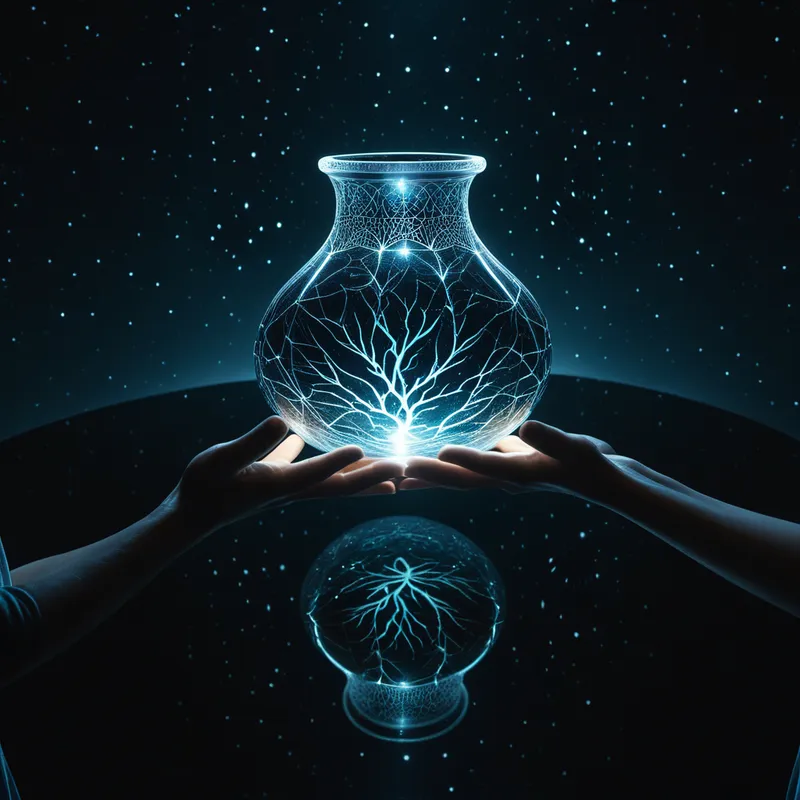
The Pandora myth is a stark map of the alchemical [nigredo](/myths/nigredo “Myth from Alchemical culture.”/), the blackening, the initial and essential stage of putrefaction and despair that precedes transformation. The individual, like Epimetheus, has accepted a beautiful, complex gift (the integrated Self, a relationship, a creative project, consciousness itself) which comes with a sealed vessel (the unconscious shadow).
Individuation demands the opening of the jar. There is no path to wholeness that bypasses the release of one’s personal and inherited sufferings.
The “gifts” of the gods are our innate talents and complexities. The jar is the sum of our unlived life, our familial curses, our repressed traumas. To live authentically is to open it, to allow those shadow contents to flood into our conscious world. This is the crisis. Life becomes “difficult,” as Hesiod described the post-Pandoran world. We must labor (Ponos) in our relationships, face our sicknesses (Nosos) of mind and spirit, and endure the ravages of time (Geras).
The alchemical [triumph](/myths/triumph “Myth from Roman culture.”/) is not in avoiding this but in the final, ambiguous gesture: slamming the lid back down. This is not a return to ignorance. It is the conscious act of containment after confrontation. After facing [the shadow](/myths/the-shadow “Myth from Jungian culture.”/), we must choose what to keep. We trap Elpis inside. In psychological terms, this is the preservation of meaning, the core of potential and faith that is not dispersed into the world’s chaos but is secured within the now-strengthened vessel of the Self. Hope is not a naive optimism released to fix everything; it is a resilient, internal resource, the [lapis philosophorum](/myths/lapis-philosophorum “Myth from Alchemical culture.”/) hidden in the dirt of experience, the one thing we salvage from the catastrophe of becoming truly human. The sealed jar, now containing only light, becomes the symbol of the integrated individual—a vessel that has faced its darkness and holds, at its center, a guarded, enduring flame.
Associated Symbols
Explore related symbols from the CaleaDream lexicon:
- Mistake
- Incredible
- Variety
- Positive
- Vase
- Trigger
- Spilled Paint
- Cupcake Wrapper
- Shattered Illusion
- Radon Whisper
- Volcanic Ash Cloud
- Puzzle Box
- Perfume Bottles
- Greek Amphora
- Grecian Urn
- Jeweled Mosaic
- Ceramic Vase
- Spilled Ink
- Ceramic Pot
- Aesthetic Armoire
- Storage Ottoman
- Vintage Dresser
- Tupperware
- Can Opener
- Corkscrew
- Jewelry Box Key
- Letter Opener
- Correction Fluid
- Mosaic Document Holder
- Jack-in-the-Box
- Pandora’s Box
- Clay Pot
- Clay Pottery
- Ceramic Vessel
- Tightly Bound Basket
- Clay Vessel
- Earthen Vessel
- Pressure Drop
- Atmospheric Inversion
- Fermi Paradox
- Symmetry Breaking
- Trust
- Fission
- Porcelain
- Ceramic
- Boredom
- Anticipation
- Wonder
- Optimism
- Shout