Palm Branches Myth Meaning & Symbolism
A sacred symbol of victory and sacrifice, the palm branch marks the triumphal entry of a king and the soul's passage through death into eternal life.
The Tale of Palm Branches
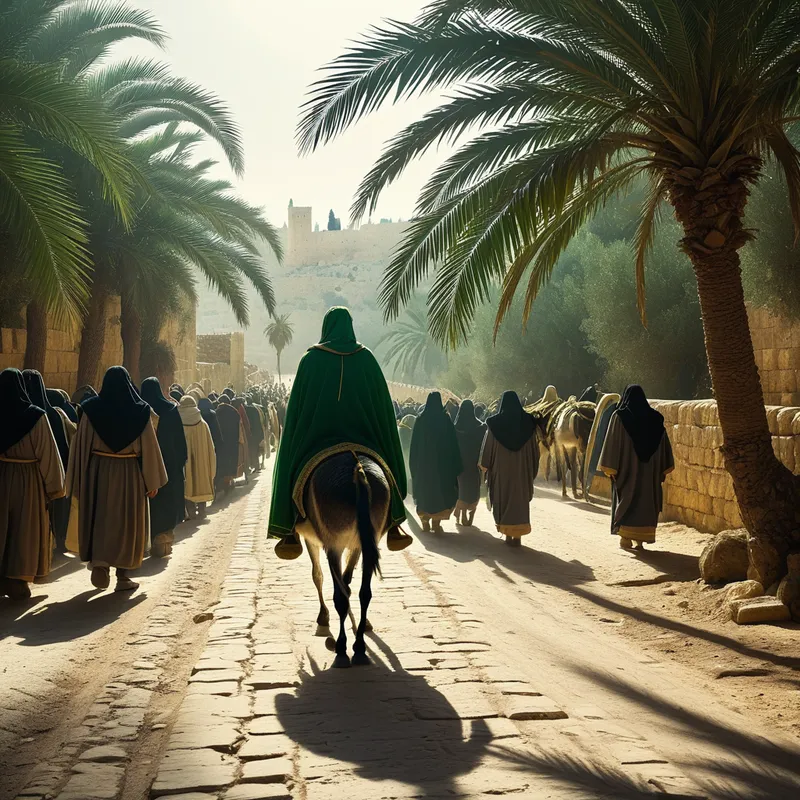
The road was dust and desire. It rose from the Bethany slope, a pale ribbon winding toward the city gates, shimmering in the heat. The air, usually carrying only the scent of olive groves and distant sacrifice, was now electric with a whispered name. It hummed in the throats of shepherds who had left their flocks, in the hushed conversations of fishermen with salt still on their hands, in the wide eyes of children perched on walls.
They came from the city, pouring out like a reverse tide, their ordinary garments—cloaks of wool and flax—suddenly become banners. They tore them from their own backs and laid them upon the dust, a carpet of humility for a king who owned no chariot. And then, from the groves that lined the Olivet ridge, they took the branches.
Not the gilded spears of soldiers, nor the polished scepters of rulers, but the fronds of the palm tree. They cut them with careful urgency, the sound a soft shush of green life severed for a greater purpose. The branches were alive, resilient, their fan-like leaves whispering secrets of oasis and survival. In a thousand hands they were raised, a forest of hope moving against [the sky](/myths/the-sky “Myth from Persian culture.”/), a rustling, living sea of verdant acclaim.
And He came, riding not a stallion of war, but the colt of a donkey, its steps slow and deliberate upon the cloak-strewn path. The shouts crescendoed—“Hosanna! Blessed is He who comes in the name of the Lord!”—a cry that was both a plea and a proclamation. The palm branches waved, not in martial rhythm, but in a joyful, chaotic symphony of faith. They brushed against His shoulders as He passed, a tangible blessing from the crowd. Children waved them like triumphant flags; elders held them aloft with trembling, reverent hands. For a breathless, suspended hour, the kingdom of heaven seemed to touch the dust of earth, announced not by trumpet blast, but by the rustle of palm leaves and the thunder of hopeful hearts. They saw a conqueror. The road, they believed, led to a throne.
But the branches, still green, were already a prophecy. They marked the path that would wind, not to a palace, but to a [Golgotha](/myths/golgotha “Myth from Christian culture.”/). The very hands that waved them would soon be clenched in a different crowd. The “Hosanna”—“save us, we pray”—would curdle into another cry. The [triumph](/myths/triumph “Myth from Roman culture.”/) of the branches was the beginning of [the passion](/myths/the-passion “Myth from Christian culture.”/). They were the green flag of a victory [the world](/myths/the-world “Myth from Tarot culture.”/) could not yet comprehend, laid at the feet of a king whose crown was yet to be woven from thorns.
Cultural Origins & Context
The palm branch, or lulav, was no spontaneous symbol. Its roots dug deep into the soil of [Sukkot](/myths/sukkot “Myth from Jewish culture.”/), one of the three great pilgrimage feasts. During this celebration, worshippers would wave bundles of palm, myrtle, and willow branches in a ritual of joyous thanksgiving for the harvest and commemoration of [the wilderness](/myths/the-wilderness “Myth from Biblical culture.”/) wanderings. It was a symbol of life, resilience, and divine provision.
By the first century, the palm had also become a potent national symbol of Judea, even minted on coins during the brief period of Hasmonean independence. It represented victory, peace, and the righteous. When the crowds on the road to [Jerusalem](/myths/jerusalem “Myth from Biblical culture.”/) cut palm branches, they were performing a deliberate, revolutionary act. They were invoking the imagery of Sukkot’s joy and combining it with the political symbolism of a triumphant, liberating king arriving at the capital during Passover, a time of heightened nationalistic fervor.
This story, passed down through the Gospel narratives, functioned on multiple levels. For the early Christian communities, it was a crucial theological hinge: the public acclamation of [Jesus](/myths/jesus “Myth from Christian culture.”/) as the Messiah, fulfilling the prophecy of [Zechariah](/myths/zechariah “Myth from Christian culture.”/) who said the king would come “gentle and riding on a donkey.” It served to highlight the irony of His kingship—acclaimed by the people, yet rejected by the religious and political authorities. The story was told and retold not as mere history, but as sacred drama, a pivotal scene where the true nature of God’s kingdom was revealed in paradox: triumph expressed in humility, victory paved by sacrifice.
Symbolic Architecture
The [palm](/symbols/palm “Symbol: The palm tree symbolizes resilience, victory, and peace, often associated with tropical climates.”/) branch in this myth is an object of profound duality, a [symbol](/symbols/symbol “Symbol: A symbol can represent an idea, concept, or belief, serving as a powerful tool for communication and understanding.”/) holding [tension](/symbols/tension “Symbol: A state of mental or emotional strain, often manifesting physically as tightness, pressure, or unease, signaling unresolved conflict or anticipation.”/) between opposing realities.
It is the banner of a victory that passes through defeat, the sign of life that marks the way to death.
Psychologically, it represents the conscious ego’s [moment](/symbols/moment “Symbol: The symbol of a ‘moment’ embodies the significance of transient experiences that encapsulate emotional depth or pivotal transformations in life.”/) of recognition and [celebration](/symbols/celebration “Symbol: The symbol of ‘celebration’ represents joy, accomplishment, and community, often serving as a collective acknowledgment of achievements or significant life milestones.”/) of [the Self](/myths/the-self “Myth from Jungian culture.”/)—the deeper, total [personality](/symbols/personality “Symbol: Personality in dreams often symbolizes the traits and characteristics of the dreamer, reflecting how they perceive themselves and how they believe they are perceived by others.”/) that includes both light and [shadow](/symbols/shadow “Symbol: The ‘shadow’ embodies the unconscious, repressed aspects of the self and often represents fears or hidden emotions.”/). The crowd, representing the collective conscious [attitude](/symbols/attitude “Symbol: Attitude symbolizes one’s mental state, perception, and posture towards life, influencing emotions and actions significantly.”/), correctly identifies the [hero](/symbols/hero “Symbol: A hero embodies strength, courage, and the ability to overcome significant challenges.”/), the divine figure, but misunderstands his [nature](/symbols/nature “Symbol: Nature symbolizes growth, connectivity, and the primal forces of existence.”/). They see only the triumphant [king](/symbols/king “Symbol: A symbol of ultimate authority, leadership, and societal order, often representing the dreamer’s inner power or external control figures.”/), the liberator from external oppression. The palm branch, in their hands, symbolizes their hope for external salvation, political [revolution](/symbols/revolution “Symbol: A fundamental, often violent transformation of social, political, or personal structures, representing upheaval, liberation, and the overthrow of established order.”/), and glorious vindication.
Yet, the myth reveals the branch’s deeper meaning. The [palm tree](/symbols/palm-tree “Symbol: The palm tree symbolizes tropical paradise, relaxation, and resilience, often reflecting a sense of freedom.”/) thrives in arid places, its roots seeking hidden [water](/symbols/water “Symbol: Water symbolizes the subconscious mind, emotions, and the flow of life, representing both cleansing and creation.”/), its form bending in storms but not breaking. It is an [emblem](/symbols/emblem “Symbol: A symbolic design representing identity, authority, or ideals, often used in heraldry, logos, or artistic expression.”/) of [resilience](/symbols/resilience “Symbol: The capacity to recover quickly from difficulties, adapt to change, and maintain strength through adversity.”/) and eternal [life](/symbols/life “Symbol: The symbol of ‘Life’ represents a journey of growth, interconnectedness, and existential meaning, encompassing both the joys and challenges that define human experience.”/). Thus, the branches laid before Jesus symbolize the [soul](/symbols/soul “Symbol: The soul represents the essence of a person, encompassing their spirit, identity, and connection to the universe.”/)’s own resilience being offered back to its [source](/symbols/source “Symbol: The origin point of something, often representing beginnings, nourishment, or the fundamental cause behind phenomena.”/). They represent the [life](/symbols/life “Symbol: The symbol of ‘Life’ represents a journey of growth, interconnectedness, and existential meaning, encompassing both the joys and challenges that define human experience.”/)-force of the individual and the [community](/symbols/community “Symbol: Community in dreams symbolizes connection, support, and the need for belonging.”/), cut and offered in [homage](/symbols/homage “Symbol: A respectful tribute or acknowledgment to someone or something influential, often in artistic or cultural forms.”/). The tragedy and the triumph of the [story](/symbols/story “Symbol: The symbol of ‘Story’ represents the narrative woven through our lives, embodying experiences, lessons, and emotions that shape our identities.”/) is that this [life](/symbols/life “Symbol: The symbol of ‘Life’ represents a journey of growth, interconnectedness, and existential meaning, encompassing both the joys and challenges that define human experience.”/)-force is being offered to a principle that will itself be “cut down” and, in so doing, transform the very meaning of life and victory.
The hero’s [journey](/symbols/journey “Symbol: A journey in dreams typically signifies adventure, growth, or a significant life transition.”/) here is not one of slaying monsters, but of accepting the paradoxical [crown](/symbols/crown “Symbol: A crown symbolizes authority, power, and achievement, often representing an individual’s aspirations, leadership, or societal role.”/). He receives the acclaim of the palm branches, knowing it is a prelude to [the crown of thorns](/myths/the-crown-of-thorns “Myth from Christian culture.”/). He embodies the [integration](/symbols/integration “Symbol: The process of unifying disparate parts of the self or experience into a cohesive whole, often representing psychological wholeness or resolution of internal conflict.”/) of acclaim and annihilation, of being hailed as king while enacting the [role](/symbols/role “Symbol: The concept of ‘role’ in dreams often reflects one’s identity or how individuals perceive their place within various social structures.”/) of the sacrificial [victim](/symbols/victim “Symbol: A person harmed by external forces, representing vulnerability, injustice, or sacrifice in dreams. Often symbolizes powerlessness or moral conflict.”/). This is the ultimate symbolic [architecture](/symbols/architecture “Symbol: Architecture in dreams often signifies structure, stability, and the framing of personal identity or life’s journey.”/): the [path](/symbols/path “Symbol: The ‘path’ symbolizes a journey, choices, and the direction one’s life is taking, often representing individual growth and exploration.”/) of true sovereignty leads through the [valley](/symbols/valley “Symbol: A valley often symbolizes a period of transition or a place of respite between two extremes.”/) of surrender.
The Dreamer’s Resonance
When the myth of the palm branches stirs in a modern dream, it often surfaces at a threshold. The dreamer may find themselves in a crowd, feeling a mix of collective euphoria and personal anxiety, waving a green branch toward an ambiguous, approaching figure. Or they may be the one on the path, receiving strange, leafy tributes with a sense of foreboding.
Such dreams signal a psychological process of recognition and costly celebration. The palm branch in the dream is the dream-ego’s acknowledgment of a new, emerging value or a central aspect of the Self coming into conscious view. It is a “Hosanna” moment—the soul crying out for salvation and, simultaneously, celebrating its arrival. This could relate to a hard-won personal insight, the acceptance of a creative calling, or the embrace of a difficult but necessary life transition.
The somatic resonance is often felt as a lifting of the heart, a surge of hope (the waving branch), immediately tempered by a knot in the stomach, a somatic dread (the knowledge of the path ahead). The dream presents the triumph but does not hide the cost. To dream of laying down one’s cloak is to dream of surrendering one’s outer protections and identities. To dream of cutting the branch is to engage in a conscious act of offering one’s own vitality to a process whose outcome is not yet secure. The dream marks the point where naive enthusiasm must mature into committed sacrifice.

Alchemical Translation
The alchemical journey mirrored in this myth is the [nigredo](/myths/nigredo “Myth from Alchemical culture.”/) to albedo—the descent into darkness that follows an initial, brilliant recognition. For the modern individual, the “Triumphal Entry” represents that fleeting, glorious moment in individuation when [the ego](/myths/the-ego “Myth from Jungian culture.”/) aligns with a vision of the Self. We see our potential, our “kingdom,” and for a moment, everything makes sense. We wave the palm branches of our enthusiasm, our new philosophy, our therapeutic breakthrough.
The alchemical fire is not lit in the palace, but on the road that leads beyond it. The gold is not found in the acclaim, but in the surrender of the one acclaimed.
But the myth insists this is only [the first stage](/myths/the-first-stage “Myth from Alchemical culture.”/). The true transmutation begins when the cheering fades and the road continues upward, toward the inner Golgotha. The palm branch must be transmuted into [the crown](/myths/the-crown “Myth from Various culture.”/) of thorns. This is the alchemical translation: the joyous offering of one’s life-energy (the green branch) must be willingly subjected to the crushing pressure of contradiction, suffering, and the death of the ego’s literal expectations (the crucifixion).
The individual is tasked with holding the paradox: to carry the memory of the palm branch—the truth of one’s value and calling—into the experience of the thorn crown, the reality of limitation, sacrifice, and apparent failure. The psychic transmutation occurs in the tension between these two symbols. The resilient, evergreen nature of the palm is not lost; it is spiritualized. It becomes the promise of resurrection—not a return to the old, naive triumph, but the emergence of a life that has integrated death. The modern seeker’s victory is not in avoiding [the via dolorosa](/myths/the-via-dolorosa “Myth from Christian culture.”/), but in understanding that their palm-waving moment of clarity was the very [thing](/myths/thing “Myth from Norse culture.”/) that set them upon it, and that the journey itself, in all its painful paradox, is the making of the soul.
Associated Symbols
Explore related symbols from the CaleaDream lexicon: