Palimpsest Papyri Myth Meaning & Symbolism
A myth of a divine scroll, erased and rewritten by fate, holding the layered history of a soul's journey through cosmic and earthly cycles.
The Tale of Palimpsest Papyri
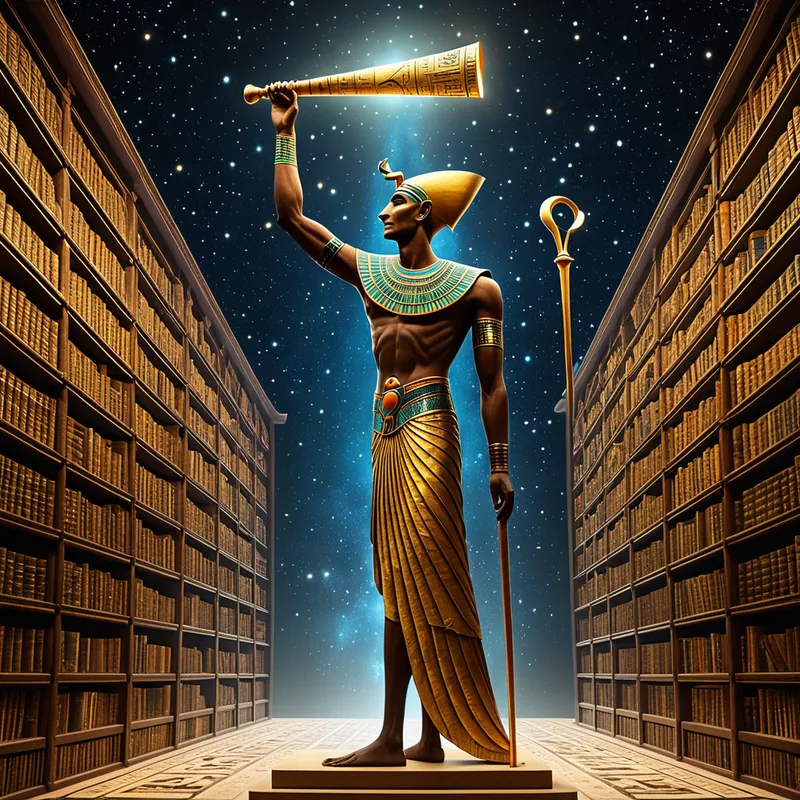
Hear now, and listen with the ears of the river and the patience of the stone. In the time before time was measured, in the silent halls of the Maat-keeper, there existed a scroll unlike any other. It rested not on a shelf of cedar, but was cradled in the lap of Thoth himself, in the chamber where the stars are catalogued and the names of the just are weighed.
This was the Scroll of Becoming, a single sheet of papyrus spun from the first reed that grew in the primordial waters of Nun. Upon it, the god’s own feather, dipped in the ink of destiny, began to write. He inscribed the true name of a soul—its divine spark, its perfect, unchanging essence in the company of the gods. The glyphs shone with a steady, golden light.
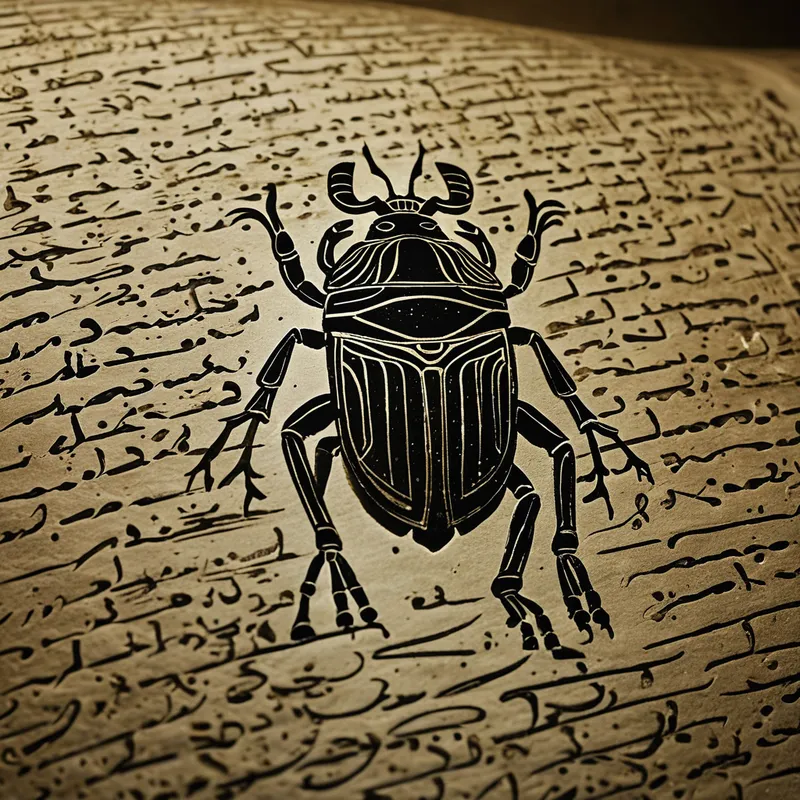
But the soul was destined for the clay of earth, for the trial of flesh and the forgetting of the river. As it descended, the golden script began to fade, not to emptiness, but to a faint, ghostly watermark beneath the surface. Upon this sacred ground, a new scribe took up the stylus: the relentless scribe of Life. This scribe wrote in the black ink of experience—of joy tasted, of grief endured, of triumphs and betrayals, of the name given at birth and the titles earned in the sun’s glare. This layer was bold, dramatic, covering much of the pristine sheet.
Yet the story was not complete. For the third scribe is the silent one, the scribe of Shadow and Fate, known as Shai. This scribe does not write in ink, but in pressure and absence. Where pride grew too tall, the stylus pressed, leaving a bruise upon the papyrus that no ink would hold. Where a vow was broken, it scraped the surface, creating a thin, weak spot. Where a truth was avoided, it left a blank space that thirsted for meaning. This layer was not seen, but felt—a topography of erasures and scars beneath the visible tale.
Thus, the soul’s scroll became a palimpsest: the golden truth beneath, the black narrative atop, and the landscape of fate etched between. In the Hall of Maat, after the body’s end, the soul would stand before this very scroll. Thoth would hold it to the light of the Wedjat eye. And the judgment was not of the black text alone, but of its alignment. Could the soul, seeing its own layered history, read the golden glyphs shining through the gaps in the black? Could it trace the shape of its divine name through the very scars left by Shai? To integrate the layers was to become whole. To see only the topmost story was to be destined for the reed-field; to see only the golden beneath was to remain forever disembodied. But to read the palimpsest—that was to achieve the true Akh, a luminous being forged from the totality of its inscriptions.
Cultural Origins & Context
The explicit term “Palimpsest Papyri” is not found in extant Egyptian texts, but the profound concept it describes is woven into the very fabric of their cosmology. This narrative is a synthesis of core Egyptian beliefs about the soul, destiny, and the afterlife, drawn from the Book of the Dead, cosmological texts, and the philosophy embedded in their ritual practices.
The myth finds its home in the scribal and priestly traditions, those who understood writing not merely as record-keeping, but as a magical act of creation and preservation. The scribe was a priest of Thoth. In this context, the papyrus was more than a medium; it was a microcosm of existence itself—a surface upon which reality was enacted. The practice of reusing papyrus (a practical reality) may have subtly informed this spiritual metaphor: nothing is ever truly lost, only integrated into a new composition.
Societally, this myth functioned as a sophisticated model of moral and existential accountability. It moved beyond a simple ledger of good and bad deeds. It taught that one’s life was a text being composed in collaboration with divine forces (Thoth), earthly experience, and fate (Shai). The ultimate goal in the Hall of Maat was not to present a flawless document, but a coherent, integrated one—where the original purpose (the golden name) could be discerned through the lived narrative and its inevitable revisions.
Symbolic Architecture
The Palimpsest Papyri is a master symbol of the psyche’s stratified architecture. Each layer represents a fundamental aspect of consciousness and the unconscious.
The Golden Layer is the archetypal Self, the daimon or original potential we are born with. It is the timeless, essential pattern—the “true name” in Egyptian terms.
The original script is not a command, but a signature of essence. It is what the soul agreed to become before the amnesia of birth.
The Black Layer is the conscious ego-personality, the story we tell ourselves and the world. It is the narrative identity forged by family, culture, trauma, and achievement. It is necessary and vivid, but often claims to be the entire text.
The Layer of Pressure and Absence is the Shadow, in its broadest sense. It comprises all that was repressed, denied, fated, or unlived. These are not merely “bad” deeds, but the silent withdrawals, the paths not taken, the vulnerabilities hidden. They create the texture—the scars and thin spots—that ultimately make the deeper layer visible. This is the work of Shai, the fate that feels external but is often the internal logic of our choices revealing itself.
The act of holding the scroll to the light is the process of introspection, therapy, or profound self-inquiry. It is the effort to see the whole document in its relational depth, understanding how the ego-narrative (black) both obscures and is shaped by the deeper Self (gold), with the shadow (erasures) acting as the crucial intermediary that defines the form of both.
The Dreamer’s Resonance
When this myth stirs in the modern unconscious, it manifests in dreams of layered spaces and hidden texts. A dreamer may find themselves in an endless library where books rewrite themselves as they are touched, or in an attic discovering a diary whose words change under their gaze. They may dream of peeling wallpaper to find older, more beautiful murals beneath, or of their own skin being inscribed with fading ink.
Somatically, this process can feel like a deep, almost archaeological itching—a sense that there is a history within the body that the conscious mind has forgotten. Psychologically, it signals a readiness for a profound review of one’s life narrative. The ego is being confronted with evidence that its story is incomplete. The dream is an invitation from the Self to begin the sacred reading, to look for the golden thread of purpose running through the apparent chaos of one’s biography, and to pay special attention to the gaps, the failures, and the silences—for they are not voids, but contours of a deeper truth.

Alchemical Translation
The journey of the Palimpsest Papyri is a precise map of the alchemical opus and Jungian individuation. The black layer (the nigredo) is the known life, often experienced as leaden, problematic, or full of conflict. The work begins with the dissolution of this layer’s absolute authority—realizing our conscious story is not the whole truth.
The engagement with the layer of erasure (the mortificatio and separatio) is the confrontation with the shadow. This is the painful, necessary scraping away of illusions and the acknowledgment of what has been denied. We must feel the thin spots and bruises in our psyche, our patterns of avoidance and broken vows to ourselves.
The transmutation occurs not by erasing the black text, but by seeing through it. The shadow’s scars become the very windows that let the gold shine through.
Finally, the integration (the coniunctio and rubedo) is the moment of holding the scroll to the light. It is the realization that the original golden essence was not corrupted by the black narrative or the erasures, but was actually expressed through them. The trauma was not a deviation from the path; its scar tissue now outlines the shape of the resilience that was always part of the golden name. The failed ambition created the empty space that allowed for a truer calling to emerge. The individual no longer identifies solely with the black text (the ego), nor fantastically with the pure gold (spiritual bypassing), but with the entire, unique, layered document. They become the scribe, the scroll, and the reader simultaneously—a whole being whose authority comes from having authenticated their own complex, palimpsest soul. This is the modern achievement of the Akh: an effective, luminous spirit grounded in the totality of its experience.
Associated Symbols
Explore related symbols from the CaleaDream lexicon: