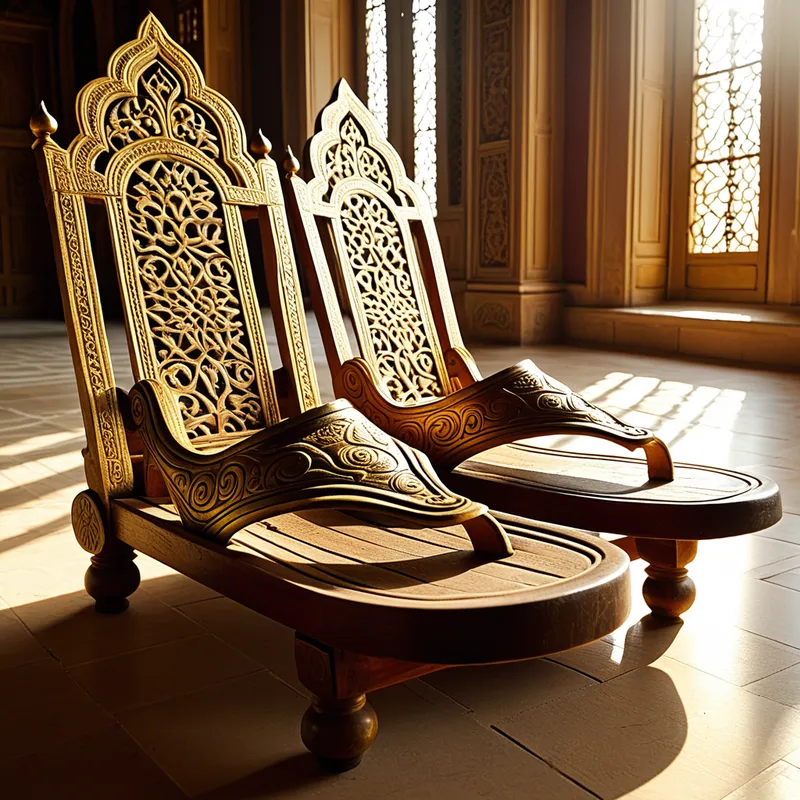
Paduka Myth Meaning & Symbolism
The myth of the divine sandals that ruled a kingdom in Rama's absence, embodying the power of sacred presence and the duty of righteous proxy.
The Tale of Paduka
Listen, and hear the tale not of a king, but of his footprints. Not of a crown, but of what carried [the crown](/myths/the-crown “Myth from Various culture.”/)’s burden.
The air in the palace of Ayodhya was thick with a poison no physician could cure—the scheming of a queen, the blindness of a king. The noble Rama, heir to the sun-wrought throne, was cast into exile for fourteen long years by a twisted promise. His wife, Sita, and his loyal brother, Lakshmana, followed him into the deep, whispering embrace of the Dandaka forest. They traded silks for bark, palaces for the hard earth.
But back in Ayodhya, a storm of another kind broke. The king, Dasharatha, died of a broken heart. The throne stood empty, a gaping maw of chaos. The queen who had orchestrated the exile intended her son, Bharata, to rule. But Bharata’s heart was pure. He raged at his mother’s deceit. The crown was not a jewel to him, but a brand of shame, a theft from his beloved brother.
So Bharata embarked on a pilgrimage of penance. With a grieving army and the entire court of sages and elders, he crossed rivers and plains, seeking the one true king in [the wilderness](/myths/the-wilderness “Myth from Biblical culture.”/). He found Rama at Chitrakuta. The meeting was a torrent of tears. Bharata fell at Rama’s feet, begging him to return. “The kingdom withers without you,” he pleaded. “The throne is yours by right and by love.”
But Rama, bound by the sacred word given to his father, would not break his vow of exile. The forest was his kingdom now; dharma, his only crown. The stalemate was absolute. The kingdom needed a ruler; Rama could not be that ruler.
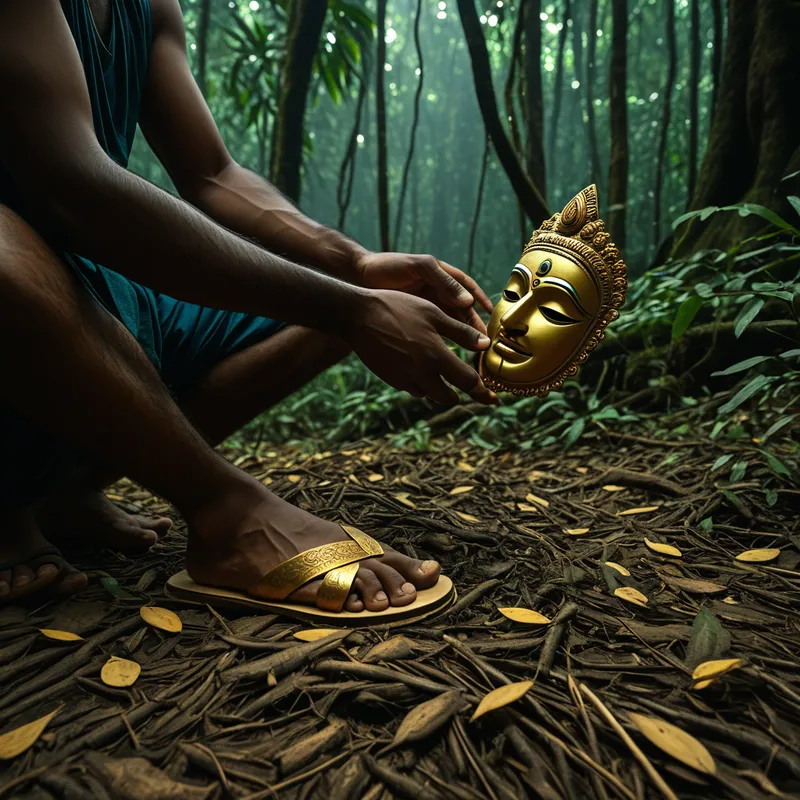
Then, in a moment of divine inspiration, a solution was woven from devotion. Rama removed his simple wooden sandals—his Paduka. They were worn from the forest paths, imprinted with the dust of his righteous journey. He placed them in Bharata’s trembling hands.
“Take these, my brother,” Rama said, his voice both soft and firm as a mountain stream. “Let them sit upon the throne of our fathers. Rule in their name. Let your commands be their commands. Where my Paduka rest, there I reign.”
Bharata received them not as footwear, but as the living essence of his brother’s spirit. He carried them back to Ayodhya not in a bag, but upon his own head, the ultimate act of submission. He placed the humble sandals upon the magnificent throne. For fourteen years, Bharata ruled as a humble regent, living outside the city in ascetic simplicity, while [the Paduka](/myths/the-paduka “Myth from Hindu culture.”/) sat in sovereign silence. Every decree was issued in their name. Every judgment was sought in their presence. The sandals were the king, and Ayodhya prospered under their silent, sacred rule.
Cultural Origins & Context
This poignant episode is a central thread in the vast epic tapestry of the Ramayana, attributed to the sage Valmiki. Passed down orally for centuries before being codified, the Ramayana is far more than a royal saga; it is India’s cultural bedrock, a compendium of ideal conduct (dharma), devotion (bhakti), and societal duty.
The myth of the Paduka functions as a profound political and theological metaphor. In a culture where the king (raja) was seen as the embodiment of divine order on earth, Rama’s exile creates a crisis of legitimacy. The Paduka myth resolves this by decoupling kingship from the physical person of the king. It establishes the principle that rightful authority resides in the symbol of righteous duty itself. This provided a template for regency, for rule by proxy, ensuring continuity of dharma even in the physical absence of the rightful ruler. It was a story told to princes and commoners alike, teaching that true power is not personal possession, but a sacred trust to be administered with selfless devotion.
Symbolic Architecture
The Paduka are one of the most potent and humble symbols in mythic literature. They are an [icon](/symbols/icon “Symbol: A sacred image or revered figure representing divine presence, artistic genius, or cultural authority, often serving as a focal point for devotion or identity.”/) of [presence](/symbols/presence “Symbol: Presence in dreams often signifies awareness or acknowledgment of something significant in one’s life.”/)-in-[absence](/symbols/absence “Symbol: The state of something missing, void, or not present. Often signifies loss, potential, or existential questioning.”/).
The footprint does not walk, yet it maps the entire journey. The symbol does not act, yet it channels the full power of what it represents.
Psychologically, the Paduka represent the Ego’s necessary submission to [the Self](/myths/the-self “Myth from Jungian culture.”/). Rama, embodying the complete, integrated Self (the Self [archetype](/symbols/archetype “Symbol: A universal, primordial pattern or prototype in the collective unconscious that shapes human experience, behavior, and creative expression.”/)), must retreat into the [forest](/symbols/forest “Symbol: The forest symbolizes a complex domain of the unconscious mind, representing both mystery and potential for personal growth.”/) of the unconscious to complete his [destiny](/symbols/destiny “Symbol: A predetermined course of events or ultimate purpose, often linked to spiritual forces or cosmic order, representing life’s inherent direction.”/). The conscious [realm](/symbols/realm “Symbol: The symbol of ‘Realm’ often signifies the boundaries of one’s consciousness, experiences, or emotional states, suggesting aspects of reality that are either explored or ignored.”/) of the [kingdom](/symbols/kingdom “Symbol: A kingdom symbolizes authority, belonging, and a sense of identity within a larger context or community.”/) ([the Ego](/myths/the-ego “Myth from Jungian culture.”/)) cannot be left leaderless. Bharata, representing the devoted Ego, does not seize power for himself. Instead, he willingly places the [symbol](/symbols/symbol “Symbol: A symbol can represent an idea, concept, or belief, serving as a powerful tool for communication and understanding.”/) of [the Self](/myths/the-self “Myth from Jungian culture.”/)—the Paduka—above himself. He agrees to govern [consciousness](/symbols/consciousness “Symbol: Consciousness represents the state of awareness and perception, encompassing thoughts, feelings, and experiences.”/) not by his own will, but in alignment with the higher, guiding principle.
The sandals themselves are rich symbols: they touch the [earth](/symbols/earth “Symbol: The symbol of Earth often represents grounding, stability, and the physical realm, embodying a connection to nature and the innate support it provides.”/), representing groundedness and [connection](/symbols/connection “Symbol: Connection symbolizes relationships, communication, and bonds among individuals.”/) to [reality](/symbols/reality “Symbol: Reality signifies the state of existence and perception, often reflecting one’s understanding of truth and life experiences.”/). They are shaped by the foot, holding its imprint—a perfect [metaphor](/symbols/metaphor “Symbol: A figure of speech where one thing represents another, often revealing hidden connections and deeper truths through symbolic comparison.”/) for a [vessel](/symbols/vessel “Symbol: A container or structure that holds, transports, or protects something essential, representing the self, emotions, or life journey.”/) that carries the essence of something greater. They are a tool for journeying, aligning with Rama’s own [path](/symbols/path “Symbol: The ‘path’ symbolizes a journey, choices, and the direction one’s life is taking, often representing individual growth and exploration.”/) of [exile](/symbols/exile “Symbol: Forced separation from one’s homeland or community, representing loss of belonging, punishment, or profound isolation.”/) as a transformative [pilgrimage](/symbols/pilgrimage “Symbol: A spiritual or transformative journey toward a sacred destination, representing personal growth, devotion, and the search for meaning.”/).
The Dreamer’s Resonance
When this mythic pattern stirs in the modern unconscious, it often manifests in dreams of proxies, stand-ins, or powerful symbols that hold authority in the dreamer’s life. You may dream of an empty chair at the head of a table that everyone still defers to. You may find a simple, personal object—a worn ring, a specific book—that you must present to others as a source of undeniable authority or truth. There is a somatic feeling of carrying something immensely precious and fragile, balanced on your head, requiring perfect posture and focus.
This dream signals a psychological process where the conscious mind (the dreamer’s waking identity) is recognizing that it is not the ultimate source of authority. It is undergoing a “Bharata phase”: a crisis of legitimacy, realizing it has been trying to rule the inner kingdom alone, leading to stagnation or guilt. The [psyche](/myths/psyche “Myth from Greek culture.”/) is preparing to acknowledge a higher, guiding center—the Self. The dream invites the ego to find the “sacred sandals” within—perhaps a core value, a moral principle, or a spiritual connection—and to place it at the center of one’s life, agreeing to act as its regent, not its owner.

Alchemical Translation
The alchemical process modeled here is the transmutation of authority from the personal to the transpersonal. The base metal of personal ambition and egoic control (Bharata’s initial refusal of the crown, which is still ego-centric) is subjected to the fire of exile (separation from the familiar) and the [water](/myths/water “Myth from Chinese culture.”/) of devotion (Bharata’s tears). Through this, it is dissolved.
The king is not the kingdom. The thinker is not the thought. The alchemist is not the Prima Materia. True power arises when the personal will becomes a vessel for the impersonal process.
The “gold” produced is the state of righteous proxy. This is the goal of individuation: not to become a tyrant of the psyche, but to become a faithful steward. The integrated individual does not act out of petty personal desire, but from a place aligned with the deeper Self. Your daily actions, your “rule” over your life, become the Paduka of your own higher nature. You place your deepest truths, your authentic dharma, on the throne. You, as the devoted Bharata-ego, live simply at the gates, executing the commands of that inner authority. The struggle is the ego’s surrender; the [triumph](/myths/triumph “Myth from Roman culture.”/) is the kingdom’s—the whole personality’s—flourishing under a rule greater than any single part. The myth teaches that ultimate sovereignty is service to the sacred imprint one carries.
Associated Symbols
Explore related symbols from the CaleaDream lexicon: