Pachacuti and the Empire Myth Meaning & Symbolism
The myth of the Inca Pachacuti, a cosmic upheaval that reorders the world, establishing divine order from primordial chaos.
The Tale of Pachacuti and the Empire
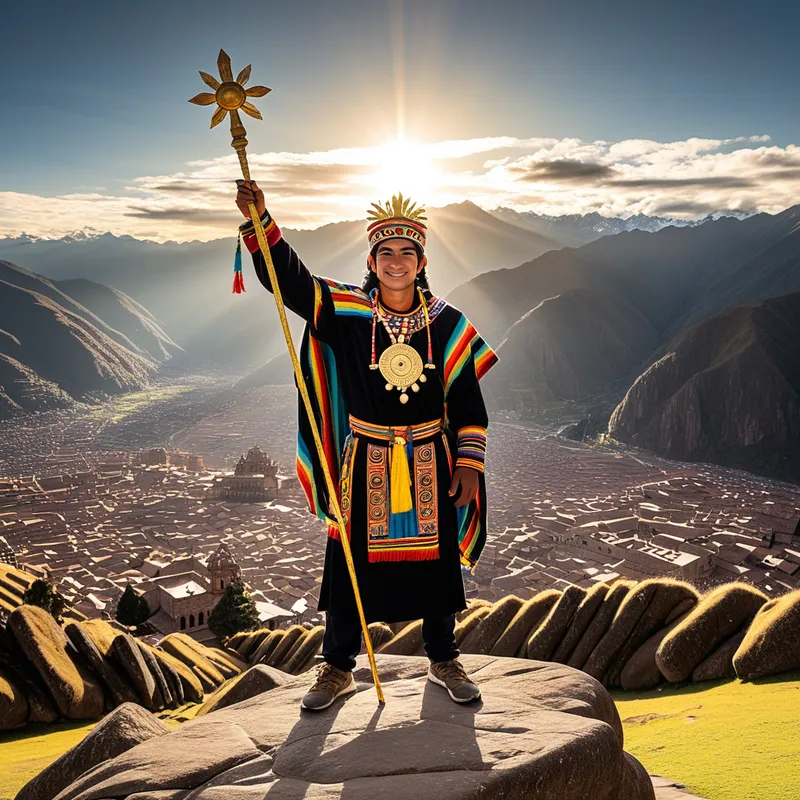
Listen. The world is old and tired. The Inka huddle in the high valley of Qosqo, a small kingdom among many, their stones laid haphazardly, their stories whispered, not sung. The sky feels low, heavy with the breath of old gods and older fears. Then, a shadow falls from the north. The Chanca come, a tide of painted warriors and clattering weapons, a wave of chaos meant to drown the Children of the Sun. The aging Inca, [Viracocha](/myths/viracocha “Myth from Incan culture.”/), flees. The heir, Urco, hides. The city holds its breath, waiting for the end.
But in the silence, a different sound begins. Not a war cry, but a vow. It comes from a prince named Cusi Yupanqui, the forgotten son. He does not see an ending, but a beginning waiting to be carved from the stone of despair. He stands before the sacred stone of Inticancha, and he does not ask for victory. He demands a sign. He speaks to the stones, to the earth, to the sky itself. “If I am chosen, let the very world bear witness.”
And the world listens.
The earth trembles, not in fear, but in recognition. The stones of the field rise, not as rubble, but as warriors of granite and spirit. The sky cracks open, and the celestial huacas roar with the voice of thunder. It is not a battle; it is a revelation. Cusi Yupanqui, now named Pachacuti, becomes the axis upon which the cosmos turns. He does not merely defeat the Chanca; he dissolves their chaos into a new pattern.
He returns to Qosqo, and his eyes see not a city, but a seed. He takes a sling, the weapon of a shepherd, and from its cup, he launches not a stone, but a vision. The four quarters of the empire, the Tawantinsuyu, radiate from this new center. He commands the very mountains to move, the rivers to bend, and the stones to lock together without mortar, in a embrace so perfect it defies time. He rebuilds the city in the shape of a sacred puma, a living, stone guardian. He establishes the mit’a, the worship of the Inti, the order of the acllas. From the formless clay of the old age, Pachacuti sculpts a world of divine geometry, where every person, every potato, every sunset has its ordained place in the luminous tapestry of order.
Cultural Origins & Context
This is not a fairy tale. It is the foundational state myth of the Inca Empire, the story told to justify and illuminate the most rapid and dramatic imperial expansion in pre-Columbian Americas. The narrative was preserved orally by the amautas and through the knotted-string records of the quipu. It was performed in ritual and ceremony, cementing the divine right of the Sapa Inca and the cosmic necessity of Inca rule.
The myth served a crucial societal function: it explained the present by mythologizing the past. The “chaos” of the pre-imperial period was retroactively cast as a time of darkness and disarray, making Pachacuti’s order not a political conquest but a cosmic correction. It provided a template for understanding the universe as fundamentally hierarchical and orderly, with the Inca at its pinnacle, directly mediating between humanity and the divine forces of nature. The story was the spiritual and political bedrock of Tawantinsuyu, a constant reminder that their world was not born, but made—and could only be maintained through sacred duty and unwavering structure.
Symbolic Architecture
At its [heart](/symbols/heart “Symbol: The heart symbolizes love, emotion, and the core of one’s existence, representing deep connections with others and self.”/), Pachacuti is not a man, but an [event](/symbols/event “Symbol: An event within dreams often signifies significant life changes, transitions, or emotional milestones.”/). The name means “world reversal” or “cataclysmic transformation.” The myth encodes the archetypal [moment](/symbols/moment “Symbol: The symbol of a ‘moment’ embodies the significance of transient experiences that encapsulate emotional depth or pivotal transformations in life.”/) where potential becomes manifest, where the latent [pattern](/symbols/pattern “Symbol: A ‘Pattern’ in dreams often signifies the underlying structure of experiences and thoughts, representing both order and the repetitiveness of life’s situations.”/) within the [soul](/symbols/soul “Symbol: The soul represents the essence of a person, encompassing their spirit, identity, and connection to the universe.”/) of a people—or an individual—erupts into [history](/symbols/history “Symbol: History in dreams often represents the dreamer’s past experiences, lessons learned, or unresolved issues that continue to influence their present.”/).
The hero does not fight the monster on its own terms; he changes the terrain of the battle into a temple.
The invading Chanca represent the undifferentiated [chaos](/symbols/chaos “Symbol: In Arts & Music, chaos represents raw creative potential, uncontrolled expression, and the breakdown of order to forge new artistic forms.”/) of the unconscious, the terrifying flood of unintegrated fears, ambitions, and [shadow](/symbols/shadow “Symbol: The ‘shadow’ embodies the unconscious, repressed aspects of the self and often represents fears or hidden emotions.”/) [material](/symbols/material “Symbol: Material signifies the tangible aspects of life, often representing physical resources, desires, and the physical world’s influence on our existence.”/). The fleeing [father](/symbols/father “Symbol: The father figure in dreams often symbolizes authority, protection, guidance, and the quest for approval or validation.”/)-[king](/symbols/king “Symbol: A symbol of ultimate authority, leadership, and societal order, often representing the dreamer’s inner power or external control figures.”/), Viracocha, symbolizes an old, impotent order of [consciousness](/symbols/consciousness “Symbol: Consciousness represents the state of awareness and perception, encompassing thoughts, feelings, and experiences.”/) that can no longer contain this rising tide. Pachacuti is the emergent ego-consciousness that does not flee or fight blindly, but confronts. His appeal to the huacas is an appeal to the deepest archetypal forces of the Self. The resulting [cataclysm](/symbols/cataclysm “Symbol: A sudden, violent upheaval or disaster of immense scale, often representing profound transformation, destruction, or the collapse of existing structures.”/) is the necessary psychic [earthquake](/symbols/earthquake “Symbol: An earthquake in a dream often symbolizes a sudden disruption or transformation that shakes the foundation of one’s life.”/) that shatters outmoded structures of [identity](/symbols/identity “Symbol: Identity represents the sense of self, encompassing personal beliefs, cultural background, and social roles.”/).
The rebuilding of Qosqo into a puma-shaped [city](/symbols/city “Symbol: A city often symbolizes community, social connection, and the complexities of modern life, reflecting the dreamer’s relationships and societal integration.”/) of perfect stonework is the ultimate [symbol](/symbols/symbol “Symbol: A symbol can represent an idea, concept, or belief, serving as a powerful tool for communication and understanding.”/) of individuation: the creation of a conscious, durable, and sacred [structure](/symbols/structure “Symbol: Structure in dreams often symbolizes stability, organization, and the framework of one’s life, reflecting how one perceives their environment and personal life.”/) (the [personality](/symbols/personality “Symbol: Personality in dreams often symbolizes the traits and characteristics of the dreamer, reflecting how they perceive themselves and how they believe they are perceived by others.”/)) from the raw material of the psyche. The Tawantinsuyu represents the [integration](/symbols/integration “Symbol: The process of unifying disparate parts of the self or experience into a cohesive whole, often representing psychological wholeness or resolution of internal conflict.”/) of the four functions of consciousness (thinking, feeling, [sensation](/symbols/sensation “Symbol: Sensation in dreams often represents the emotional and physical feelings experienced in waking life, highlighting one’s intuition or awareness.”/), [intuition](/symbols/intuition “Symbol: The immediate, non-rational understanding of truth or insight, often described as a ‘gut feeling’ or inner knowing that bypasses conscious reasoning.”/)) around a stable, radiant center—the ruling principle of the Self.
The Dreamer’s Resonance
When this myth stirs in the modern dreamer, it announces a profound interior shift. You may dream of your childhood home being violently remodeled, of a familiar landscape cracking open to reveal gleaming foundations beneath, or of being tasked with organizing a vast, chaotic library according to a secret, innate geometry.
Somatically, this can feel like a pressure in the solar plexus—a gathering of will. Psychologically, it is the process of “drawing a line in the sand” against internal chaos. The dreamer is in the role of Cusi Yupanqui before the battle: aware of an overwhelming threat (often a life crisis, a depression, a loss of meaning), abandoned by old coping mechanisms (the fleeing father), and on the brink of a choice between dissolution and a terrifying, total responsibility. The dream is the call to that responsibility. It is the summons to become the architect of your own reality, to stop being a subject of your internal chaos and become the sovereign who orders it.
Alchemical Translation
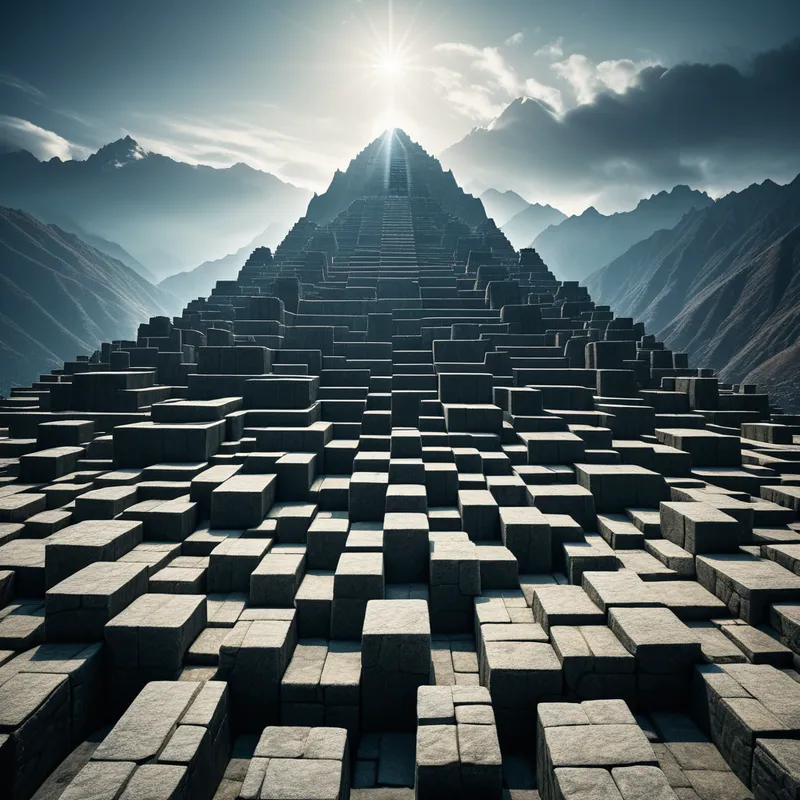
The alchemical journey mirrored in Pachacuti’s myth is the transition from the nigredo—the blackening, the chaotic mass of the prima materia (the besieged, formless Qosqo)—to the albedo and ultimately the creation of the Philosopher’s Stone: the perfected, enduring Self (the empire of Tawantinsuyu).
The first step is confrontatio. The shadow (Chanca) must be faced, not avoided. This requires a descent into one’s own personal “mud of the mountain pass,” a moment of utter humility and desperation where the only asset is raw, untested potential (the sling). The divine intervention—the stones rising—symbolizes the miraculous discovery of inner resources and archetypal support that only becomes available when one stands firm in that place of total commitment.
The transmutation occurs not when you win the battle, but when you realize you are the battlefield, the general, and the law of physics governing the war all at once.
The subsequent “rebuilding” is the long, meticulous work of individuation. It is the analysis, the structuring of habits, the integration of complexes, the establishment of personal rituals and ethics (the mit’a, the temples). It is making the unconscious conscious, laying stone upon psychic stone without mortar of self-deception. The goal is not a sterile perfection, but a living, breathing order—a self that is as resilient, interconnected, and awe-inspiring as Inca masonry, capable of holding the immense pressures of existence and channeling them into a coherent, purposeful life.
Associated Symbols
Explore related symbols from the CaleaDream lexicon:
- Mountain — The immutable, sacred axis of the world; represents the ultimate achievement of order and the stable foundation of the Self that Pachacuti establishes.
- Stone — The primary material of transformation; the chaotic field-stones become the ordered, eternal architecture of the new consciousness.
- Order — The supreme principle of the myth; the divine geometry imposed upon chaos to create a viable world and a coherent psyche.
- Chaos — The primordial state represented by the Chanca invasion; the undifferentiated, threatening raw material of the unconscious that must be confronted and shaped.
- Hero — Pachacuti as the archetypal world-transformer; the aspect of the psyche that accepts the call to total responsibility and radical change.
- Sun — The ruling principle, Inti; symbolizes consciousness, clarity, divine mandate, and the luminous center from which all order radiates.
- Temple — The built manifestation of sacred order; the Coricancha and the redesigned Qosqo represent the psyche organized around a central, numinous value.
- Circle — The shape of Qosqo and the concept of Tawantinsuyu; wholeness, completion, and the integrated Self.
- Thunder — The voice of the huacas during the battle; the terrifying, awe-inspiring sound of archetypal forces intervening in the human realm.
- Ritual — The prescribed ceremonies and duties (mit’a) established by Pachacuti; the conscious, repeated actions that maintain psychic order and connection to the divine.
- Rebirth — The core event of Pachacuti; the death of the old, limited identity and the birth of the world-ordering Self.
- Crown — The llautu of the Sapa Inca; the assumed sovereignty of the conscious ego over the realm of the personal psyche.