Oya at the Marketplace of the Dead
The Yoruba goddess Oya journeys to the underworld's marketplace, navigating deals with spirits and confronting mortality in a realm of commerce and transition.
The Tale of Oya at the Marketplace of the Dead
[The wind](/myths/the-wind “Myth from Various culture.”/) that precedes the storm is not empty air; it is a [herald](/myths/herald “Myth from Greek culture.”/), a scout, a breath of intention. So it was with Oya, goddess of winds, tempests, and the sacred Niger River, she who guards the gateway between life and what lies beyond. A restlessness, sharper than the ada, stirred within her. It was not a call to battle, but to a deeper, more perilous confrontation. The whispers had reached her—whispers of a place where the currency was not cowrie shells or goodwill, but essence itself: the Marketplace of the Dead.
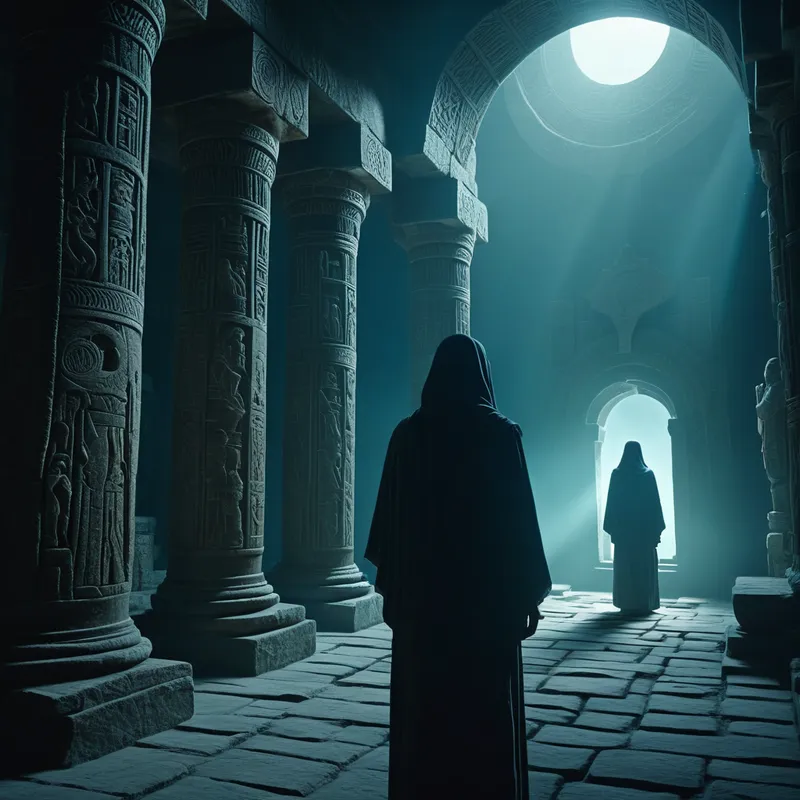
Leaving the realm of the living, where her winds cleanse and her storms renew, Oya descended. The path was not of earth, but of memory and silence, a spiraling descent through the roots of the Iroko. She arrived not with fanfare, but as a sudden, silent gust that stirred the dust of that eternal plaza. The Marketplace of the Dead was a paradox of vibrant desolation. Spirits, shades of their former selves, moved with a purpose both urgent and timeless. They did not barter for yams or cloth, but for fragments of experience: a forgotten laugh traded for a moment of clarity, a surrendered regret exchanged for a glimpse of a loved one’s face. The air thrummed with the quiet cacophony of these transactions, a commerce of the soul.
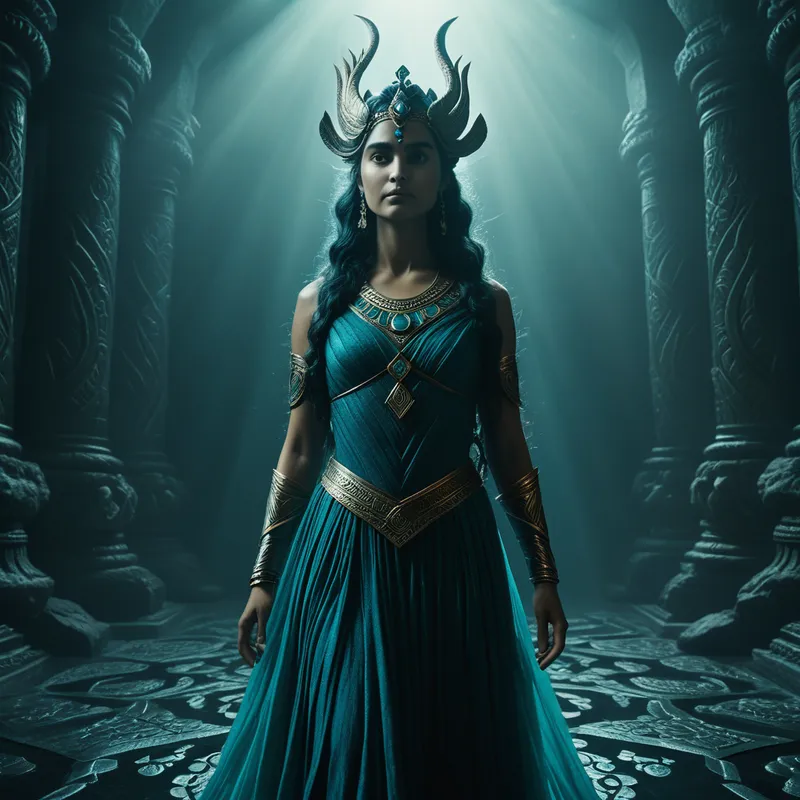
Oya, cloaked in the shifting hues of nine skirts—the colors of the rainbow and [the earth](/myths/the-earth “Myth from Hindu culture.”/)—moved among them. Her eyes, reflecting lightning, saw not just spirits, but the commodities they carried: shimmering cords of attachment, heavy stones of guilt, delicate, fading petals of joy. She was known here, for she is the one who escorts the dead to this very realm. Yet, her presence as a buyer, not a guardian, sent a ripple through [the market](/myths/the-market “Myth from Various culture.”/). What could the goddess of change possibly lack?
She sought no trivial token. Her quest was for the very architecture of transition. She approached a spirit who held not an object, but a sound—the last, rattling breath of a thousand lives, condensed into a single, silent vibration. “I seek the price of unmaking,” Oya stated, her voice the low rumble before the thunder. The spirit merely extended a hand, its palm open to reveal not a line, but an abyss. The price was a piece of her own sovereignty, a fragment of her named identity to be left here, forever. She passed on.
Next, she found a merchant of silence, trading in the pauses between heartbeats. “I seek the secret of the wind that carries souls but does not get lost,” she demanded. The merchant offered the secret in exchange for her memory of the Niger’s first bend, the sensation of its [water](/myths/water “Myth from Chinese culture.”/) as life, not as boundary. Oya, whose essence is tied to that river, turned away. The bargains were mirrors, each reflecting a part of herself she was asked to leave behind.
Finally, in the heart of the market, where the stalls bled into mist, she found the oldest trader. This one dealt not in fragments, but in wholes: completed destinies, fully spent rages, consummated loves. Before this ancient one, Oya understood her true desire. She did not come to acquire, but to comprehend the final transaction. She came to witness the moment a spirit trades its last tether to [the world](/myths/the-world “Myth from Tarot culture.”/) of form for the peace of dissolution. She sought to understand the cost of absolute release, not for herself, but to better shepherd those in her charge.
No words were exchanged. The ancient spirit simply opened its cloak, and within, Oya saw the Marketplace itself from above—a vast, swirling pattern of giving and receiving, a dance of release where every loss was a gain elsewhere in the pattern. The bargain she sought was not for an object, but for this vision. The price was to feel, fully and irrevocably, the desolation of the marketplace—the weight of all the surrendered loves, the echo of all the abandoned hopes. It was a pain not of violence, but of absolute, quiet letting go.
Oya paid the price. She stood in the center of the market and let its existential sorrow flow through her like a wind through a hollow tree. In that moment, her nine skirts flared, not with the colors of life, but with the stark, beautiful grays of ash and twilight. She did not take a [thing](/myths/thing “Myth from Norse culture.”/) from that place. But she left with a transformed understanding: true transformation requires not just the violence of the storm, but the willingness to stand in the silent marketplace of the soul and pay for wisdom with raw experience. She returned to the world not with a trophy, but with a deeper, more compassionate wind—one that could now guide the dead not just to the gate, but through the final, terrifying, and liberating transaction of release.
Cultural Origins & Context
Oya (also known as Oya-Iyansan, “mother of nine”) is a central Orisha in the Yoruba [pantheon](/myths/pantheon “Myth from Roman culture.”/), a tradition originating from what is now southwestern Nigeria and its diaspora. Her domains are manifold and potent: she is goddess of the Niger River (called Odò Oya), of winds, storms, lightning, and, critically, of the cemetery. She is the guardian of the gate between life and [death](/myths/death “Myth from Tarot culture.”/), often syncretized with Saint Barbara or Our Lady of [Candlemas](/myths/candlemas “Myth from Christian culture.”/) in diasporic traditions like Santería and Candomblé.
The concept of a marketplace in the realm of the dead (Ikole Orun, the invisible world of the spirits) is deeply embedded in Yoruba cosmology. The afterlife is not a static heaven or hell, but a dynamic continuation of existence. The idea of commerce—ija owo or tità—is fundamental to Yoruba society, and this logic extends to the spiritual world. Spirits are believed to engage in activities, require sustenance, and interact through exchange. Esu-Elegba, [the trickster](/myths/the-trickster “Myth from Various culture.”/) and messenger Orisha, is often associated with markets and [crossroads](/myths/crossroads “Myth from Celtic culture.”/), the points of transaction and choice. Oya’s journey to this specific locale underscores her role not as a passive [psychopomp](/myths/psychopomp “Myth from Greek culture.”/), but as an active participant in the economy of the soul, seeking advanced knowledge to fulfill her duties. Her venture is one of extreme risk, for even a deity can be transformed or diminished by what they encounter in the realm of the ancestors (Ara Orun).
Symbolic Architecture
The Marketplace of the Dead is a profound symbolic construct. It represents the [psyche](/myths/psyche “Myth from Greek culture.”/)’s processing center, where the contents of a [life](/symbols/life “Symbol: The symbol of ‘Life’ represents a journey of growth, interconnectedness, and existential meaning, encompassing both the joys and challenges that define human experience.”/) are assessed, valued, and ultimately integrated or released. It is the bazaar of the unconscious where we, often unwillingly, negotiate with our past.
The market is the ultimate democracy of the soul. Here, a king’s pride and a beggar’s hope are weighed on the same scales, their value determined not by worldly measure, but by the weight they still hold on the spirit.
Oya’s nine skirts symbolize her multifaceted [nature](/symbols/nature “Symbol: Nature symbolizes growth, connectivity, and the primal forces of existence.”/)—her [ability](/symbols/ability “Symbol: In dreams, ‘ability’ often denotes a recognition of skills or potential that one possesses, whether acknowledged or suppressed.”/) to move between realms, her [connection](/symbols/connection “Symbol: Connection symbolizes relationships, communication, and bonds among individuals.”/) to the nine tributaries of the Niger, and the totality of her power. In the market, their colors shifting to gray signifies the necessary [dissolution](/symbols/dissolution “Symbol: The process of breaking down, dispersing, or losing form, often representing transformation, release, or the end of a state of being.”/) of [identity](/symbols/identity “Symbol: Identity represents the sense of self, encompassing personal beliefs, cultural background, and social roles.”/) that must occur to gain transcendent wisdom. She does not conquer the [underworld](/symbols/underworld “Symbol: A symbolic journey into the unconscious, representing exploration of hidden aspects of self, transformation, or confronting repressed material.”/); she is humbled and deepened by it. Her refusal to trade core aspects of her [identity](/symbols/identity “Symbol: Identity represents the sense of self, encompassing personal beliefs, cultural background, and social roles.”/) (her sovereignty, her [memory](/symbols/memory “Symbol: Memory symbolizes the past, lessons learned, and the narratives we construct about our identities.”/) of the [river](/symbols/river “Symbol: A river often symbolizes the flow of emotions, the passage of time, and life’s journey, reflecting transitions and movement in one’s life.”/) as life) shows that even in transformation, a vital core must remain intact. The final “purchase” of pure understanding, paid for with empathetic suffering, reframes her [role](/symbols/role “Symbol: The concept of ‘role’ in dreams often reflects one’s identity or how individuals perceive their place within various social structures.”/) from a force of external change (the storm) to a [vessel](/symbols/vessel “Symbol: A container or structure that holds, transports, or protects something essential, representing the self, emotions, or life journey.”/) of internal, compassionate transition.
The Dreamer’s Resonance
To dream of Oya’s marketplace is to encounter a moment of profound psychic reckoning. In the theater of sleep, this myth manifests when the dreamer stands at a life threshold—the end of a relationship, a career, an identity, or the confrontation with a deep, personal loss. The dream may feature a crowded, unfamiliar bazaar where one is searching for something unnamed, or being pressured to trade a cherished memory or talent.
The psychological imperative is the same as Oya’s: to consciously engage with the process of letting go. The marketplace dream forces the dreamer out of passive grief or avoidance and into the active, painful, and necessary work of soul-accounting. What outdated versions of [the self](/myths/the-self “Myth from Jungian culture.”/) must be bartered away? What cherished wounds are we finally willing to sell? The anxiety in such dreams is the fear of the transaction itself—the terror of what we might have to give up to move forward. Oya’s journey assures us that this engagement, however terrifying, is [the crucible](/myths/the-crucible “Myth from Alchemical culture.”/) of growth. To avoid the marketplace is to remain haunted by unlived potentials and unprocessed endings.

Alchemical Translation
In the alchemy of the psyche, Oya’s myth maps the stage of mortificatio or [nigredo](/myths/nigredo “Myth from Alchemical culture.”/)—the blackening, the dissolution. This is not destruction for its own sake, but the breaking down of complex, rigid structures (identities, beliefs, attachments) into their raw components so they may be reassembled at a higher level.
The fire of Oya’s lightning is not merely destructive; it is the spark of analysis that reduces experience to its essential salts. The wind of her spirit is the solve that dissolves, and the marketplace is the alembic where this dissolution is negotiated.
Her journey is an allegory for deep psychotherapy or spiritual crisis, where one voluntarily descends into the “[underworld](/myths/underworld “Myth from Greek culture.”/)” of the unconscious to confront shadow material. The “bargains” offered are the seductive defenses and compromises the psyche presents: “Give up your anger and I will give you peace” (a false peace of repression). Oya’s rejections model the necessity of refusing cheap grace. The true alchemical gold she obtains—empathic understanding of the totality of loss—is only forged in the fire of direct, unshielded experience. She returns not simply changed, but capable of facilitating change in others; the therapist who has undergone their own analysis, the guide who knows the path because they have walked it, scarred and wiser.
Associated Symbols
Explore related symbols from the CaleaDream lexicon:
- Market — The dynamic, transactional space of the psyche where elements of the self and soul are evaluated, exchanged, and transformed.
- Wind — The invisible force of change, communication between realms, and the breath that carries away the old to make way for the new.
- River — The boundary between worlds, the flow of time and consciousness, and a conduit for transition and cleansing.
- Door — [The threshold](/myths/the-threshold “Myth from Folklore culture.”/) between states of being, guarded by Oya, representing opportunity, passage, and the moment of decisive change.
- Fire — The transformative and purifying element of lightning and spirit, capable of both destruction and revelation.
- Spirit — The essential, non-corporeal essence engaged in commerce in the afterlife, representing the core self beyond the physical form.
- Death — Not merely an end, but a transition point, a necessary dissolution that precedes any profound rebirth or new understanding.
- Transformation Cocoon — The liminal state represented by the marketplace itself, where old identities are broken down in preparation for a new state of being.
- Goddess — The divine feminine principle as an active, powerful agent of change, protector of thresholds, and master of elemental forces.
- Shadow — The disowned or unseen parts of the self that must be encountered and negotiated with in [the underworld](/myths/the-underworld “Myth from Greek culture.”/) marketplace of the psyche.
- Journey — The intentional descent into the unknown or unconscious for the purpose of gaining essential wisdom or retrieving a lost part of the soul.
- Release — The ultimate goal of the marketplace transaction: the voluntary letting go of attachments, identities, and pains to achieve peace or progress.