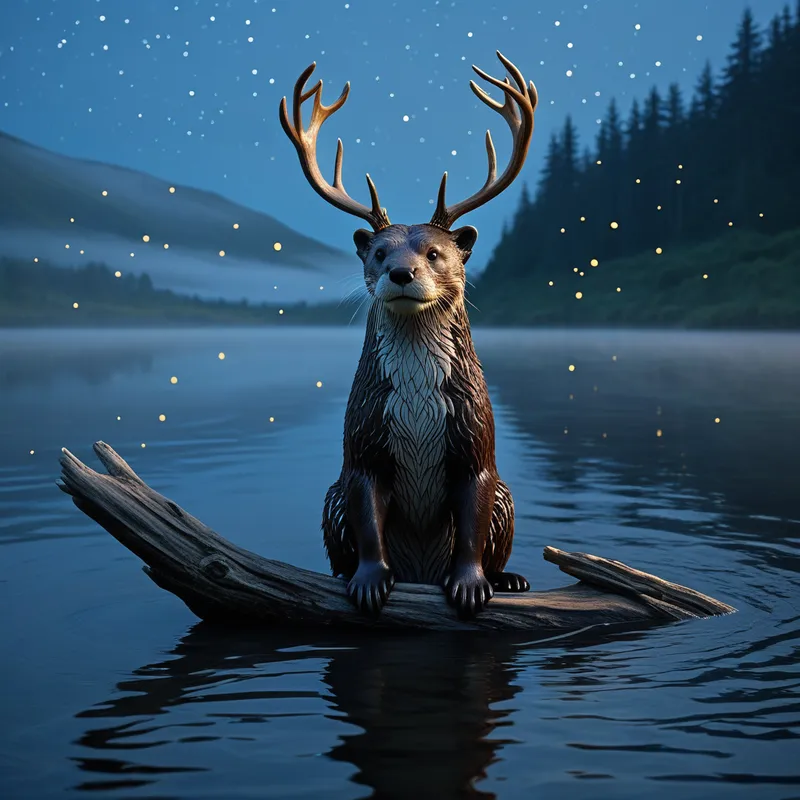
Otter Kings Myth Meaning & Symbolism
A tale of a shape-shifting otter king, a sacred debt of skin, and the profound price of violating the pact between the human and animal worlds.
The Tale of Otter Kings
Listen. [The river](/myths/the-river “Myth from Buddhist culture.”/) remembers. In the time when [the world](/myths/the-world “Myth from Tarot culture.”/) was woven tighter, when [the veil](/myths/the-veil “Myth from Various culture.”/) between what is seen and what is known was thin as a salmon’s scale, there lived a man. He was not just any man, but Fergus mac Léti, a king of Ulster. His story is bound not in gold or stone, but in [water](/myths/water “Myth from Chinese culture.”/) and fur.
One day, weary from the weight of [the crown](/myths/the-crown “Myth from Various culture.”/), Fergus sought the solace of the wild. He came to the estuary where the fresh water kisses the salt, a place of shifting boundaries. There, in the dappled shallows, he saw a wonder. Three otters were at play, but theirs was no ordinary sport. They moved with a grace that spoke of more-than-animal intelligence, working together to herd a great, silver salmon from the deep pool. They took it to the bank and began to feast, but their eating was a ritual, a sacred sharing. And as Fergus watched, hidden in the rushes, he saw the truth. These were no mere beasts. They were the [Sídhe](/myths/sdhe “Myth from Celtic / Irish culture.”/), the people of the mounds, wearing otter-skins as a man wears a cloak. They were the Otter Kings.
A deep sleep, sent by the magic of that place, fell upon Fergus. When he awoke, the otter-beings were gone, but they had left their skins upon the bank, glistening in the sun like spilled midnight. A covetous fire lit in the king’s heart. Here was a prize beyond any boar’s tusk or wolf pelt—a skin of power. He seized one, the most lustrous of all, and bore it back to his fortress at Ráth Cruachan.
He showed his warriors the pelt, boasting of his find. But the skin held a silence that was heavier than any trophy. That night, a presence filled his hall. It was the Otter King, now in his ríastrad, his true, terrifying form—a being of water and wrath. His voice was the sound of a river in flood. “You have taken what was not given. You have stolen my cochall, my hood of transformation. You have broken the covenant between your world and mine.”
The king, defiant in his mortal hall, refused. The Otter King did not strike him down. Instead, he laid a geis upon him, a fate-binding curse. “So long as you keep my skin, you shall thirst. But no water of Ireland, from the deepest well to the mightiest river, will slake it. You will drink, and your thirst will only grow, until you return what is mine.”
The curse took root. Fergus drank from every cup, every stream, every lake. His throat became a desert, his body a parched vessel. His strength, the very essence of his kingship, drained away with the unquenched thirst. He was a king dying of water. In his final desperation, he returned to the estuary. He laid the stolen pelt upon the bank, his hands trembling not with greed, but with exhaustion and awe. As the skin touched [the earth](/myths/the-earth “Myth from Hindu culture.”/), the Otter King emerged. He looked upon the broken king, took up his skin, and without a word, slipped beneath the waters. And Fergus, at last, drank from the river. The water was cool, clear, and final. He drank his fill, and his life flowed out with the current. The river took back its king.
Cultural Origins & Context
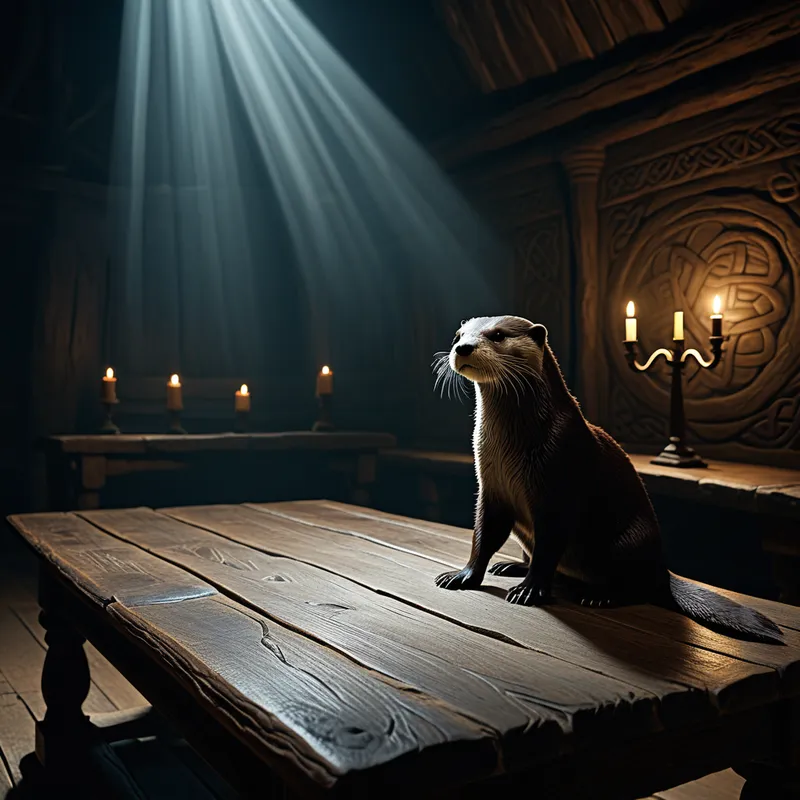
This tale of Fergus mac Léti and the Otter King is preserved in the early Irish text Echtra Fergusa maic Léti (“The Adventure of Fergus son of Léti”). It belongs to the rich corpus of echtraí and immrama, narratives that explore the perilous and wondrous intersections between the human realm and the [Otherworld](/myths/otherworld “Myth from Celtic culture.”/).
The myth was not mere entertainment. It functioned as a profound piece of legal and ecological philosophy, transmitted by the fili, the poet-seers who were the custodians of tradition. In a society where kingship was sacral and nature was animate, the story encoded critical lessons. It articulated the concept of sacred property and the catastrophic consequences of its violation—the otter skin is not just an item, but an intrinsic part of [the Otherworld](/myths/the-otherworld “Myth from Celtic culture.”/) being’s identity and power. Furthermore, it reinforced the idea of the king’s fír flathemon, the “ruler’s truth.” A king who acts from greed and violates natural law loses his legitimacy and his very life force, symbolized by the unquenchable thirst. The myth served as a cautionary tale for rulers, binding them to a code of respect for the mysterious sovereignties that exist beyond the human fort.
Symbolic Architecture
At its [heart](/symbols/heart “Symbol: The heart symbolizes love, emotion, and the core of one’s existence, representing deep connections with others and self.”/), the myth is a masterclass in boundaries and their transgression. The [otter](/symbols/otter “Symbol: A playful, social aquatic mammal symbolizing joy, adaptability, and connection to emotions.”/) itself is the perfect [symbol](/symbols/symbol “Symbol: A symbol can represent an idea, concept, or belief, serving as a powerful tool for communication and understanding.”/) of this liminal [space](/symbols/space “Symbol: Dreaming of ‘Space’ often symbolizes the vastness of potential, personal freedom, or feelings of isolation and exploration in one’s life.”/). It is a [creature](/symbols/creature “Symbol: Creatures in dreams often symbolize instincts, primal urges, and the unknown aspects of the psyche.”/) of two worlds: [water](/symbols/water “Symbol: Water symbolizes the subconscious mind, emotions, and the flow of life, representing both cleansing and creation.”/) and land, a masterful [shapeshifter](/symbols/shapeshifter “Symbol: A shapeshifter embodies transformation and adaptability, often indicating change on a personal or societal level.”/) in its own right. The [Otter](/symbols/otter “Symbol: A playful, social aquatic mammal symbolizing joy, adaptability, and connection to emotions.”/) [King](/symbols/king “Symbol: A symbol of ultimate authority, leadership, and societal order, often representing the dreamer’s inner power or external control figures.”/) amplifies this into a divine principle.
The stolen skin is not a possession, but a covenant. To take it is to steal a soul’s capacity for transformation.
Fergus’s sin is one of literalization. He sees a magical [skin](/symbols/skin “Symbol: Skin symbolizes the boundary between the self and the world, representing identity, protection, and vulnerability.”/) and reduces it to a [trophy](/symbols/trophy “Symbol: The trophy symbolizes achievement, recognition, and the reward for perseverance in competitive endeavors.”/), a symbol of his own [dominance](/symbols/dominance “Symbol: A state of power, control, or influence over others, often reflecting hierarchical structures, authority, or social positioning.”/). He fails to perceive it as a living [relationship](/symbols/relationship “Symbol: A representation of connections we have with others in our lives, often reflecting our emotional state.”/), a dynamic between worlds. His theft is a psychic act of [enclosure](/symbols/enclosure “Symbol: A bounded space representing psychological containment, social boundaries, or existential limitations. It can symbolize both safety and restriction.”/), attempting to capture and own a wild, fluid power that can only be honored, never possessed.
The [curse](/symbols/curse “Symbol: A supernatural invocation of harm or misfortune, often representing deep-seated fears, guilt, or perceived external malevolence.”/)—the unquenchable thirst—is a perfect symbolic retaliation. It is the inverse of the otter’s essence. Where the otter moves with fluid ease between elements, Fergus is trapped in a single, agonizing need. He is consumed by the very element the otter masters. His kingship, which should be a wellspring for his people, becomes a personal desert.
The Dreamer’s Resonance
When this myth stirs in the modern unconscious, it often surfaces in dreams of profound, existential thirst. One may dream of searching for water in a barren landscape, or drinking from a tap that yields only dust. This is the somatic signature of the Fergus-complex: a deep, spiritual dehydration.
Psychologically, this signals a violation of an inner covenant. The dreamer has, perhaps unknowingly, “stolen a skin.” This could manifest as:
- Profaning a Talent: Using a creative gift solely for external validation or profit, draining it of its intrinsic joy.
- Forcing a Transformation: Attempting to will oneself into a new identity (a new “skin”) through sheer effort, without the necessary inner dissolution and rebirth.
- Exploiting an Instinct: Over-intellectualizing or commodifying a deep, animal wisdom—like intuition or eros—until it becomes a dry, functional tool.
The dream is the Otter King’s curse, making the cost visceral. It says: [the way](/myths/the-way “Myth from Taoist culture.”/) you are engaging with this deep part of yourself is unsustainable. It is leaving your soul parched.
Alchemical Translation
The path of individuation modeled here is not one of heroic conquest, but of humiliating, necessary surrender. Fergus’s journey is an anti-hero’s [nigredo](/myths/nigredo “Myth from Alchemical culture.”/).
- Theft (Identification with the [Persona](/myths/persona “Myth from Greek culture.”/)): [The ego](/myths/the-ego “Myth from Jungian culture.”/), here the King, sees a numinous power (the skin/instinct/archetype) and claims it for its own aggrandizement. “This magic will make me more of who I am.” This is the inflation of the persona.
- The Curse (Enantiodromia): The unconscious retaliates with its opposite. The sought-after power becomes a source of unbearable lack. The ego is trapped in [the shadow](/myths/the-shadow “Myth from Jungian culture.”/) of the archetype it tried to own—mastery becomes impotence.
- The Return (The Sacrifice of the Ego): The only solution is the return of the stolen goods. This is the critical alchemical stage. Fergus must give back the skin. Psychologically, this means relinquishing egoic control over the complex. It is admitting, “This does not belong to me. I am in service to it.”
- The Draught (Transmutatio): The final act is not performed by the hero, but for him. He is allowed to drink. The life-giving water, previously poison, now becomes the medium of his dissolution and release. His individual life ends, but his story is reintegrated into the larger flow—the river of [the Self](/myths/the-self “Myth from Jungian culture.”/).
The myth teaches that we do not possess our depths; we are possessed by them. Wholeness comes not from capturing the Otter King’s skin, but from kneeling at the riverbank and returning it, acknowledging a sovereignty greater than our own.
The true “king” that emerges is not Fergus, but the restored balance itself—the flowing river where human and otherworld, consciousness and the unconscious, recognize their eternal, thirsty, and necessary pact.
Associated Symbols
Explore related symbols from the CaleaDream lexicon: