Osiris' Flail and Crook Myth Meaning & Symbolism
The story of Osiris, his murder, resurrection, and the symbols of the flail and crook that represent his eternal rule over life, death, and order.
The Tale of Osiris’ Flail and Crook
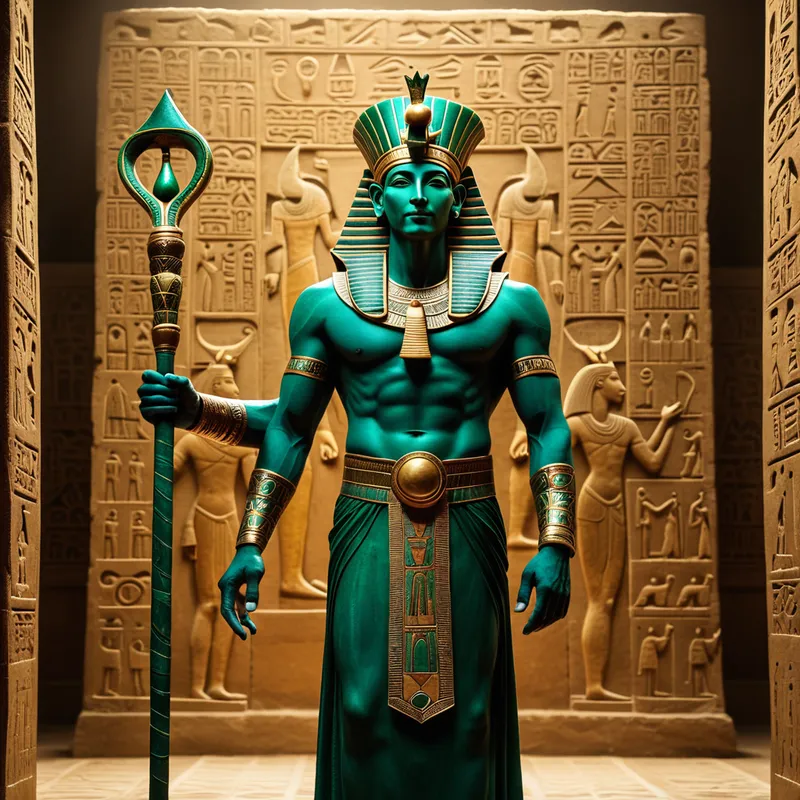
In the First Time, when the gods walked the black earth sprung from the waters of Nun, a king brought civilization to the land. His name was [Osiris](/myths/osiris “Myth from Global/Universal culture.”/), and his skin was the color of fertile silt, his eyes the deep green of the [papyrus](/myths/papyrus “Myth from Egyptian culture.”/) marsh. He ruled with his sister-queen, Isis, whose wings could stir the breath of life itself. To the people, [Osiris](/myths/osiris “Myth from Global/Universal culture.”/) gave the gifts of the grain, the vine, and [the law](/myths/the-law “Myth from Biblical culture.”/), teaching them to turn from savagery. In his hands, he carried the symbols of his sacred charge: the crook, to gather and protect his flock, and the flail, to thresh the wheat and separate bounty from chaff.
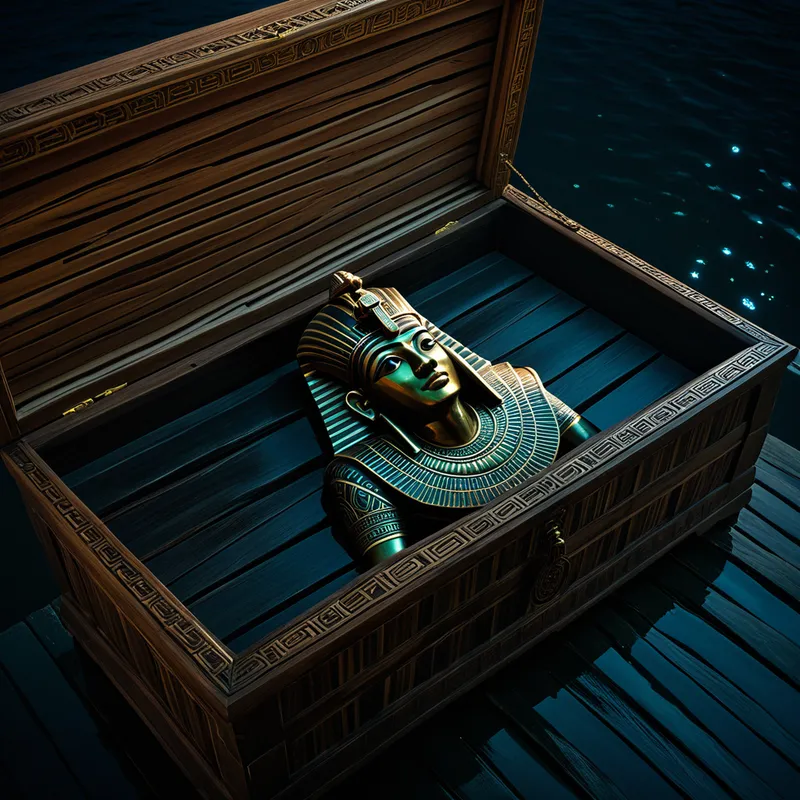
But a shadow grew in the splendid court of Abydos. It was [the shadow](/myths/the-shadow “Myth from Jungian culture.”/) of his brother, Set, whose heart was as arid as the red deserts he loved. Set saw the love the people bore Osiris, and it festered within him like a poison. He crafted a plot of magnificent treachery. At a great feast, he presented a chest of fragrant cedar, inlaid with ivory and ebony. “This shall belong,” he declared, “to whomsoever fits within it perfectly.” One by one, the guests tried and failed. But when Osiris, trusting and regal, lay down within the ornate box, it was made for him alone. In an instant, Set’s conspirators slammed the lid shut, sealed it with molten lead, and cast the chest—now a coffin—into the waiting, indifferent Nile.
[The river](/myths/the-river “Myth from Buddhist culture.”/) carried the divine king away, out to the great green sea. Isis, her heart shattered, took the form of a kite and searched [the world](/myths/the-world “Myth from Tarot culture.”/), her cries piercing [the sky](/myths/the-sky “Myth from Persian culture.”/). She found the chest lodged in a tamarisk tree in far-off Byblos, which had grown around it like a protective shell. She brought the body of her husband back to the hidden marshes of the Delta to mourn and, with her mighty magic, conceived their son, [Horus](/myths/horus “Myth from Egyptian culture.”/). But Set, hunting by the light of the full moon, discovered the hidden bier. In a rage that shook [the earth](/myths/the-earth “Myth from Hindu culture.”/), he tore the body of Osiris into fourteen pieces, scattering them to the farthest corners of Egypt.
Undeterred, Isis and her sister [Nephthys](/myths/nephthys “Myth from Egyptian culture.”/) began the great gathering. They traveled as swallows, as winds, as whispers, finding each sacred fragment—all but one, consumed by the Nile fish. Where each piece was found, a temple would later rise. With spells older than the world and tears that held the power of the stars, Isis reassembled the body, weaving it with linen and life. She fanned her wings over him, and for a moment, the breath returned. It was enough. Osiris rose, not to rule the land of the living, but to ascend to a greater throne. He became the King of the West, the Lord of the Silent Land, the judge of souls in the Hall of Ma’at. And there, eternally, he holds his crook and flail—no longer tools of earthly harvest, but emblems of cosmic order, gathering the justified dead and separating truth from falsehood for all eternity.
Cultural Origins & Context
The myth of Osiris is not a single, frozen text but a living tapestry woven over millennia, from the Old Kingdom [Pyramid Texts](/myths/pyramid-texts “Myth from Egyptian culture.”/) (c. 2400-2300 BCE) through the Coffin Texts and the Book of the Dead. It was the central cult narrative of Egyptian religion, performed annually in dramatic rituals at Abydos and Philae. These were not mere plays but sacred re-enactments believed to directly renew the fertility of the land and the cosmic order ([ma’at](/myths/maat “Myth from Egyptian culture.”/)).
The story was transmitted by the priesthood but lived in the heart of every Egyptian. It explained the central, brutal fact of life: the annual death and rebirth of vegetation along the Nile, mirrored in the human experience of death and the hope for an afterlife. Osiris was [the drowned](/myths/the-drowned “Myth from Norse culture.”/), dismembered, and resurrected grain. The flail and crook, ever-present in royal iconography from the earliest pharaohs, connected the king directly to this divine prototype. To hold them was to claim the legitimate, Osirian mandate to guide and provide for the people, embodying the promise that chaos (Set) could be overcome, and life could emerge from decay.
Symbolic Architecture
The myth’s power lies in its profound symbolic [architecture](/symbols/architecture “Symbol: Architecture in dreams often signifies structure, stability, and the framing of personal identity or life’s journey.”/). Osiris represents [the principle](/symbols/the-principle “Symbol: A fundamental truth, law, or doctrine that serves as a foundation for a system of belief, behavior, or reasoning, often representing moral or ethical standards.”/) of [life](/symbols/life “Symbol: The symbol of ‘Life’ represents a journey of growth, interconnectedness, and existential meaning, encompassing both the joys and challenges that define human experience.”/) that willingly enters the [condition](/symbols/condition “Symbol: Condition reflects the state of being, often focusing on physical, emotional, or situational aspects of life.”/) of [death](/symbols/death “Symbol: Symbolizes transformation, endings, and new beginnings; often associated with fear of the unknown.”/) and [fragmentation](/symbols/fragmentation “Symbol: The experience of breaking apart, losing cohesion, or being separated into pieces. Often represents disintegration of self, relationships, or reality.”/) to be transformed. He is the Dying and Rising God, a [pattern](/symbols/pattern “Symbol: A ‘Pattern’ in dreams often signifies the underlying structure of experiences and thoughts, representing both order and the repetitiveness of life’s situations.”/) found across the ancient world. His murder by Set is not merely fratricide but the necessary incursion of [chaos](/symbols/chaos “Symbol: In Arts & Music, chaos represents raw creative potential, uncontrolled expression, and the breakdown of order to forge new artistic forms.”/) (isfet) into order, a [rupture](/symbols/rupture “Symbol: A sudden break or tear in continuity, often representing abrupt change, separation, or the shattering of established patterns.”/) that makes conscious transformation possible.
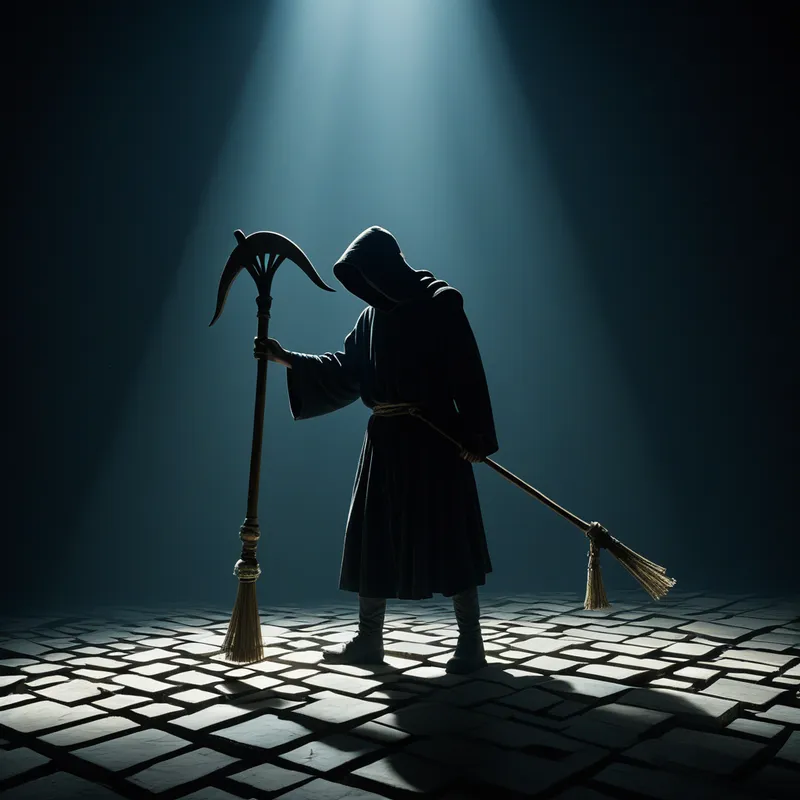
The crook and flail are not just tools of a farmer-king; they are the twin instruments of psychic alchemy. One gathers what is scattered; the other separates what is essential from what must be released.
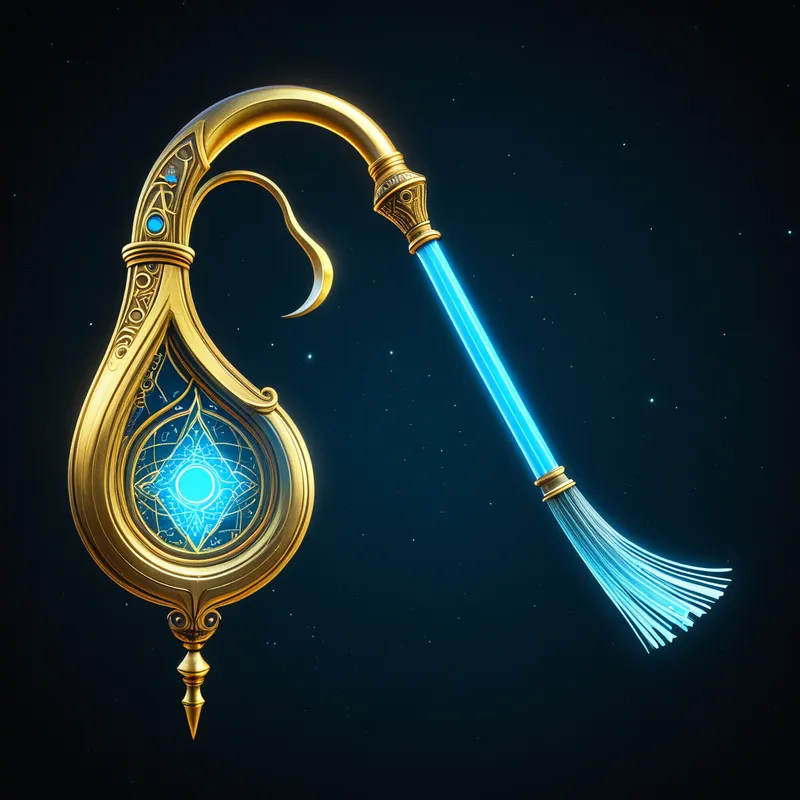
The Crook (heqa) symbolizes the guiding, protective, and gathering function. It is the hook that retrieves the [soul](/symbols/soul “Symbol: The soul represents the essence of a person, encompassing their spirit, identity, and connection to the universe.”/) from the [depths](/symbols/depths “Symbol: Represents the subconscious, hidden emotions, or foundational aspects of the self, often linked to primal fears or profound truths.”/), the arm that draws the [community](/symbols/community “Symbol: Community in dreams symbolizes connection, support, and the need for belonging.”/) together, the gentle [authority](/symbols/authority “Symbol: A symbol representing power structures, rules, and control, often reflecting one’s relationship with societal or personal governance.”/) that shepherds the lost. Psychologically, it represents [the ego](/myths/the-ego “Myth from Jungian culture.”/)’s [capacity](/symbols/capacity “Symbol: A measure of one’s potential, limits, or ability to contain, process, or achieve something, often reflecting self-assessment or external demands.”/) for [integration](/symbols/integration “Symbol: The process of unifying disparate parts of the self or experience into a cohesive whole, often representing psychological wholeness or resolution of internal conflict.”/), pulling disparate parts of [the self](/myths/the-self “Myth from Jungian culture.”/)—memories, talents, [shadow](/symbols/shadow “Symbol: The ‘shadow’ embodies the unconscious, repressed aspects of the self and often represents fears or hidden emotions.”/) aspects—back into a coherent whole after a [period](/symbols/period “Symbol: Periods in dreams can symbolize cyclical patterns, renewal, and the associated emotions of loss or change throughout life.”/) of fragmentation or [trauma](/symbols/trauma “Symbol: A deeply distressing or disturbing experience that overwhelms the psyche, often manifesting in dreams as unresolved emotional wounds or psychological injury.”/).
The [Flail](/symbols/flail “Symbol: A medieval agricultural or weapon tool for threshing grain or combat, symbolizing forceful separation, chaotic power, and primal transformation.”/) (nekhakha), often misinterpreted as a [weapon](/symbols/weapon “Symbol: A weapon in dreams often symbolizes power, aggression, and the need for protection or defense.”/), is fundamentally an agricultural tool for threshing [grain](/symbols/grain “Symbol: Represents sustenance, growth cycles, and the foundation of civilization. Symbolizes life’s harvest, patience, and transformation from seed to nourishment.”/). Its [symbolism](/symbols/symbolism “Symbol: The use of symbols to represent ideas or qualities, often conveying deeper meanings beyond literal interpretation. In dreams, it’s the language of the unconscious.”/) is one of necessary violence for the sake of nourishment: separating the nourishing [kernel](/symbols/kernel “Symbol: Represents potential, hidden essence, or the core of something waiting to develop. Often symbolizes beginnings, nourishment, or unexpressed emotions.”/) from the inedible [husk](/symbols/husk “Symbol: A hollow, discarded outer shell, often representing emptiness, potential, or transformation after the core has been removed.”/), the eternal [truth](/symbols/truth “Symbol: Truth represents authenticity, honesty, and the quest for knowledge beyond mere appearances.”/) from the mortal [shell](/symbols/shell “Symbol: Shells are often seen as symbols of protection, transition, and the journey of personal growth.”/), the justified [heart](/symbols/heart “Symbol: The heart symbolizes love, emotion, and the core of one’s existence, representing deep connections with others and self.”/) from the [weight](/symbols/weight “Symbol: Weight symbolizes burdens, responsibilities, and emotional loads one carries in life.”/) of sin. It is the principle of discernment and judgment, the difficult process of sifting our experiences to retain only what truly feeds the soul.
The Dreamer’s Resonance
When this myth stirs in the modern dreamer, it often signals a profound process of disintegration and reintegration. To dream of being trapped in a box or chest may reflect a feeling of being stifled, confined by circumstances or one’s own life structure. Dreams of dismemberment are rarely literal; they speak to a feeling of being pulled apart by conflicting duties, identities, or a traumatic event that has shattered one’s sense of self.
The appearance of a shepherd’s crook or a farming flail in a dream is a potent archetypal signal. The crook suggests the unconscious is offering a tool for retrieval—perhaps a lost part of oneself, a forgotten passion, or a needed guidance is now accessible. The flail indicates a necessary, and perhaps painful, period of discernment is at hand. The dreamer may be processing a “threshing floor” experience in waking life: a career change, the end of a relationship, or a moral dilemma that requires separating their core values from external expectations. The somatic feeling is often one of profound fatigue followed by a strange, quiet strength—the fatigue of Isis’s long search, the strength of Osiris’s reassembled form.
Alchemical Translation
The Osiris myth is a perfect map of the alchemical process of individuation. It begins in the [nigredo](/myths/nigredo “Myth from Alchemical culture.”/), the blackening: Osiris in the sealed chest, the ego entombed in a problem, a depression, or a life transition that feels like death. This is the necessary descent.
The dismemberment by Set is the [separatio](/myths/separatio “Myth from Alchemical culture.”/), the violent breaking apart of old, rigid structures of personality and identity. One cannot become whole by remaining in an unexamined, unified state; the old king must be torn apart. Isis’s search represents the work of the conscious mind (and the anima/animus) gathering the insights and pieces of self-awareness from the shadowy realms of the unconscious.
Resurrection is not a return to the old life, but an ascent to a different order of being. The reconstituted self rules not the sunlit world of persona, but the rich, inner kingdom of the soul.
The reassembly is the coagulatio, the re-forming of the self with a new understanding. Crucially, the body is reassembled but is not the same; it is wrapped, sanctified, and missing a part (the phallus, representing generative power, is replaced by magic). This signifies that the transformed individual operates from a different center—not brute instinct, but a connection to a transcendent, life-giving source (symbolized by the conceived Horus).
Finally, Osiris ascends to rule [the Duat](/myths/the-duat “Myth from Egyptian culture.”/). In psychological terms, the integrated self assumes sovereignty over the inner world. The crook and flail are the permanent attributes of this new, ruling consciousness: the compassionate ability to integrate new experiences (the crook) and the discerning wisdom to judge inner states and outer choices from a place of deep, non-egoic truth (the flail). The individual becomes the steward of their own soul, guiding and providing for its growth through the endless cycles of death and rebirth that constitute a truly examined life.
Associated Symbols
Explore related symbols from the CaleaDream lexicon: