Orphic Egg Myth Meaning & Symbolism
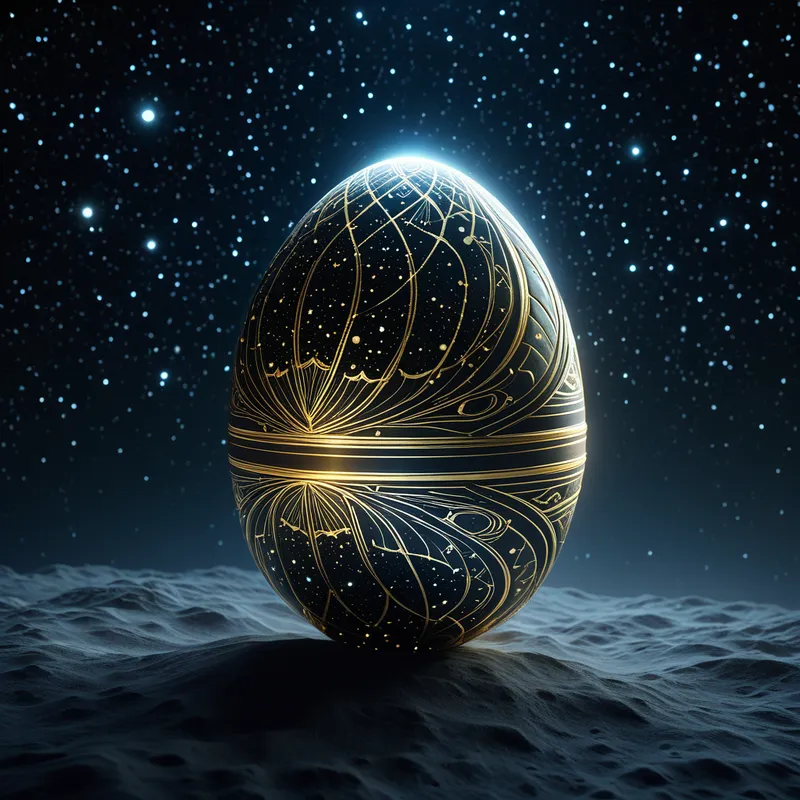
A cosmic egg, born of Night and Wind, cracks open to birth the first god, Phanes, containing all potential for the universe and the soul.
The Tale of the Orphic Egg
In the beginning, there was no beginning. There was only Chaos, a yawning, silent, and boundless deep. No light, no dark, no up, no down. Only a breathless potential. From this abyss, two ancient powers stirred: Nyx</ab title>, the Night, a velvet cloak of infinite depth, and Erebus, the Wind, a whispering, formless motion.
In the embrace of this eternal darkness, a miracle was conceived. Not through passion, but through necessity. From the union of the unmoving Night and the restless Wind, a singular, impossible thing took form. It was an Egg. Not of bird or beast, but of the cosmos itself. A perfect, self-contained sphere, its shell neither silver nor gold but both, shimmering with the light of stars yet to be born. It was the Orphic Egg, cradled in the infinite womb of Erebus.
Time, which did not yet exist, seemed to hold its breath. Within that seamless shell, a pressure grew—a symphony of opposites yearning for expression: fire and ice, earth and sky, male and female, life and death, all churning in a divine, undifferentiated soup. The Egg was the All and the Nothing, the ultimate secret waiting to be told.
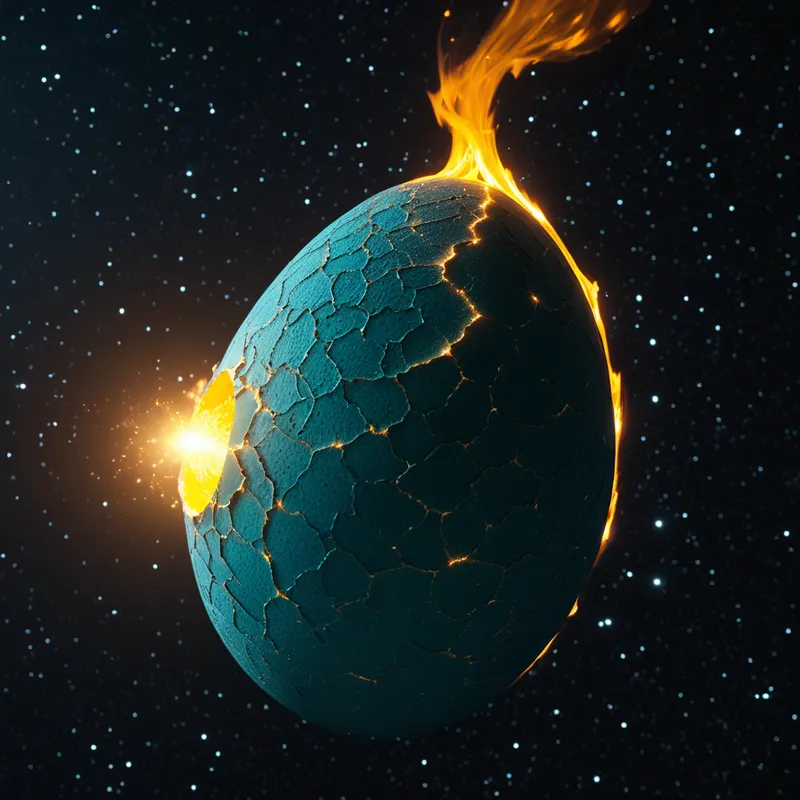
Then, a sound. A faint, crystalline crack that echoed through the void. A fissure, delicate as a spider’s thread, appeared on the luminous surface. From it spilled not liquid, but light—pure, creative, blinding light. The crack widened, a network of brilliant lines spreading across the cosmic sphere.
And from within, he emerged. Or they emerged. A being of dazzling, terrifying beauty: Phanes, the Shining One, the First-Born. He was winged, golden, and radiant, with the faces of a bull, a lion, and a god. In some tellings, he was androgynous, containing within himself the seeds of all genders and all life. In his hands, he held the scepter of the cosmos and a torch that cast the first true shadows upon the face of Chaos. With his birth, the universe gasped into being. The eggshell did not fall away to waste; its halves became the dome of the sky and the bowl of the earth. Phanes, the creator locked within the creation, set the stars in motion and began the great work of differentiation, spinning the world out from his own boundless being.
Cultural Origins & Context
This haunting creation narrative does not belong to the more familiar Olympian tradition of Hesiod. It is the heart of Orphism, a mystical, ascetic cult that flourished in the Greek world from the 6th century BCE onward. Orphics were seekers, not merely worshippers. They believed in the divine origin and tragic fall of the human soul, which they saw as a daimon imprisoned in the "tomb" of the physical body, cycling through endless reincarnations.
The myth of the Orphic Egg was their sacred cosmogony, passed down through secretive initiations, hymns, and inscribed gold tablets buried with the dead to guide their souls in the afterlife. These texts are our primary sources, fragmentary and enigmatic. The myth was not a public story for entertainment but a map of reality for the adept. It served a profound societal and psychological function: it provided a metaphysical framework that placed the individual soul (psyche) at the center of a cosmic drama of unity, fragmentation, and the arduous journey back to wholeness. In a world of polytheistic chaos, it offered a monistic origin—everything from one source, the Egg—and a path to personal salvation through purity and knowledge.
Symbolic Architecture
The Orphic Egg is perhaps the most potent symbol of primordial unity in Western esoteric thought. It represents the state before duality, the unus mundus of the alchemists, where all opposites are contained in perfect, latent harmony.
The Egg is the soul’s memory of wholeness, a perfect sphere of potential that exists both at the dawn of time and at the core of the self.
Its shell is the boundary between the unmanifest and the manifest, the unconscious and the conscious. The cracking is the necessary, traumatic act of creation—the Big Bang of the psyche. Without this rupture, there is no universe, no life, no individual consciousness, but neither is there suffering or separation. Phanes, the emergent deity, symbolizes the first spark of conscious awareness born from this unity. He is the archetypal Self in its nascent, cosmic form—androgyne, complete, and creative, holding the blueprint for all that will follow. The myth tells us that our deepest nature is not born of conflict but of a sacred, self-differentiating unity.
The Dreamer's Resonance
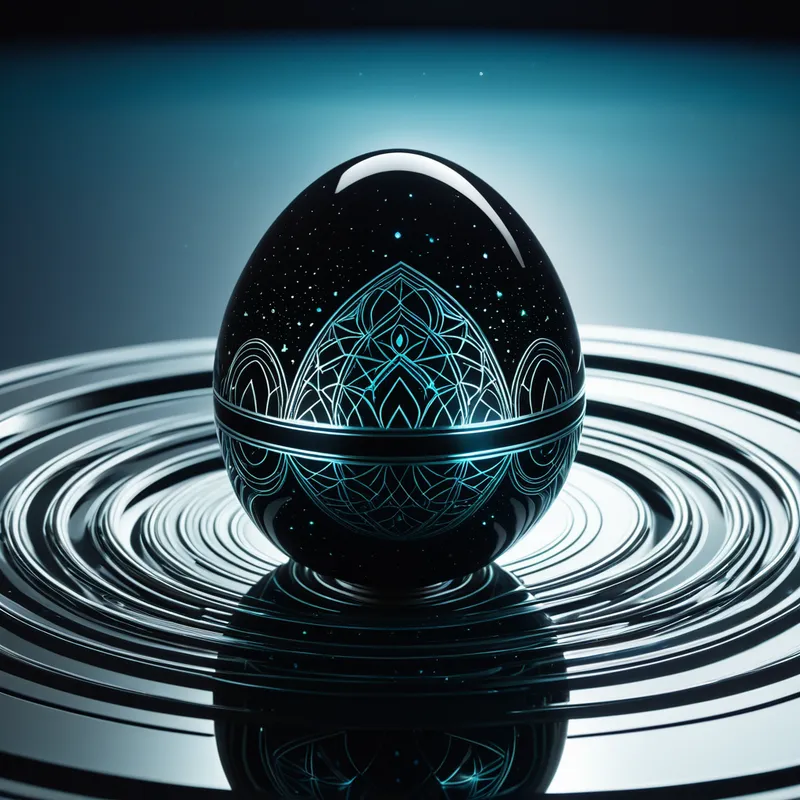
When this myth stirs in the modern unconscious, it often manifests in dreams of profound containment and emergence. You might dream of finding a mysterious, glowing egg in a dark place—a basement, a cave, the depths of space. You may feel an overwhelming sense of awe and protection toward it, or a terrifying urgency to either protect it or break it open.
Somatically, this can correlate with feelings of creative gestation or psychic pressure—a sense that something whole and new is forming within but cannot yet be named. The dream-egg can symbolize a nascent idea, a new phase of life, a healing integration of opposites (perhaps masculine and feminine energies within), or the very core of the dreamer’s identity waiting to be acknowledged. The cracking in the dream is critical. It may be peaceful or violent. This mirrors the psychological process of a latent wholeness within the psyche beginning to make itself known to the conscious ego, a process that can feel both exhilarating and deeply destabilizing, as old structures of identity must expand to accommodate this new, more complete self.
Alchemical Translation
The journey of the Orphic Egg is the model for the alchemical individuation process. It begins with the nigredo, the dark chaos of the unexamined life, where all potentials are mixed in confusion. The Egg itself represents the albedo—a state of purified, lunar potential, the silver-white shell containing the golden truth.
The work of individuation is not to create the soul, but to remember the egg from which it was born, and to consciously re-enact the sacred cracking.
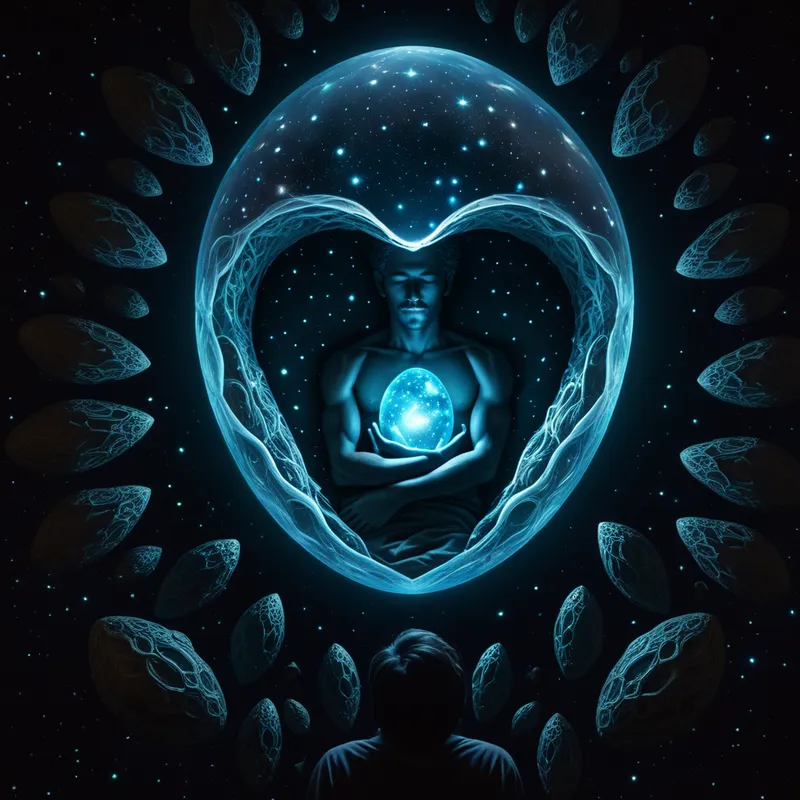
The conscious ego is not Phanes; it is a later, fragmented descendant. The alchemical task is for the ego to undertake the perilous journey back toward that center, to confront the chaos and the darkness (Nyx and Erebus), and to discover the intact, glowing egg of the Self within. To "crack" it consciously in therapy, art, or deep reflection is to allow the integrated, creative light of Phanes—the authentic, whole personality—to emerge and illuminate one’s personal cosmos. The myth assures us that fragmentation and suffering are not the original state. They are a consequence of creation. Our healing, therefore, is a sacred remembering and a deliberate re-creation, where we become both the egg and the shining being born from it, stewards of our own universe.
Associated Symbols
Explore related symbols from the CaleaDream lexicon: