Orpheus's Broken Lyre Myth Meaning & Symbolism
The divine musician Orpheus loses his love, fails to retrieve her from Hades, and is torn apart, his broken lyre a symbol of shattered harmony.
The Tale of Orpheus’s Broken Lyre
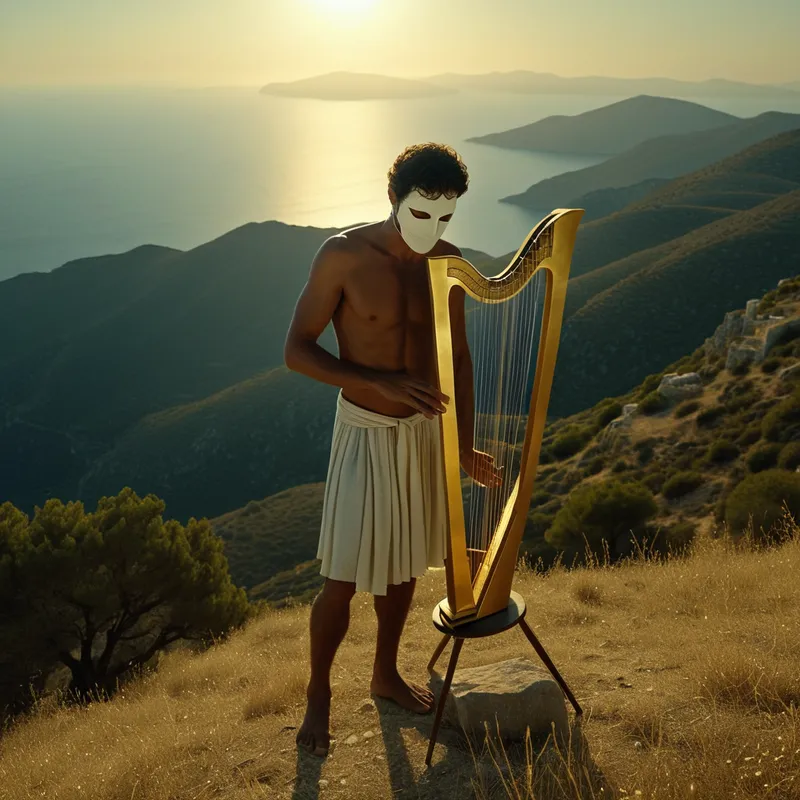
Hear now the song of the one who made the stones weep and the rivers stand still. His name was Orpheus, and his voice was a gift from the gods themselves, carried on the strings of a lyre given by Apollo. With it, he could gentle the savage heart of the beast and make the oak tree lean down to listen. His greatest harmony, however, was found not in nature, but in the eyes of a nymph named Eurydice. Their love was a perfect chord, a melody that promised to never end.
But the world is tuned to discord as well as harmony. On their wedding day, fleeing an ardent pursuer through a meadow, Eurydice stepped upon a nest of vipers. A single bite, a gasp, and the color fled her cheeks. The song was severed. Orpheus held her cooling form, and his lament was so pure in its agony that even the Demeter paused in her eternal sorrow to hear it.
Driven by a love that refused silence, Orpheus did what no living soul had dared. He descended the path to Hades. His music was his passport. He sang to Charon, who wept rusty tears and poled him across the Styx. He played for Cerberus, and the beast lay down, all three heads dreaming. In the throne room of shadows, before the pale king Hades and his queen Persephone, he poured out his grief. He sang of the emptiness of the sun without its shadow, of the silence that follows the last note. His song was so potent it softened the iron heart of death itself. Hades consented. Eurydice could follow him back to the world of light, on one condition: he must not look back at her until they both stood fully under the sun.
The ascent was a torment of silence and hope. Orpheus led, hearing only the faintest whisper of a footfall behind him. Was it her? Was it the echo of his own desperate heart? The darkness began to thin; a sliver of real light pierced the gloom ahead. In that moment, doubt, that serpent of the mind, struck deeper than any viper. Was she there? Had the lords of the dead tricked him? At the very threshold of life, as the sweet air touched his face, he turned.
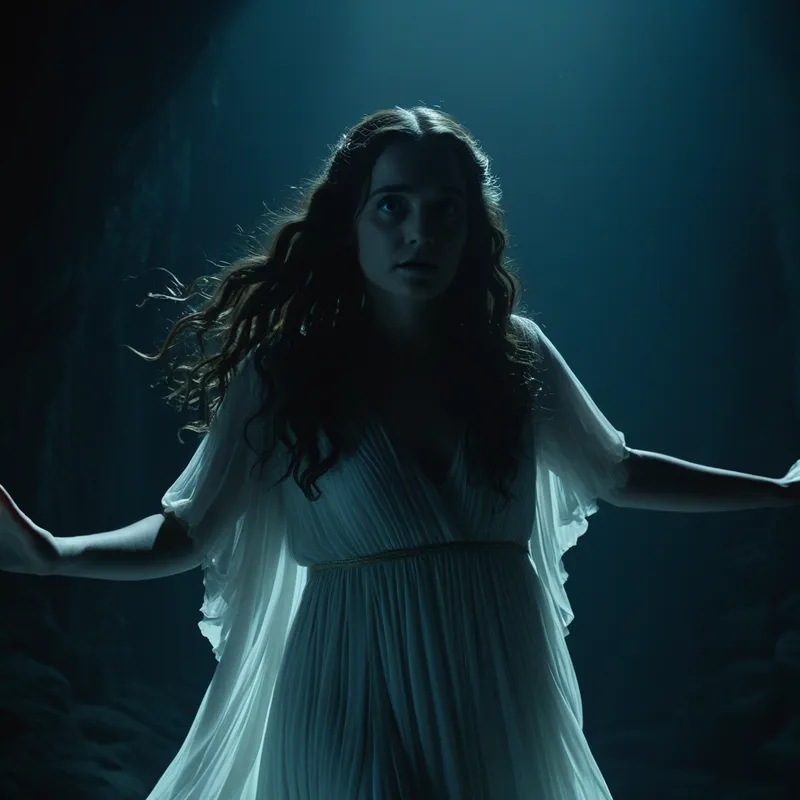
He saw her for a fleeting second—her eyes wide with love and sudden, devastating understanding. Then, as if pulled by a great wind, she was drawn back into the depths, her form dissolving into the gloom, her whisper of “Farewell” the last note of their song. His hand clutched at empty air.
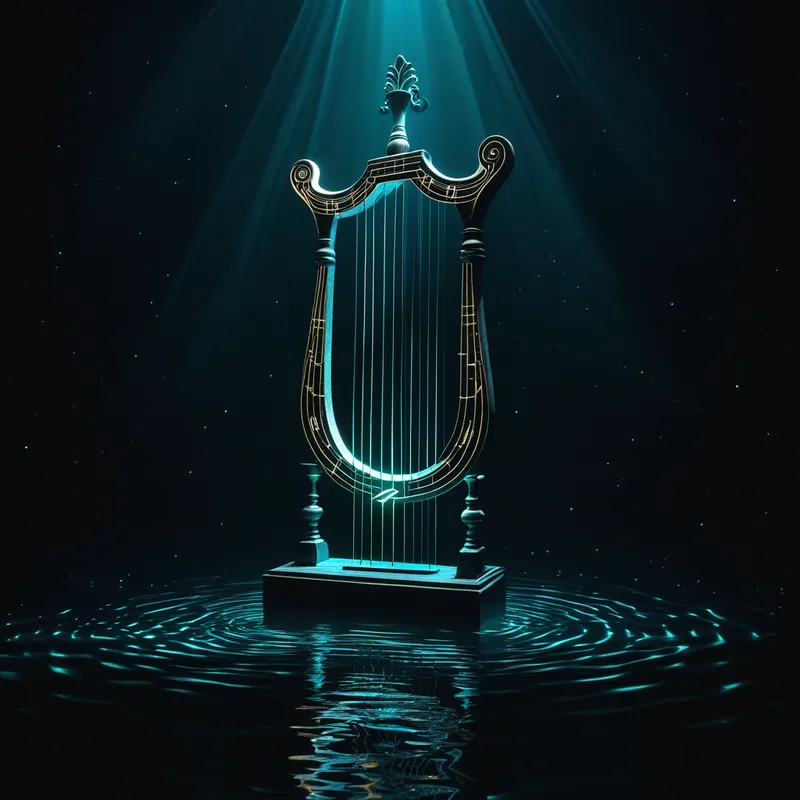
He was alone. He wandered the world after that, a hollow man. His music remained, but it sang only of loss. It drew the wild Maenads, who in their frenzied state, demanded a song of joy. He offered them only dirges. Enraged, they fell upon him, and the man who had charmed all of nature was torn asunder by mortal hands. His head and his lyre were cast into the river Hebrus. As they floated downstream, the lips of the severed head were said to still whisper “Eurydice,” and the broken lyre, its strings snapped, echoed the final, shattered chord of a love that reached into death and was undone by a human glance.
Cultural Origins & Context
The myth of Orpheus is one of the most layered and enduring in the Greek tradition. Unlike the tales of Olympian feuds or heroic labors, it is fundamentally a poet’s myth, concerned with the power of art, the fragility of the human condition, and mysteries beyond the grave. Its primary sources are fragmentary but powerful, found in the works of poets like Hesiod and later, most comprehensively, in the Roman poet Ovid’s Metamorphoses and the poet Virgil’s Georgics.
The myth was not merely entertainment; it was the foundational narrative for the Orphic Mysteries, a secretive religious movement that promised initiates a better fate in the afterlife through purification and knowledge. In this context, Orpheus was a theologian, a revealer of sacred truths. His katabasis (descent into the underworld) modeled the soul’s own journey, and his failure served as a warning about the perils of doubt and attachment. The myth was performed, sung, and ritualized, functioning as a societal vessel for exploring the most profound anxieties about love, death, and what, if anything, of the individual’s beautiful song persists after the body is broken.
Symbolic Architecture
The broken lyre is the central, resonant symbol of the entire drama. It represents the shattering of cosmic and personal harmony. Orpheus’s music initially symbolizes the unifying, logos-like principle of the cosmos—the power of art and consciousness to order chaos, to persuade, to create meaning. The breaking of the lyre signifies the intrusion of an irreversible, tragic reality into that ordered world.
The glance over the shoulder is not a mistake of navigation, but the soul’s inevitable turn toward the ghost of its own unfinished story.
Orpheus himself is the archetype of the artist whose art is born from and speaks to the deepest wounds. His journey is not one of physical strength but of persuasive beauty. His failure is profoundly human; it is not a failure of love, but a failure of faith—in the divine decree, in the unseen, in the promise itself. Eurydice symbolizes the anima, the soul-image, the ultimate value that feels both intimately ours and eternally separate, that which we can momentarily retrieve from the unconscious but cannot hold onto through conscious will alone. The Underworld is not just a place of punishment, but the unconscious itself, the realm of memory, trauma, and lost potentials.
The Dreamer’s Resonance
When this myth stirs in the modern dreamer, it often manifests as a profound somatic experience of irreversible loss or a fatal mistake. One might dream of finally retrieving a lost, precious object or reuniting with a beloved figure, only to watch it vanish upon the moment of waking or by breaking a simple, inexplicable rule. The feeling upon awakening is one of crushing, resonant grief, often disproportionate to the dream’s events.
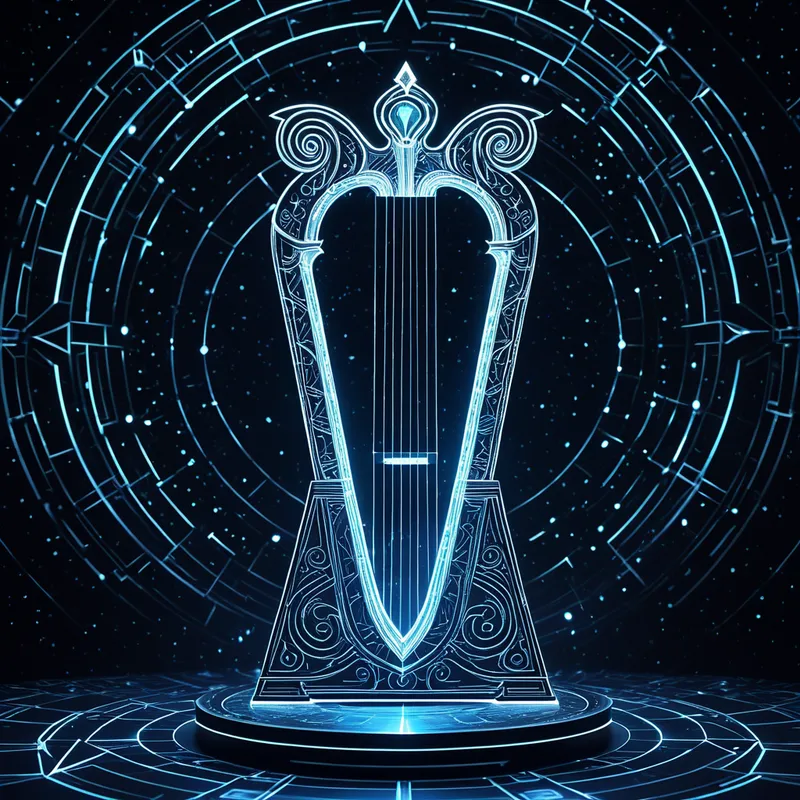
Psychologically, this signals a process of confronting a “point of no return.” It is the psyche working through a past trauma, a severed relationship, or a life path not taken, where the central wound is the knowledge that a different choice could have been made. The dream is not about changing the past, but about finally feeling the full weight of its finality. The broken lyre in a dream—a shattered instrument, a silent speaker, a fractured mirror—points to a part of the self that feels its creative or connective power has been fundamentally damaged by this loss. The process is one of mourning, not to repair the lyre to its original state, but to hear the new, more complex music its fractures now allow.
Alchemical Translation
The alchemical journey of Orpheus models the nigredo, the blackening, of the soul—the necessary descent into the darkest material of one’s being. His initial art represents the pristine, unconscious unity of the unio mentalis. The loss of Eurydice forces the separatio, the crushing division between consciousness and its deepest value. The descent is the courageous solutio, dissolution into the waters of the unconscious to seek reunion.
The gold is not in the retrieval of the lost object, but in the song that is born from the acknowledgment that it is truly, irrevocably gone.
His failure at the threshold is the critical moment of mortificatio, the symbolic death. He looks back because the conscious ego cannot fully trust the processes of the unconscious; it must “see” to believe, and in that seeing, it loses the transformative prize. His dismemberment is the ultimate separatio, the total breaking apart of the old identity. The alchemical promise, however, lies in the aftermath. His head and lyre continue to sing. This is the coniunctio achieved on a higher level: the conscious mind (the head) and its creative spirit (the lyre) are purified by their dissolution in the river of life (the Hebrus). They are broken apart from the mortal body but not silenced. For the modern individual, the myth teaches that our deepest wounds and failures are not the end of our song. The work of individuation is to gather the scattered fragments of that broken lyre—the memories, the regrets, the loves lost—and from them, fashion not a restoration, but a new instrument capable of a more tragic, wiser, and ultimately more resonant music. The wholeness sought is not a return to a naive paradise, but an integration that includes the fracture lines as essential features of the design.
Associated Symbols
Explore related symbols from the CaleaDream lexicon: