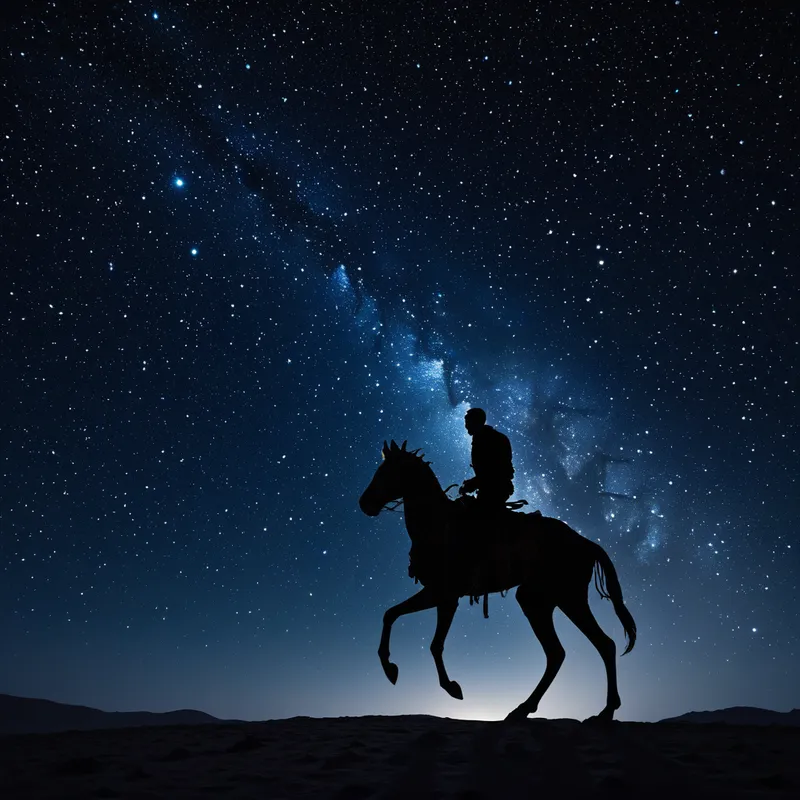
Orion's Belt Myth Meaning & Symbolism
The hunter Orion, beloved by Artemis, is slain by a scorpion's sting and immortalized as a constellation by the grieving gods.
The Tale of Orion’s Belt
Listen, and let the night sky tell its oldest story. It begins not with a whisper, but with a boast that shook the very foundations of [the earth](/myths/the-earth “Myth from Hindu culture.”/). His name was [Orion](/myths/orion “Myth from Greek culture.”/), a colossus born of [the sea](/myths/the-sea “Myth from Greek culture.”/) and [the sky](/myths/the-sky “Myth from Persian culture.”/), whose stride could cross mountains and whose hands could tame any beast. He walked [the world](/myths/the-world “Myth from Tarot culture.”/) with a club of solid oak and a heart as untamed as the wilds he hunted.
His prowess drew the eye of Artemis, the virgin goddess who knew the secret paths of every forest. She, who spurned the company of men, found in Orion a kindred spirit. Together, they roamed the twilight realms, their arrows singing the same tune, a divine harmony between hunter and huntress. For a time, the world was their sacred grove. But the heart of a giant is a restless [thing](/myths/thing “Myth from Norse culture.”/). Flushed with power and the favor of a goddess, Orion’s pride swelled like a storm cloud. On the sun-drenched island of Chios, he stood before King Oenopion and made a fateful vow. “I will clear this island of every wild beast,” he declared, his voice echoing with hubris. “No creature that walks, crawls, or flies shall remain.”
He very nearly succeeded. The earth grew quiet under his shadow. But such an absolute claim is a challenge thrown at the feet of [the Fates](/myths/the-fates “Myth from Greek culture.”/). It was heard by Gaia, the Earth Mother herself, who stirred in her deep slumber. She would not suffer one of her children to boast of laying her bounty utterly bare. From the scorched rocks and the hidden crevices, she summoned her answer: a single, perfect scourge. A scorpion, armored in night, its stinger a droplet of primordial venom.
The battle was not of clashing titans, but of fatal touch. Orion’s club was useless against the creature that struck at his heel. The sting was not merely poison; it was the Earth’s rebuttal. The mighty hunter fell, his great strength seeping into the soil from which he came. Artemis found him thus, her companion laid low not by a noble beast, but by a creeping, silent [justice](/myths/justice “Myth from Tarot culture.”/). Her grief was a cold fire, a silent scream that reached the throne of her brother, Zeus.
Moved by the tragedy—[the fall](/myths/the-fall “Myth from Biblical culture.”/) of the great, the grief of the divine—Zeus acted. But the scorpion, too, had acted in service to the natural order. And so, the lord of Olympus performed a celestial compromise, a divine arbitration of memory and balance. With a gesture, he placed the giant hunter among the eternal lights. But he did not place him alone. There, in the winter sky, Orion forever flees, his belt of three stars—Alnitak, Alnilam, and Mintaka—gleaming like frozen tears. And forever at his heel, rising as he sets, is the constellation Scorpius, the eternal pursuer. The friendship, the pride, the sting, and the grief—all were translated into a story written in starlight, a myth hung upon the black velvet of night for all time.
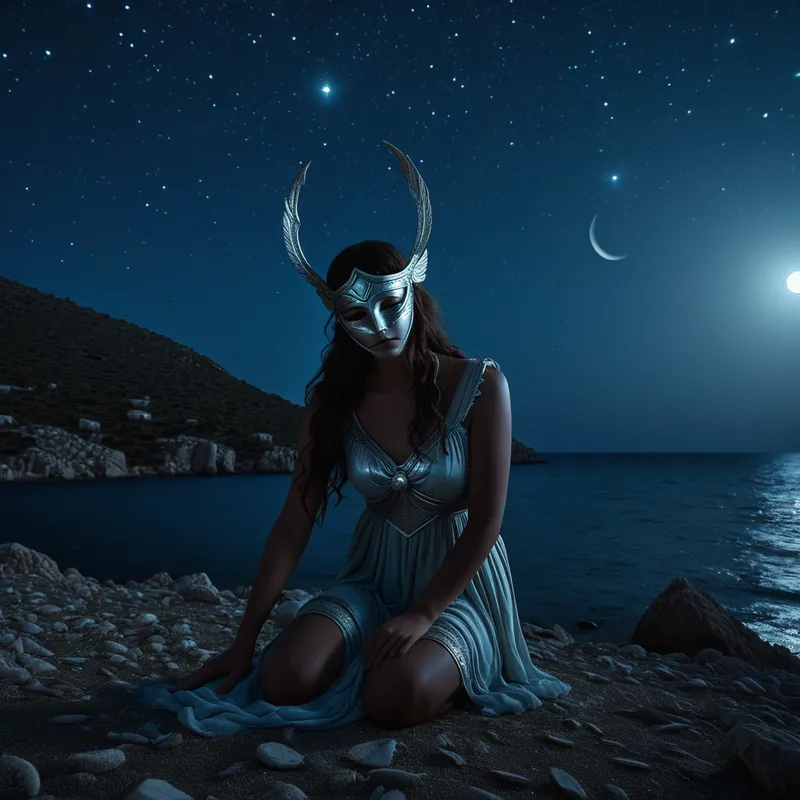
Cultural Origins & Context
The myth of Orion is not a single, canonical text, but a tapestry woven from many looms. It appears in fragments in the works of Hesiod, is recounted by the Alexandrian poet Apollonius of Rhodes, and finds its most detailed, though varied, forms in the later compilations of mythographers like Hyginus and the traveler Pausanias. This very variability speaks to its origin as an oral tradition, a story told by sailors navigating by his stars, by shepherds watching his seasonal march, and by poets seeking to explain the majestic, fearful patterns overhead.
Its societal function was multifaceted. For a practical, seafaring culture, Orion’s heliacal rising and setting were crucial calendrical markers, signaling the coming of storms and the seasons for planting and sailing. The myth provided an aition—a cause—for this celestial phenomenon. But on a deeper level, it served as a profound moral and cosmological lesson. It illustrated the peril of hubris, even for those favored by the gods. It demonstrated the immutable balance of nature (Gaia’s revenge) and the ultimate authority of the cosmic order (Zeus’s judgment). The stars were not random dots; they were a divine court of record, a permanent memorial to the dramas that define the human—and superhuman—condition.
Symbolic Architecture
At its core, the myth of Orion’s Belt is an archetypal [drama](/symbols/drama “Symbol: Drama signifies narratives, emotional expression, and the exploration of human experiences.”/) of the [psyche](/myths/psyche “Myth from Greek culture.”/)’s encounter with its own limits. Orion represents the potent, undifferentiated [energy](/symbols/energy “Symbol: Energy symbolizes vitality, motivation, and the drive that fuels actions and ambitions.”/) of the [Animus](/symbols/animus “Symbol: In Jungian psychology, the masculine inner personality in a woman’s unconscious, representing logic, action, and spiritual guidance.”/) in its raw, heroic form: the drive for conquest, mastery, and total control over one’s environment (the clearing of the [island](/symbols/island “Symbol: An island represents isolation, self-reflection, and the need for separation from the external world.”/)). His belt, those three fixed stars, symbolizes a [moment](/symbols/moment “Symbol: The symbol of a ‘moment’ embodies the significance of transient experiences that encapsulate emotional depth or pivotal transformations in life.”/) of crystallization, an [identity](/symbols/identity “Symbol: Identity represents the sense of self, encompassing personal beliefs, cultural background, and social roles.”/) forged and then frozen.
The belt is not a weapon, but a marker. It signifies the point where ambition becomes definition, and definition becomes a cage.
Artemis represents the related but distinct principle of instinctual, focused wildness—a [consciousness](/symbols/consciousness “Symbol: Consciousness represents the state of awareness and perception, encompassing thoughts, feelings, and experiences.”/) in [harmony](/symbols/harmony “Symbol: A state of balance, agreement, and pleasing combination of elements, often associated with musical consonance and visual or social unity.”/) with [nature](/symbols/nature “Symbol: Nature symbolizes growth, connectivity, and the primal forces of existence.”/), not at war with it. Their [alliance](/symbols/alliance “Symbol: A formal or informal union between individuals or groups for mutual benefit, support, or protection.”/) is the potential for a conscious [integration](/symbols/integration “Symbol: The process of unifying disparate parts of the self or experience into a cohesive whole, often representing psychological wholeness or resolution of internal conflict.”/) of power and instinct. The shattering of this [alliance](/symbols/alliance “Symbol: A formal or informal union between individuals or groups for mutual benefit, support, or protection.”/) by Orion’s hubris is inevitable. The [scorpion](/symbols/scorpion “Symbol: A venomous arachnid symbolizing danger, hidden threats, and potent transformation. Often represents repressed anger or deep-seated fears.”/), sent by Gaia, is the [symbol](/symbols/symbol “Symbol: A symbol can represent an idea, concept, or belief, serving as a powerful tool for communication and understanding.”/) of the [Shadow](/symbols/shadow “Symbol: The ‘shadow’ embodies the unconscious, repressed aspects of the self and often represents fears or hidden emotions.”/) in its most elemental and autonomous form. It is the unconscious backlash, the ignored [truth](/symbols/truth “Symbol: Truth represents authenticity, honesty, and the quest for knowledge beyond mere appearances.”/) of limitation that rises from the “[earth](/symbols/earth “Symbol: The symbol of Earth often represents grounding, stability, and the physical realm, embodying a connection to nature and the innate support it provides.”/)” of one’s own being to deliver a fatal correction. The sting is not [punishment](/symbols/punishment “Symbol: A dream symbol representing consequences for actions, often tied to guilt, societal rules, or internal moral conflicts.”/) from an external god, but the psychic catastrophe that occurs when [the ego](/myths/the-ego “Myth from Jungian culture.”/) identifies completely with its own heroic [persona](/symbols/persona “Symbol: The social mask or outward identity one presents to the world, often concealing the true self.”/), declaring itself sovereign over the entire inner [landscape](/symbols/landscape “Symbol: Landscapes in dreams are powerful symbols representing the dreamer’s emotional state, personal journey, and the broader context of life situations.”/).
Zeus’s act of catasterism—placing them in the stars—represents the transcendent function. The conflict is not resolved, but sublimated. It is moved to a higher [plane](/symbols/plane “Symbol: Dreaming of a plane often symbolizes a desire for freedom, adventure, and new possibilities, as well as transitions in life.”/) of existence, transformed from a personal tragedy into an eternal, objective [pattern](/symbols/pattern “Symbol: A ‘Pattern’ in dreams often signifies the underlying structure of experiences and thoughts, representing both order and the repetitiveness of life’s situations.”/). The [hero](/symbols/hero “Symbol: A hero embodies strength, courage, and the ability to overcome significant challenges.”/) and his [nemesis](/symbols/nemesis “Symbol: The Greek goddess of retribution and divine justice, representing inevitable consequences for hubris and moral imbalance.”/) are both honored and imprisoned within a cosmic order greater than themselves.
The Dreamer’s Resonance
When the pattern of Orion’s Belt appears in a modern dream—whether as three lights, three stones, three figures, or the specific constellation—it often signals a profound somatic and psychological process of reckoning with a fixed identity. The dreamer may be experiencing the culmination of a long period of striving, success, or a rigidly maintained self-image (the “hunter” [persona](/myths/persona “Myth from Greek culture.”/)).
The somatic sensation can be one of impressive, yet brittle, stature—a feeling of being “larger than life” but with a lurking vulnerability in the heel, the foundation. The dream may introduce a “scorpion” element: a small, overlooked detail, a forgotten commitment, a repressed emotion, or a sudden betrayal that threatens to topple the entire self-structure. This is the psyche’s attempt to correct a course, to introduce the necessary poison that dissolves hubris.
To dream of being Orion is to confront the cost of one’s own ambitions. To dream of the belt alone is to encounter the symbol of one’s own achieved, yet potentially limiting, position. The eternal chase in the sky mirrors an internal loop the dreamer is caught in—a pattern of pursuit and avoidance where a core shadow aspect (the scorpion) perpetually challenges a core identity ([the hunter](/myths/the-hunter “Myth from African culture.”/)).
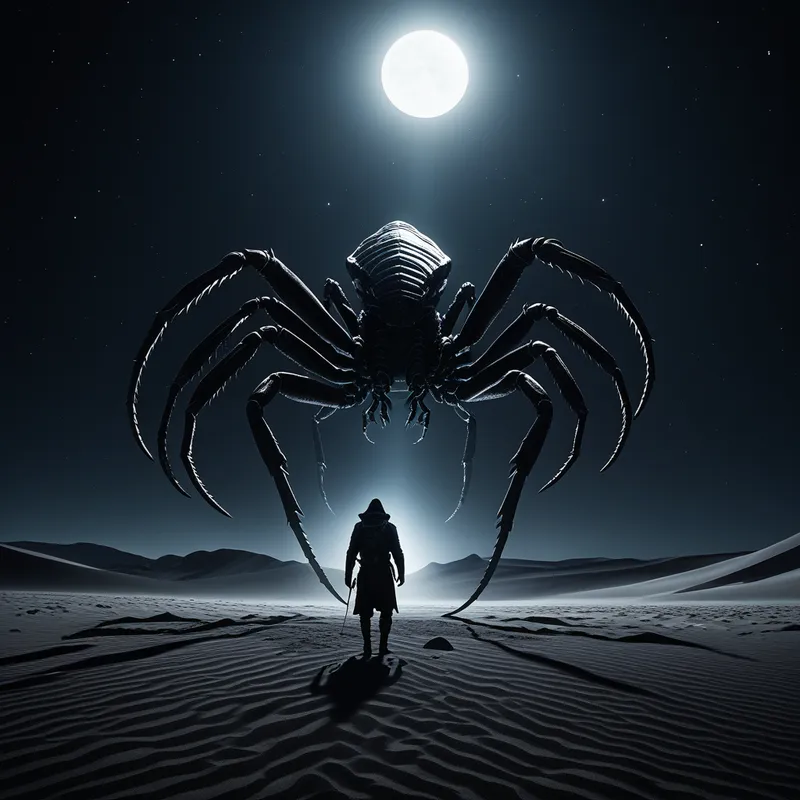
Alchemical Translation
The myth models the alchemical process of psychic transmutation, or individuation, with stark clarity. Orion begins in a state of [nigredo](/myths/nigredo “Myth from Alchemical culture.”/)—the blackening, not of despair, but of undifferentiated, chaotic potential (the giant born of primordial forces). His alliance with Artemis represents a kind of albedo, a silver lunar consciousness that refines and directs his raw power. His hubris on Chios is the failed [rubedo](/myths/rubedo “Myth from Alchemical culture.”/), the reddening or inflation where the ego mistakes its partial integration for total mastery. It is a pseudo-gold, an arrogance that must be shattered.
The true gold is not in the hunter’s conquest, but in the celestial pattern his story ultimately forms. Individuation is not about winning the battle, but about having one’s entire struggle—victories, flaws, and nemeses—recognized and reconstituted as part of a meaningful, universal order.
The scorpion’s sting is the necessary mortificatio, the death of the inflated ego. This is not an end, but the crucial dissolution that makes transformation possible. Zeus’s act is the sublimatio: the raising of the conflict to a symbolic level. For the modern individual, this translates to the process of moving from identifying as the hero (or the victim) of one’s story, to becoming the witness to the entire archetypal drama playing out within.
The three stars of the belt become symbolic of the threefold nature of the integrated Self: the conscious position, the unconscious counterpart, and the transcendent function that holds them in tension. One does not defeat one’s scorpion; one learns to see it, and oneself, as eternal, complementary figures in the grand constellation of the soul. The goal is not to stop the chase, but to understand its celestial necessity, to find the awe in the fact that our deepest struggles are, in the end, what make us shine.
Associated Symbols
Explore related symbols from the CaleaDream lexicon: