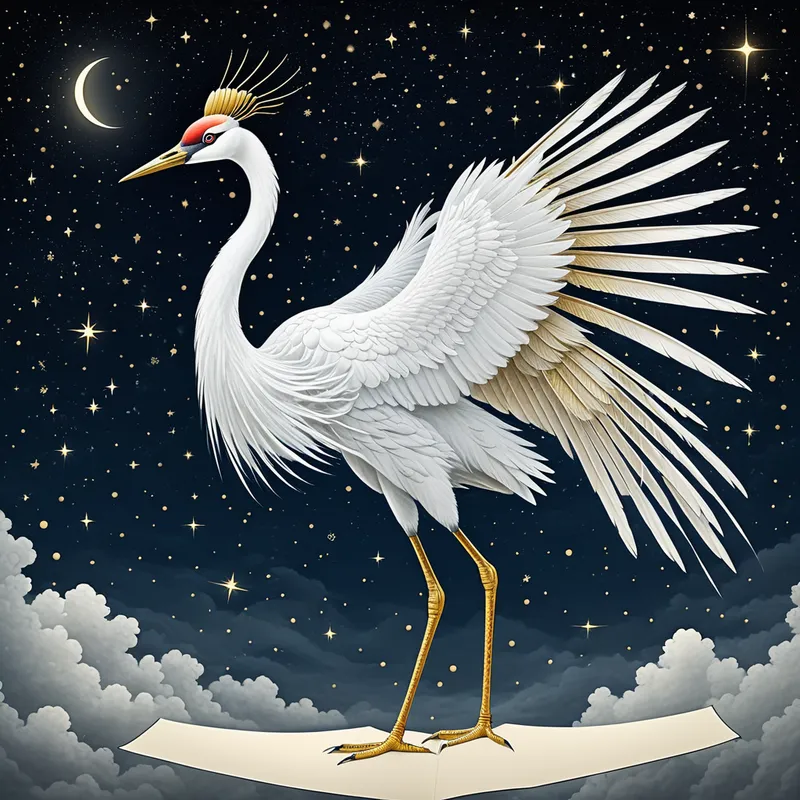
Origami Tsuru Myth Meaning & Symbolism
A myth of a mortal who becomes a thousand paper cranes, embodying the soul's journey through sacrifice, transformation, and ultimate flight beyond form.
The Tale of Origami Tsuru
In the time when [the world](/myths/the-world “Myth from Tarot culture.”/) was still a whisper between the mountains and [the sea](/myths/the-sea “Myth from Greek culture.”/), there lived a humble paper-maker named Kamiya. His hands were calloused from the vat, his back bent from the sun, but his spirit was as clear as the stream where he washed the mulberry bark. He lived in a small village shadowed by a great, sorrowful mountain, a place where [the wind](/myths/the-wind “Myth from Various culture.”/) did not sing but sighed, for the mountain was home to a lonely, earth-bound kami of stone and root. This spirit, once a guardian of flight and sky, had been wounded in an age-old clash of elements, its wings turned to granite, its song to the grinding of rocks.
One autumn, as the leaves bled crimson, a profound stillness fell. [The river](/myths/the-river “Myth from Buddhist culture.”/) slowed. The birds fell silent. The villagers grew weak, their vitality seeping into the hungry earth. The mountain kami was fading, and with it, the soul of the land. The village elder spoke of an ancient prophecy: only a sacrifice of perfect, non-utilitarian creation could mend a broken spirit. Not a tool, not a weapon, but a [thing](/myths/thing “Myth from Norse culture.”/) of beauty made with absolute selflessness, offered not to the gods, but for the god.
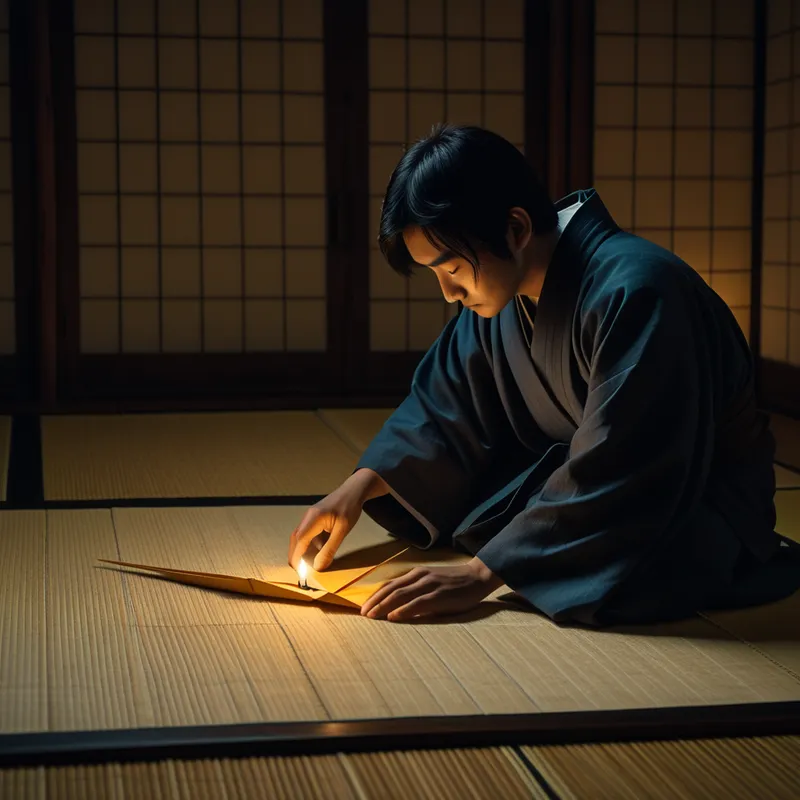
Kamiya knew. The knowledge settled in his bones like a chill. He looked at his strong hands, made for pulling life from pulp. He looked at his stores of precious, flawless washi paper. He went to the silent stream, and under the weeping willow, he began to fold.
He did not eat. He barely slept. His world shrank to [the square](/myths/the-square “Myth from Platonic culture.”/) of paper and the dance of his fingers. He folded not with ambition, but with devotion. The first crane was clumsy. The tenth was better. The hundredth held a ghost of grace. As he folded, he poured into each crease not just technique, but a memory: the laughter of his child, the scent of plum blossoms, the coolness of dawn. He was unfolding his own soul, pleat by pleat.
His body grew thin as parchment. His vision blurred. At nine hundred and ninety-nine cranes, he was a wraith, sustained only by the act itself. With the last of his breath, the final fold of the one-thousandth crane, he did not see a bird of paper. He saw the essence of flight, the memory of the mountain kami’s freedom. He smiled, a dry rustle of leaves, and his form dissolved—not into death, but into a cascade of a thousand pure white cranes.
The paper birds did not rest. They rose as one, a silent, swirling storm of folded hope. They flew to the sorrowful mountain, and where they landed, the stone softened. Granite feathers became real. The grinding roar became a cry—a beautiful, piercing crane’s call that shattered the stillness. The mountain kami, its wings restored, surged from the rock, and the thousand cranes merged with its form, becoming the living pattern on its majestic wings. Life rushed back into the stream, the trees, the people. Where Kamiya had sat, only a single, perfect sheet of paper remained, blank, waiting.
Cultural Origins & Context
The myth of the [Origami](/myths/origami “Myth from Japanese culture.”/) [Tsuru](/myths/tsuru “Myth from Japanese culture.”/) is a mukashibanashi that finds its roots not in the grand imperial chronicles like the Kojiki, but in the intimate, oral traditions of artisans and villagers. It is a story born from the very materials it venerates: paper and the act of folding. Historically, paper (kami) in Japan has been sacred, intrinsically linked to Shinto rituals where it is used to denote purity and to attract benevolent spirits, as seen in shimenawa and shide.
[The crane](/myths/the-crane “Myth from Japanese culture.”/) (tsuru) has long been a symbol of longevity, good fortune, and fidelity. The practice of folding a thousand paper cranes (senbazuru) is a more modern, 20th-century tradition often associated with prayers for healing and peace, famously embodied by Sadako Sasaki. The ancient myth we discuss here is the spiritual and symbolic precursor to this practice. It was likely told among paper-making communities and jinja attendants, serving a societal function that was both pedagogical and psychological. It taught the value of dedicating one’s craft to something greater than oneself and framed the ultimate act of creation as one that requires the dissolution of the egoistic creator.
Symbolic Architecture
At its [heart](/symbols/heart “Symbol: The heart symbolizes love, emotion, and the core of one’s existence, representing deep connections with others and self.”/), this myth is an alchemical map of [consciousness](/symbols/consciousness “Symbol: Consciousness represents the state of awareness and perception, encompassing thoughts, feelings, and experiences.”/). The [protagonist](/symbols/protagonist “Symbol: The central character or hero in a narrative, representing the dreamer’s ego, agency, or the part of the self navigating life’s challenges.”/), Kamiya, represents the conscious ego—the craftsman of [identity](/symbols/identity “Symbol: Identity represents the sense of self, encompassing personal beliefs, cultural background, and social roles.”/). The wounded [mountain](/symbols/mountain “Symbol: Mountains often symbolize challenges, aspirations, and the journey toward self-discovery and enlightenment.”/) kami symbolizes the deep, neglected [aspect](/symbols/aspect “Symbol: A distinct feature, quality, or perspective of something, often representing a partial view of a larger whole.”/) of [the Self](/myths/the-self “Myth from Jungian culture.”/), the archetypal [spirit](/symbols/spirit “Symbol: Spirit symbolizes the essence of life, vitality, and the spiritual journey of the individual.”/) of [nature](/symbols/nature “Symbol: Nature symbolizes growth, connectivity, and the primal forces of existence.”/) and instinct that has become petrified, dragging the entire “psychic ecosystem” (the [village](/symbols/village “Symbol: Symbolizes community, connection, and a reflection of one’s roots or origins.”/)) into stagnation.
The sacrifice demanded is not of life, but of the form of life. The ego must be willing to translate its substance—its memories, its love, its very identity—into a new medium, to be folded into oblivion for the sake of a greater whole.
The paper is the pliable substance of the [soul](/symbols/soul “Symbol: The soul represents the essence of a person, encompassing their spirit, identity, and connection to the universe.”/), the [prima materia](/myths/prima-materia “Myth from Alchemical culture.”/) of the [psyche](/myths/psyche “Myth from Greek culture.”/). The act of folding is the disciplined, repetitive work of introspection and conscious [effort](/symbols/effort “Symbol: Effort signifies the physical, mental, and emotional energy invested toward achieving goals and personal growth.”/). The one thousand cranes are not a random [number](/symbols/number “Symbol: Numbers in dreams often symbolize meaning, balance, and the quest for understanding in the dreamer’s life, reflecting their mental state or concerns.”/); in East [Asian](/symbols/asian “Symbol: The term ‘Asian’ in dreams can represent cultural identity, diversity, and a connection with specific traits or values associated with Asian cultures.”/) [numerology](/symbols/numerology “Symbol: The study of numbers’ mystical significance, suggesting divine patterns, life paths, and hidden meanings in numerical sequences.”/), it signifies a [magnitude](/symbols/magnitude “Symbol: A measure of scale, intensity, or importance, often reflecting one’s perception of significance, impact, or overwhelming force in life.”/) beyond the ordinary, a complete and perfected [effort](/symbols/effort “Symbol: Effort signifies the physical, mental, and emotional energy invested toward achieving goals and personal growth.”/). The transformation—from man, to cranes, to the [pattern](/symbols/pattern “Symbol: A ‘Pattern’ in dreams often signifies the underlying structure of experiences and thoughts, representing both order and the repetitiveness of life’s situations.”/) on the kami’s wings—illustrates a profound [truth](/symbols/truth “Symbol: Truth represents authenticity, honesty, and the quest for knowledge beyond mere appearances.”/): [the ego](/myths/the-ego “Myth from Jungian culture.”/) does not die, but is subsumed. It becomes an integral, beautiful part of the restored Self, losing its isolated identity to gain cosmic participation.
The Dreamer’s Resonance
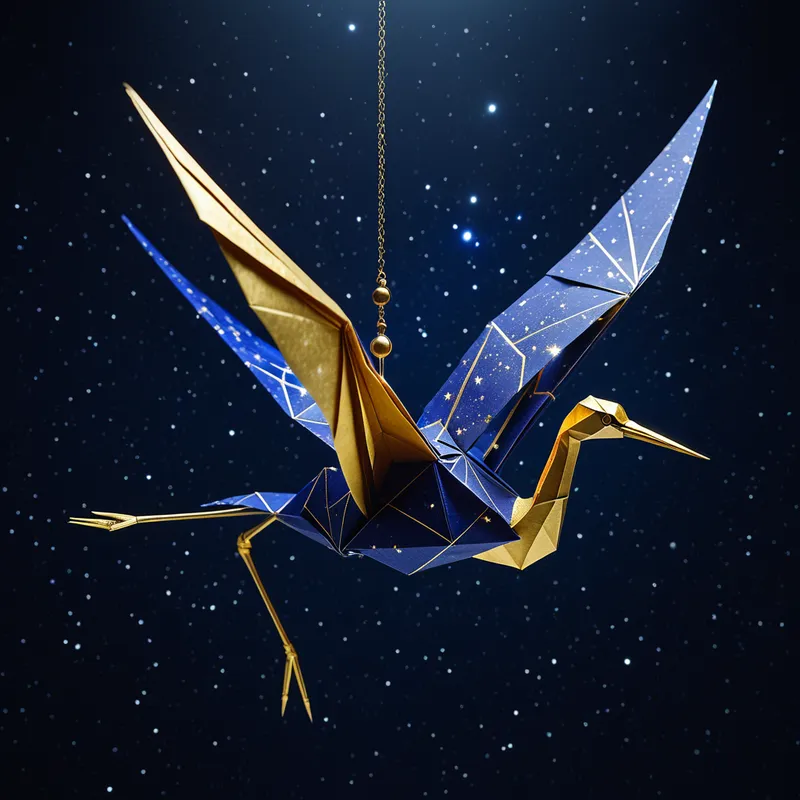
When this myth pattern stirs in the modern dreamer, it often manifests as dreams of intricate, compulsive making. One might dream of folding countless small objects, weaving an endless tapestry, or writing the same word over and over. There is a somatic quality of exhaustion paired with determination. The dream-ego is engaged in a process of active surrender.
Psychologically, this signals a critical phase in what Carl Jung called the transcendent function—the psyche’s drive to reconcile opposites. The conscious attitude has become insufficient; it is “fading,” like the village. The dream is presenting the solution: the ego must willingly engage in a creative, self-emptying ritual. The frustration in the dream mirrors the sacrifice. The dreamer is not being asked to physically die, but to allow their current self-concept to be deconstructed and repurposed by a deeper, archetypal force (the mountain kami/Self). The resolution, if the process is embraced, might be a subsequent dream of miraculous flight or the healing of a barren landscape.
Alchemical Translation
For the individual on the path of individuation, the myth of the Origami Tsuru models the final, terrifying, and glorious stage of psychic transmutation: the sublimation of the ego into the service of the Self.
The first stages are clear: recognizing the stagnation (the dying village), hearing the call of the neglected Self (the prophecy), and committing to the work (Kamiya’s decision). The long, arduous folding is the analysis, [the shadow](/myths/the-shadow “Myth from Jungian culture.”/) work, the relentless examination of complexes—each crane a small insight, a released memory, a healed wound. It is repetitive, often feels endless, and depletes the energy once invested in maintaining the [persona](/myths/persona “Myth from Greek culture.”/).
The crisis point arrives at the 999th crane. This is the brink of the nigredo, where the ego, having given everything, faces its own annihilation. It must make the final fold—the ultimate act of trust—with no guarantee of personal survival.
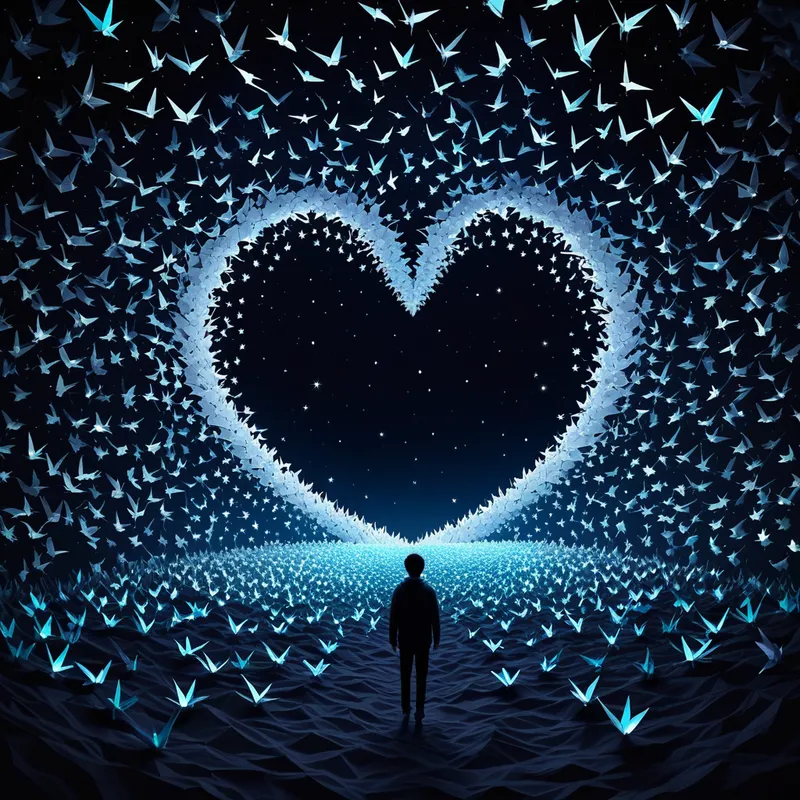
This is the alchemical [solutio](/myths/solutio “Myth from Alchemical culture.”/): dissolution. The ego-structure dissolves, not into chaos, but into a swarm of liberated essences (the cranes). These are the integrated parts of the personality, now free to coalesce into a new, archetypal configuration. The individual does not become a god (the mountain kami). Instead, their life’s work, their refined consciousness, becomes the living, beautiful pattern on the wings of the divine. The individual will to live becomes aligned with the transpersonal will of the Self. One’s life is no longer a standalone statement, but an essential, graceful contribution to the movement of something vast and eternal. The blank sheet left behind is not an emptiness, but the pure potential from which the next cycle of creation—now guided by the restored Self—can begin.
Associated Symbols
Explore related symbols from the CaleaDream lexicon: