
Origami Cranes Myth Meaning & Symbolism
A story of a humble girl's thousand paper cranes, a plea to the gods, and the alchemy of patience into a promise of healing and eternal return.
The Tale of Origami Cranes
Listen. There is a whisper in the rustle of paper, a story folded into the very grain of being.
In a time when the world was closer to the kami, the spirits that dwell in rock and river, there lived a girl named Tsuru. Her name was the word for crane, but her body was frail, a vessel of breath and bone too delicate for the harsh winds of the world. A sickness had taken root in her, a shadow that dimmed her light with each passing season. The village healer could do nothing; the local shrine’s prayers seemed to dissipate like morning mist.
One night, as a cold moon silvered the tatami mats, a vision came to her in the space between sleep and waking. It was Amaterasu-Ōmikami herself, not in her blazing solar chariot, but as a gentle, radiant warmth that filled the room. With her was the messenger of the gods, a majestic, snow-white crane. The crane spoke not with sound, but directly into Tsuru’s heart.
“The gods hear the sincere plea,” the vision conveyed. “But a prayer must be made with the hands as well as the heart. Your spirit is willing, but your body is weak. Transmute your fragility. Take that which is flat and lifeless—paper—and with your own breath and intention, give it the form of life. Fold one thousand of my likeness. With each crease, you fold a fragment of your suffering into hope. With each completed form, you build a ladder of devotion. Upon the one-thousandth, we will answer.”
The vision faded, leaving only a single, perfect square of pure white paper beside her pillow.
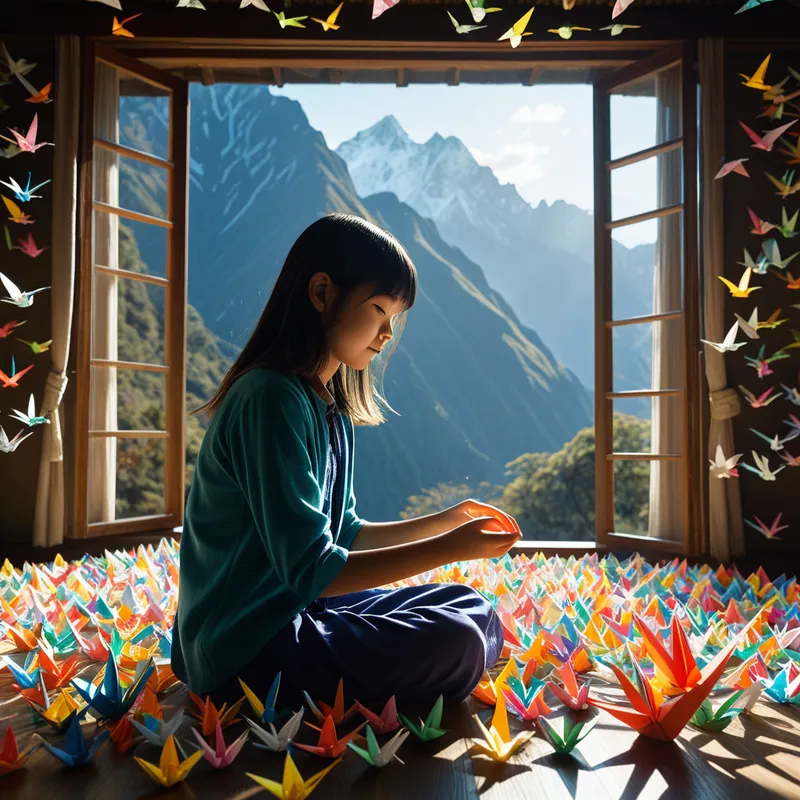
So began her great work. While her strength allowed, Tsuru folded. Her fingers, though thin, became precise instruments of faith. The first cranes were clumsy, their wings lopsided. But with each one, her focus deepened. She folded in the morning light, her movements a silent meditation. She folded by candlelight, the shadows dancing with the emerging shapes of birds. The cranes began to accumulate—a flock of paper souls perched on shelves, hung from strings, gathered in baskets. They were of every color: the crimson of sunrise, the deep indigo of twilight, the vibrant green of new leaves. Each crane was a captured moment of her life, a testament to her enduring will.
The seasons turned. The village watched, first with pity, then with awe, as the girl who was fading away instead filled her world with silent, poised birds of paper. The act of folding became her entire world—the sharp crease of a valley fold, the gentle puff of breath to inflate the body, the careful pull to shape the wings. It was a ritual of profound patience. On some days, she could only manage one. On others, when a strange vitality flowed through her, a dozen would take flight from her fingertips.
Finally, after a year and a day, she folded the one-thousandth crane. It was from the original white paper, now softened by time and touch. As she set it down amongst the vast, colorful congregation, a profound silence filled the room. Then, a warm breeze, smelling of plum blossoms and clean mountain air, swept through the closed screens. The thousand paper cranes rustled, a sound like a forest of leaves. And then, as one, they began to glow with a soft, inner light.
The cranes stirred. Not as puppets, but as beings filled with a gentle spirit. They lifted from their perches, a swirling, silent tornado of color and light. They encircled Tsuru, their paper wings brushing her skin with whispers of comfort. Their collective light poured into her, not as a violent cure, but as a deep, resonant warmth that filled the hollows the sickness had carved. The shadow within her did not vanish; it was transformed, folded into the very pattern of her renewed being.
When the light faded and the cranes settled once more, now mere paper but somehow still sacred, Tsuru rose. The crushing weakness was gone, replaced by a resilient strength. She walked to the veranda, looked out at the world, and breathed deeply for the first time in years. The promise was kept. She had not just been healed; she had become the healer, her own devotion the medicine. And it is said that from that day, anyone who undertakes the sincere journey of a thousand cranes invites a fragment of that same transformative grace into their own life.
Cultural Origins & Context
The story of the thousand origami cranes, or senbazuru, is not a single, codified myth from ancient texts like the Kojiki. Rather, it is a modern folk legend, a powerful narrative that crystallized in the mid-20th century around the true, tragic figure of Sadako Sasaki, a young victim of the Hiroshima atomic bomb. Sadako’s determined folding, fueled by the popular belief that doing so would grant her a wish for health, transformed a traditional craft into a global symbol of peace, healing, and the resilience of the human spirit.
This narrative seamlessly wove itself into older, deep-rooted cultural threads. The crane (tsuru) has long been a sacred creature in Japan, a symbol of longevity, good fortune, and fidelity, often depicted alongside gods and immortals. The art of origami itself, while recreational, has Shinto underpinnings; the pure, uncut paper (kami) is homophonous with spirit (kami), making the act of folding a form of inviting spirit into material form. The societal function of the senbazuru story is thus multifaceted: it is a vessel for collective grief and hope (post-war), a model for patient, mindful action, and a tangible ritual for focusing intention, whether for personal healing or global peace. It is a myth born from history, passed down not by bards but by schoolchildren, peace activists, and hospital visitors, making it one of the most living and actively practiced myths of our time.
Symbolic Architecture
At its core, the myth is an alchemical map of inner transformation. The flat, square paper represents the potential within the mundane, the unactivated self or the “raw material” of a life. The sickness is any state of fragmentation, despair, or disconnection—the soul’s cry for wholeness.
The crane is not merely a bird; it is the archetype of the transcendent function, the psychic entity that mediates between the earthly realm of suffering and the spiritual realm of meaning.
The act of folding is the critical, repetitive work of consciousness. Each precise crease is a conscious decision, a small, disciplined action taken against the chaos of illness or despair. The number one thousand is not arbitrary; it represents the overwhelming, near-infinite nature of the work required for healing or self-realization. It is a number that forces the surrender of immediate gratification and demands commitment to process over outcome.
The completed senbazuru is the mandala of the integrated self. The single crane is beautiful but isolated; the thousand together create a new, emergent entity—a community of effort, a constellation of endured moments. The divine intervention (the kami’s grace) does not occur instead of human effort, but through it. The gods answer only when the human hand has built the sacred ladder, rung by painstaking rung.
The Dreamer’s Resonance
When the myth of the origami cranes appears in modern dreams, it often signals a profound somatic and psychological process of patient integration. Dreaming of folding cranes, especially with a sense of urgency or quiet focus, suggests the dreamer is in the midst of a long, meticulous healing journey. This could be recovery from trauma, the slow processing of grief, or the daily discipline of managing chronic illness or depression. The hands in the dream are vital; they represent the ego’s capacity to take the raw, flat material of overwhelming experience and deliberately shape it into something bearing meaning and form.
Dreaming of incomplete or crumpled cranes may point to frustration in this process, a fear that one’s efforts are futile or imperfect. Dreaming of a vast, suspended flock of glowing cranes, however, is a powerful symbol from the unconscious affirming that the work, though invisible in waking life, is accumulating and creating a new internal structure. It is the Self reassuring the ego that the patient, repetitive acts of self-care and conscious attention are not in vain—they are constructing a psychic sanctuary.
Alchemical Translation
For the modern individual navigating a fractured world, the myth models the complete arc of individuation—the Jungian process of becoming whole. The initial “sickness” is the felt sense of alienation, anxiety, or meaninglessness. The instruction from the Self (the inner Amaterasu) is not to seek a quick, external cure, but to engage in a transformative practice.
The alchemy occurs not in the final product, but in the metabolism of time, attention, and fragility within the crucible of the folding hands.
The “paper” is one’s own life narrative, memories, and daily experiences. The “folding” is the practice of reflective journaling, therapy, meditation, or any consistent ritual of turning inward to examine and reconfigure one’s story. Each session, each moment of mindfulness, is a single fold. The goal of “one thousand” teaches the dissolution of the goal itself; one must fall in love with the process, with the texture of the paper and the geometry of the crease.
The eventual “healing” or transcendence is not an eradication of wounds, but their integration. The shadow—the sickness, the pain—becomes the very tension that creates the beautiful, complex structure of the crane. The individual discovers that by faithfully tending to their own fragmentation, they become a vessel for something transcendent. They realize they are not just folding cranes; they are, through devoted action, slowly becoming the crane—rising from the flatland of unconscious suffering into the three-dimensionality of a soul capable of flight, their once-burden now the very architecture of their grace. The myth ultimately promises that devoted, hands-on engagement with our own brokenness is the sacred technology for weaving a soul.
Associated Symbols
Explore related symbols from the CaleaDream lexicon: