Orestes Myth Meaning & Symbolism
A prince avenges his father by killing his mother, is pursued by Furies, and seeks purification, embodying the crisis of blood guilt and divine law.
The Tale of Orestes
Hear now the tale of a house cursed by the gods, a lineage steeped in the blood of kin. The air in Mycenae is thick with the memory of murder. King Agamemnon is dead, slain in his bath by his queen, Clytemnestra, and her lover, Aegisthus. His blood still whispers from the palace stones. His son, Orestes, has grown to manhood in exile, a ghost in his own story, nourished on tales of his father’s glory and his mother’s treachery.
The command comes from the shining one, Apollo, speaking through the sacred tripod at Delphi. The god’s voice is clear as crystal and cold as mountain snow: Orestes must avenge his father. It is divine law. The weight of the command settles on his shoulders like a bronze yoke. He returns to Mycenae in secret, a stranger in his homeland. At the tomb of Agamemnon, he meets his sister, Electra, her grief hardened into a sharp, relentless fury. Their tears mingle with the libations poured for the dead, and a pact is forged in that sacred, sorrowful place.
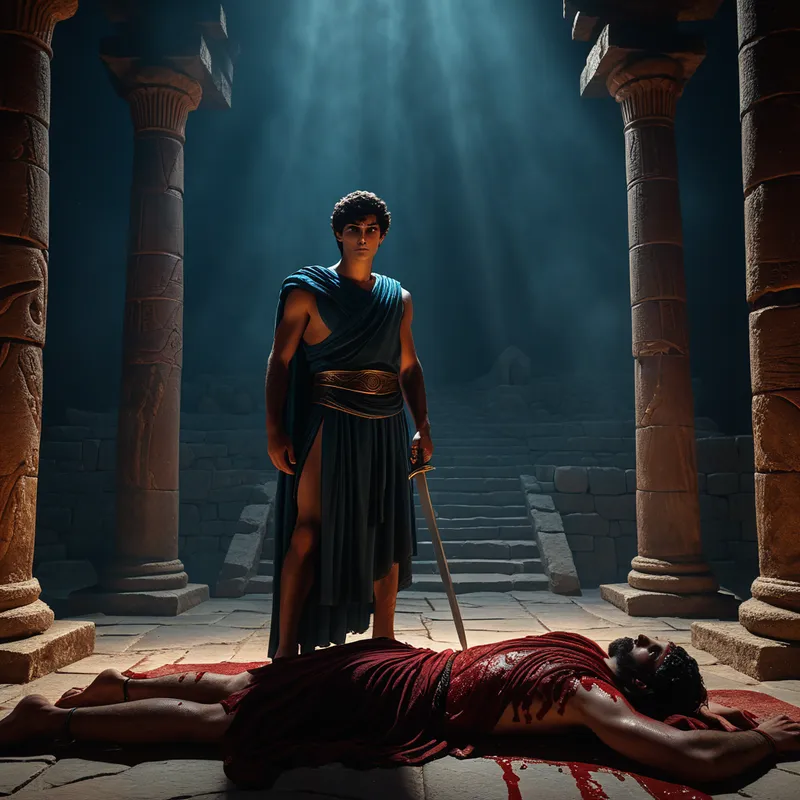
Disguised as travelers bearing news of Orestes’ own death, they gain entry to the palace. The great hall, once a place of feasting, now feels like a tomb. Clytemnestra approaches, a queen still in her power, her eyes holding a complex history of grief—for her daughter Iphigenia, sacrificed by Agamemnon for fair winds to Troy. For a moment, maternal instinct flickers; she pities the reported death of her son. But the deception holds. Then, the revelation. The disguise falls. Orestes stands before her, sword in hand, the ghost of his father at his back. The air crackles with the tension of an impossible choice: the son’s duty to his father against the primal taboo of matricide. He drives the blade home. Her dying cry is not just a scream of pain, but a curse, an invocation. Aegisthus meets the same fate, and the palace floor runs red.
But the true horror begins not with the killing, but after. As the adrenaline fades, Orestes looks upon his mother’s face. The deed is done, Apollo’s order fulfilled. Yet, no peace comes. Instead, a sound begins—a low, insistent buzzing that grows into a chorus of shrieks. They appear from the shadows, from the very corners of his vision: the Erinyes. Ancient, terrible, with serpents for hair and eyes that weep black tears. They are the embodiments of blood guilt, the persecutors of kin-slayers. They see only one law: a mother’s blood is the most sacred, and her killer must be hounded from the earth. Their whispers fill his mind, their breath is the stench of the grave. Orestes flees, a madman racing across the earth, the relentless Furies always at his heels, their claws grazing his neck. His sanity unravels like a frayed thread. The god who commanded the act, Apollo, offers sanctuary but cannot stop the torment. There is only one hope: a trial. A new judgment, for a new age.
He is led to Athens, to the sacred hill of the Areopagus. Here, the goddess Athena convenes a jury of Athenian citizens. The scene is cosmic. On one side, Apollo argues for Orestes: the father is the true parent, the king’s murder demanded vengeance, the new patriarchal order must be upheld. On the other, the Erinyes wail their ancient truth: the bond of the womb is primordial, her blood cries out, and the old chthonic laws of vengeance must be satisfied. Athena, born from the head of Zeus, acknowledges both claims. The vote is cast. It is a tie. And Athena, in her wisdom, casts the deciding vote—for Orestes. Not because the matricide was pure, but because the cycle must end. She offers the defeated Erinyes a new home, a new honor as the Eumenides, protectors of the city’s justice. The torment ceases. The blood is washed clean. Orestes, at last, is free.
Cultural Origins & Context
The myth of Orestes is not a single, fixed story but a powerful current running through the heart of Greek epic and dramatic tradition. Its earliest known form appears in the Odyssey, but its most profound and complex treatments are the work of the 5th-century BCE Athenian tragedians: Aeschylus in his monumental trilogy, the Oresteia, and later, Sophocles and Euripides in their own plays (Electra, Orestes). This was a culture deeply concerned with the concepts of dike (justice, order), miasma (ritual pollution), and hubris (destructive arrogance). The myth served as a foundational narrative for exploring the terrifying transition from a tribal system of blood feud and clan vengeance to a civic system of trial by jury and communal law.
Performed during the great City Dionysia, these plays were not mere entertainment but a form of civic and religious ritual. The audience of Athenian citizens would watch the house of Atreus tear itself apart, only to be reassembled on their own Acropolis in the trial scene. The myth thus functioned as a cultural mirror and a psychic container. It legitimized the nascent Athenian legal system by giving it a divine origin story (the trial of Orestes establishing the Areopagus court) and processed the profound anxieties surrounding kinship loyalty, the authority of the gods, and the price of civilization.
Symbolic Architecture
At its core, the myth of Orestes maps the psyche’s brutal confrontation with impossible, contradictory imperatives. He is the archetypal figure caught in a double bind of sacred duties: the son’s obligation to his father and the child’s taboo against harming the mother. This is not a conflict between good and evil, but between two equally valid, yet mutually exclusive, moral and psychic laws.
Orestes represents the conscious ego thrust into an ancestral drama it did not create but must resolve. His sword is the instrument of conscious choice, and it inevitably draws blood from the very source of his own life.
The key symbols are a triad of forces. Apollo represents the light of conscious, patriarchal order, logic, and divine decree—the voice that says “you must act.” The Erinyes embody the unconscious, chthonic, matriarchal power of the blood-tie, guilt, and the autonomous, punishing conscience—the feeling that says “you are damned for acting.” Athena symbolizes the transcendent function, the reconciling wisdom that can hold the tension of opposites and forge a new, more complex order from their conflict. Orestes’ madness is the inevitable psychic disintegration that occurs when one pole is violently chosen over the other without integration.

The Dreamer’s Resonance
When the pattern of Orestes manifests in modern dreams, the dreamer is typically in the grip of a profound moral or psychological crisis born of legacy. One does not dream of Orestes when making simple choices, but when feeling trapped by a “command” (from family, society, or an internalized parent) that requires one to betray a deep, instinctual part of oneself to fulfill it.
The somatic experience is one of persecution and paralysis. The dreamer may be chased by shadowy female figures (the Furies), representing a rising tide of guilt, anxiety, or somatic symptoms that have no clear medical cause. They may find themselves in a courtroom (the Areopagus) feeling judged for an action they felt compelled to take. The central image is often a violent act against a maternal figure or a maternal space (a house, a womb-like room), followed immediately by a sense of contamination and panic. This dream state indicates that the psyche is actively wrestling with an introjected, conflicting command structure. The “madness” is the psyche’s refusal to let the conflict be buried; it forces it to the surface, demanding a trial.

Alchemical Translation
The alchemical journey of Orestes is a masterful map of individuation. It begins in the nigredo, the blackening: the murder of Clytemnestra. This is not a virtuous act, but a necessary, horrific one—the brutal separation from the unconscious, all-encompassing grip of the maternal complex. The ego, acting on Apollo’s command (the voice of a spiritual or intellectual ideal), severs the primal tie. The immediate consequence is the mortificatio: the pursuit by the Furies. The ego is dissolved in guilt and terror; it is psychologically annihilated. This is the crucial, purgative phase where the price of conscious action is paid in full.
The trial is the alchemical coniunctio oppositorum—the conjunction of opposites. The conscious, solar principle (Apollo) and the unconscious, chthonic principle (the Erinyes) are brought into the same vessel (the court) and held in tension by the mediating wisdom of Athena.
The trial does not declare one side “right” and the other “wrong.” The tie vote is essential. It signifies that from the psyche’s perspective, both claims are utterly valid. Athena’s vote for acquittal is the transcendent function in action: it acknowledges the necessity of the new conscious stance (Orestes’ action) while honoring and integrating the power of the old unconscious law (by transforming the Furies into the Eumenides, protectors of the new order). The outcome is not a victory, but a transformation. The psychic energy that was bound in self-destructive persecution (the Furies) is redeemed and put into the service of a higher, more conscious structure (the civic justice of the polis). For the modern individual, this translates to the arduous process of taking a stand that may feel like a betrayal of one’s familial or internal programming, enduring the subsequent crisis of guilt and identity, and ultimately finding a new, self-authored integrity that honors, but is no longer enslaved by, the ghosts of the past.
Associated Symbols
Explore related symbols from the CaleaDream lexicon: