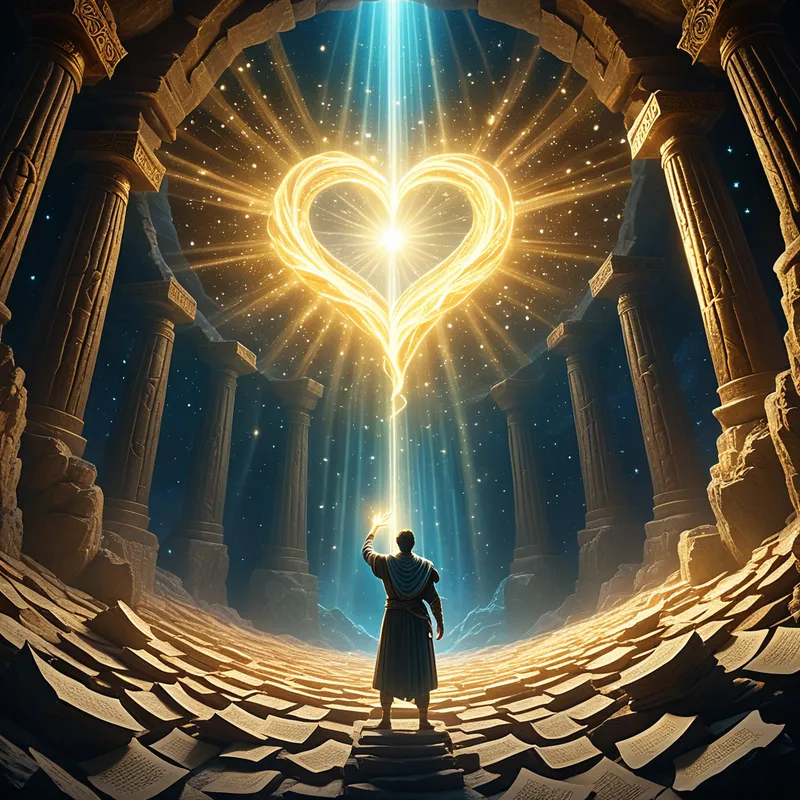
Oracle Scrolls Myth Meaning & Symbolism
A mortal's perilous quest to steal the gods' unreadable scrolls of fate, revealing the terror and liberation of confronting ultimate truth.
The Tale of Oracle Scrolls
Hear now a tale not of heroes and monsters, but of a silence so profound it became a scream. In the sun-drenched, olive-scented world of mortals, whispers were the currency of life. Whispers from the rustling leaves of Dodona, from the chasm at Delphi where the earth itself breathed prophecy. Yet, for all the riddles spoken, a deeper hunger gnawed at the soul of a man named Noos. He was a seeker, not of gold or glory, but of the source. Where did the whispers begin? What parchment held the first word of fate?
His journey was not across seas, but inward, up the slopes of longing to the very home of the gods. Not to the gleaming palaces of Zeus, but to the mountain’s secret, beating heart: the Chamber of Moirai. It was said that here, in a cavern lit by no torch but the cold fire of stars, the Moirai did not spin, measure, and cut. Here, they inscribed. And their inscriptions were the Oracle Scrolls.
Noos found the cavern, a geode of the cosmos. The air was thick, not with dust, but with potential—the scent of ozone before a world-altering storm. And there they floated: not one, but countless scrolls, suspended in the still air. They were not of papyrus or vellum, but of a material that drank the light, bound with cords that seemed woven from twilight itself. This was the unspoken library, the divine antecedent. Before a word was uttered at Delphi, it was written here. Before a thread was spun, its pattern was described.
His hand, calloused from a mortal life of seeking, reached out. The moment his skin brushed the cool, non-surface of the nearest scroll, the Chamber awoke. The silent stars flared. The scroll unfurled of its own will, not with a rustle, but with a sound like the universe inhaling. He looked upon the writing. And he saw… nothing. And everything.
The script was not Greek, nor any language of men. It was the language of causality itself—a shimmering, ever-shifting pattern of light and shadow that depicted not events, but the roots of events. He saw the birth of a storm in a butterfly’s wing-beat three continents away; he saw a king’s downfall in the unspoken grudge of a slave’s grandfather. It was truth in its raw, unfiltered, paralyzing totality. To read it was not to understand, but to know in a way that bypassed the mind and seared the soul.
And in that knowing, the conflict was born—not with a god, but within himself. The rising action was the silent shattering of his own psyche. The prophecy he sought was this: the terrifying, beautiful, and absolute interconnectedness of all things. His quest ended not with a theft, but with a confrontation. He could not take the scroll, for its truth had already taken him. He left the Chamber not as a thief, but as an empty vessel, the echo of the scroll’s silent thunder now the only thing within him. The resolution was his return to the world of whispers, forever hearing the deafening silence from which they all sprang.
Cultural Origins & Context
The myth of the Oracle Scrolls is a charter myth for the profound Greek ambivalence towards knowledge and fate. While no single canonical version exists in surviving literature, its essence is woven from the threads of many. It is the shadow story behind every recorded oracle. It speaks to the culture that produced Oedipus and Prometheus—a culture deeply committed to seeking truth, yet equally convinced that ultimate truth is destructive to mortals.
This was likely a tale told not in public theaters, but in philosophical circles and mystery cults. It functioned as a philosophical parable, a warning and an invitation. Its societal function was to interrogate the very practice of divination. Why seek answers from oracles if the answers are riddles? The myth suggests the riddle is a mercy. The clear, complete truth—the Scroll itself—is not for human minds. It is the province of the Moirai and Apollo, the god who knows but speaks obliquely. The myth validates the cultural practice of indirect prophecy by presenting the alternative as catastrophic enlightenment.
Symbolic Architecture
The Oracle Scrolls represent the Plenum of the unconscious—the complete, unfiltered record of psychic causality that underlies our conscious thoughts and decisions. They are not a book of future events, but the living database of all potentials, connections, and archetypal patterns.
The Scrolls do not tell a story; they are the substance from which all stories are reluctantly carved.
The mortal seeker, Noos (Mind/Spirit), symbolizes the ego’s heroic but ultimately flawed quest to make the unconscious conscious on its own terms. The Chamber is the psychic center, the Self. The conflict is not against a guardian monster, but against the nature of consciousness itself. The ego seeks to “read” the Self, to possess its knowledge as information. But the Self communicates not in data, but in symbols, synchronicities, and the transformative experience—the “whispers” of Delphi.
The terrifying, unreadable script is the core symbol. It signifies that raw truth, before it is processed by the filters of perception, language, and ego, is inherently incomprehensible. It is pure meaning without a container. To behold it directly is to experience what mystics call the mysterium tremendum et fascinans—a reality so vast it annihilates the separate self that tries to grasp it.
The Dreamer’s Resonance
When this myth stirs in modern dreams, it rarely appears as ancient scrolls. It manifests as the dreamer finding a secret room in their house, filled with incomprehensible blueprints or a computer containing the complete, chaotic data of their life. The dreamer feels a compulsive need to “understand” it, but the files are corrupted, the language alien, the diagrams endless and looping.
This dream pattern signals a critical somatic and psychological process: the ego’s confrontation with material it is not equipped to integrate. The “scrolls” are often emergent contents from the deep unconscious—repressed memories, latent talents, or core wounds—that are presenting themselves not as manageable narratives, but as overwhelming, non-linear truth. The dreamer’s anxiety is the somatic recognition of psychic overload. The dream is not a puzzle to be solved, but a ritual of exposure. It is the psyche forcing the ego to stand at the threshold of the unknowable, to feel the vertigo of its own depths, and to retreat, changed. This is the beginning of humility, the necessary failure that precedes a more authentic relationship with the inner oracle.

Alchemical Translation
The myth of the Oracle Scrolls models the nigredo and albedo of individuation. The quest represents the initial, fiery drive for self-knowledge. The entry into the Chamber is the descent into the unconscious. The confrontation with the unreadable Scroll is the pivotal numinous experience that shatters the old, knowing ego.
The alchemical vessel is shattered by the very truth it sought to contain, so that a new vessel, capable of holding mystery, can be formed from the pieces.
Noos’s failure to “read” or “take” the scroll is, paradoxically, the success of the operation. He is kenotically emptied. His old identity as “the seeker who finds” is dissolved. This is the blackening. His return to the world, carrying only the “echo” of the experience, is the whitening. He does not possess knowledge; he is oriented by it. The whispers of the world are no longer obscure riddles, but poignant, merciful reflections of the great Silence he has touched.
For the modern individual, this translates to the moment we stop trying to “figure ourselves out” through lists, therapies, or ideologies aimed at total explanation. It is the moment we surrender the demand for a clear, coherent, and controllable narrative of our own fate. The alchemical triumph is to develop a capacity to hold the tension of the unknown—to listen to the whispers of intuition, dream, and synchronicity without demanding they unfurl into definitive scrolls. We become, not readers of our fate, but humble scribes in dialogue with it, learning to inscribe our small portion of the great text with conscious grace.
Associated Symbols
Explore related symbols from the CaleaDream lexicon: