
Oracle of Dodona Myth Meaning & Symbolism
In a sacred grove, Zeus whispers through rustling oak leaves and bronze gongs, offering primal wisdom to those who can interpret the voice of the world.
The Tale of the Oracle of Dodona
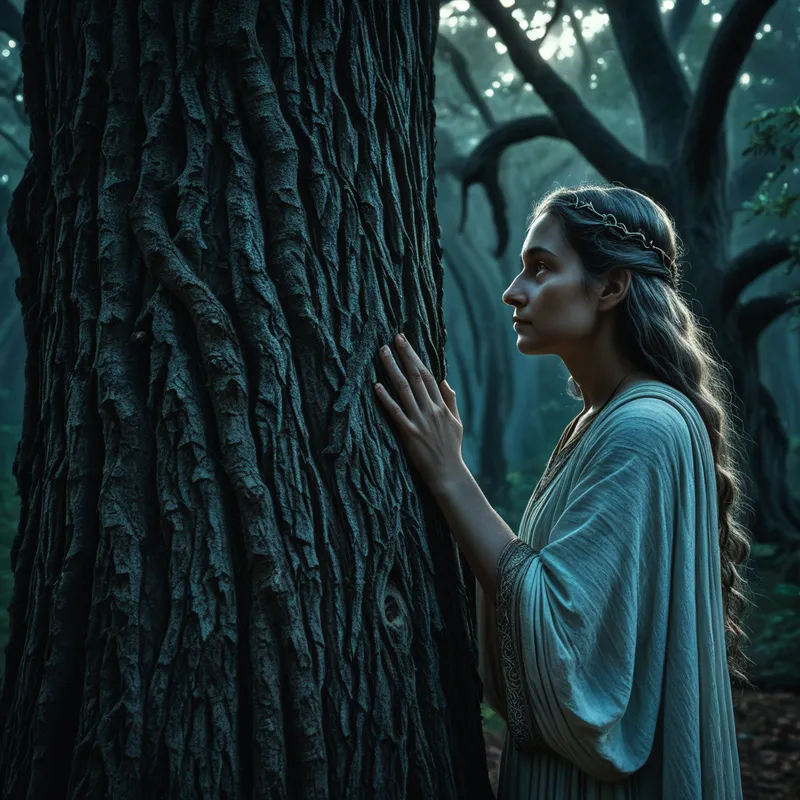
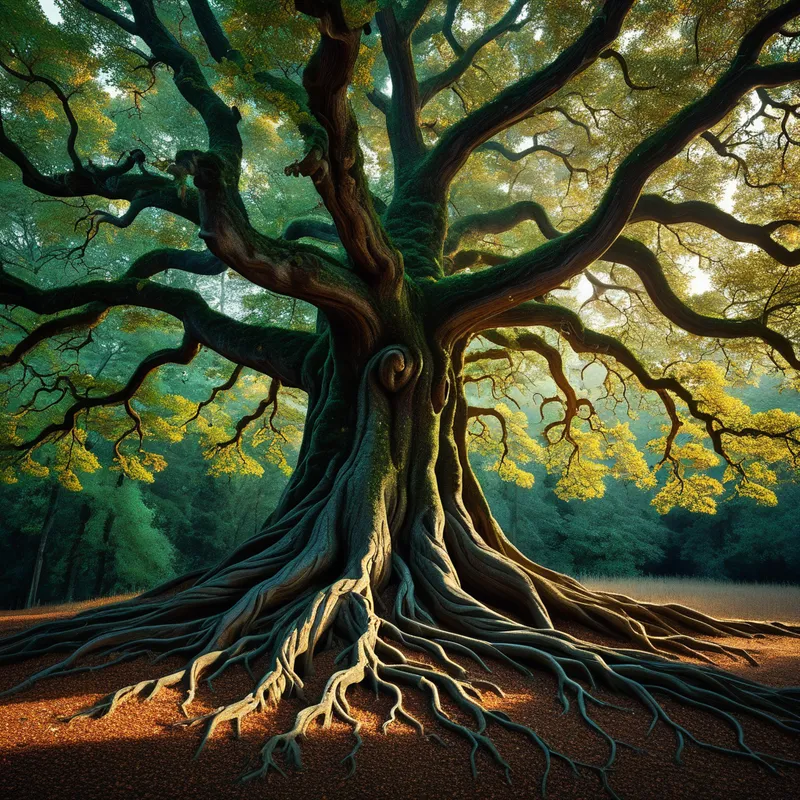
Listen. Before the marble of Delphi gleamed white under the sun, there was a deeper, older voice. It did not speak from a polished stone cleft, but from the living heart of the earth itself. In the wild, mist-shrouded highlands of Epirus, where the wind carried the scent of pine and cold stone, there stood a grove. Not just any grove, but a sanctuary of oak, ancient and vast, their branches like the tangled beards of sleeping titans.
Here, the god did not use a mortal mouthpiece. Here, Zeus spoke directly. His voice was the sigh of the wind through the countless leaves of the sacred oak. It was a susurrus, a secret language of rustling green. To understand it required not learning, but a different kind of knowing—a listening with the soul’s ear.
The story of its founding is itself a whisper from a lost age. Some say two black doves flew from the ancient sanctuary of Thebes in Egypt. One alighted at Libyan Siwa, the other here, in this Epirus grove, and each spoke with a human voice, commanding the establishment of an oracle to Zeus. Others tell of a more primal origin: that the first priestesses were the Hamadryads of these very oaks, or that the oracle was founded by the goddess Rhea herself, in the time when the Titans still ruled.
The seekers came. Kings and commoners, their hearts heavy with questions of war, love, harvest, and fate. They did not descend into a dark chamber. They stood under the open, often stormy sky, before the oldest and grandest oak. They presented their pleas to the silent, barefoot priests, the Selloi, who slept on the ground and never washed their feet, keeping them in constant contact with the chthonic pulse. Later, three priestesses, the Peleiades (“Doves”), became the interpreters.
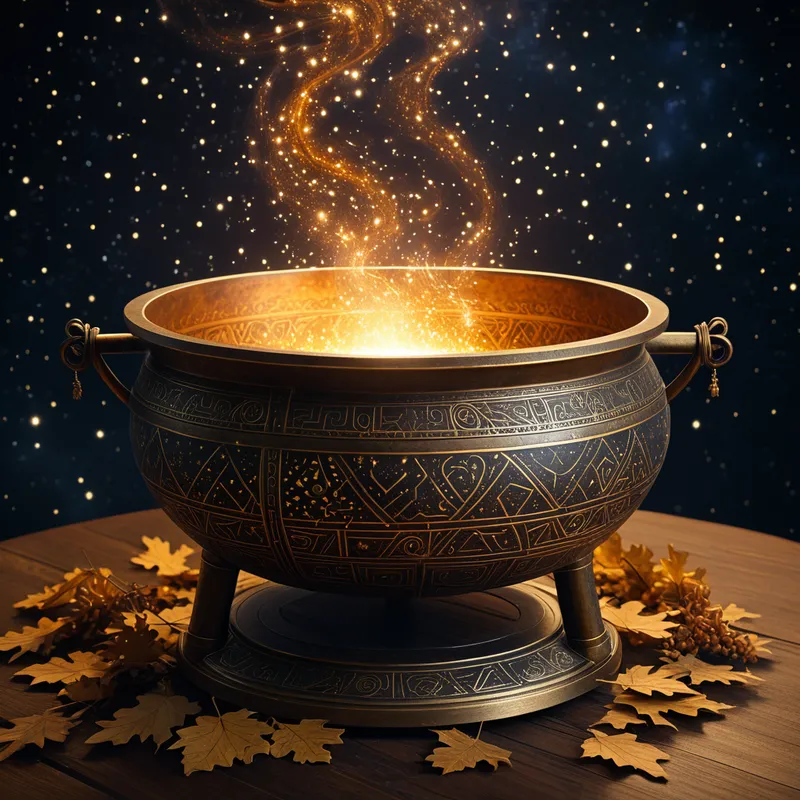
The ritual was one of sound and waiting. A great bronze cauldron stood beside the oak, and beside it, a bronze statue of a boy holding a whip whose cords were fashioned from strands of bronze. When the wind blew, it would set the whip in motion, striking the cauldron. The resulting ring—a deep, resonant gong—would echo through the grove, mingling with the rustle of the leaves. This was the orchestra of the divine. The Peleiades would stand, their eyes closed, their beings attuned not to words, but to patterns within the chaos of sound. From the interplay of metallic resonance and arboreal whisper, they would weave the god’s response—often enigmatic, always profound. The oracle was not about predicting a fixed future, but about revealing the hidden currents of the present, the will of Zeus woven into the very fabric of the world.
Cultural Origins & Context
Dodona claims the title of the oldest Hellenic oracle, a site whose veneration stretches back into the dim Bronze Age, possibly to the second millennium BCE. Its origins are pre-Greek, rooted in the indigenous Pelasgian worship of an earth goddess. The arrival of Zeus-worshipping Hellenic tribes saw a syncretism, a layering of the sky god over the chthonic sanctuary. This duality is key: Dodona was always a place where the celestial (Zeus) communicated through the profoundly terrestrial (the oak, the earth).
Unlike the politically central and formalized Oracle of Delphi, Dodona retained a more rustic, decentralized character. It was the oracle of the people of northern Greece, of shepherds and farmers, as much as of kings like Philip II and Jason, who was said to have consulted its oak for his voyage. Its authority derived from its immense antiquity and its direct, unmediated connection to the primal forces. The prophecies were recorded on lead tablets—simple, folded sheets asking direct questions, which have been excavated by archaeologists, providing a stunningly intimate glimpse into the personal anxieties and hopes of ancient Greeks. Dodona functioned as a cosmic listening post, a place where human uncertainty could be offered up to the oldest voices the world knew.
Symbolic Architecture
At its core, the Oracle of Dodona symbolizes primal, unscripted revelation. It represents wisdom that is not codified in law or text, but that emerges spontaneously from the interaction of elemental forces. The oak tree, the central symbol, is an axis mundi—a world pillar connecting the underworld (through its roots), the earthly realm (its trunk), and the heavens (its branches). Zeus, the god of order and sky, choosing to speak through this tree, signifies that true cosmic order is not imposed from above, but grows organically from the heart of nature.
The oracle does not speak in the language of the court, but in the grammar of the grove. Its truth is not a statement, but a symphony of rustling leaves and resonant bronze, waiting for a human soul to become its translator.
The bronze gong and whip introduce the element of arousing the divine voice. Wisdom is not always passively present; sometimes it must be struck into being, its resonance drawn out by a catalyst (the wind, the seeker’s urgent question). The Selloi, with their unwashed feet, embody the necessity of groundedness. One cannot interpret the voice of heaven without being firmly rooted in the earth. The doves of the foundation myth symbolize the soul (psyche) itself—the vehicle that carries prophetic intuition from distant, sacred sources to find its nesting place within the human world.
The Dreamer’s Resonance
To dream of Dodona is to dream of listening to a voice you feel but cannot quite decipher. It manifests in modern dreams as finding oneself in a vast, ancient forest where the wind carries whispers. You strain to understand, but the words are just beyond comprehension. You may encounter a single, magnificent tree that seems to pulse with significance, or hear a deep, resonant gong that vibrates in your chest rather than your ears.
Somatically, this dream pattern correlates with a process of deep intuitive listening. The dreamer is likely at a crossroads where logical analysis has failed. The conscious mind is seeking data, but the unconscious is urging a different approach: to become still, to ground oneself, and to attend to the subtle, often chaotic-seeming signals from the body and the deeper psyche (the rustling leaves, the random gong). The frustration of not understanding is part of the initiation. The dream signals that the answer is not a piece of information to be received, but a pattern of meaning to be felt and integrated from a more holistic, non-linear level of awareness.
Alchemical Translation
The journey to Dodona models the alchemical stage of solutio—dissolution—followed by coagulatio—coagulation. The seeker arrives with a rigid question, a solidified problem (the lead tablet). They then must dissolve their certainty in the ambiguous symphony of the grove. They must let go of the need for a clear, verbal answer and instead open themselves to the raw, unprocessed data of sensation and intuition (the wind, the sound).
The psychic transmutation occurs in the act of interpretation performed by the Peleiades. This represents the ego’s necessary but humble role. The ego does not generate the wisdom; it translates the symbolic language of the Self (the unified totality of the psyche, represented by Zeus) into a form the conscious mind can use.
Individuation is not about finding a definitive answer from an external oracle, but about cultivating the inner Peleias—the priestess who can stand calmly in the storm of the unconscious and discern meaning in its whispers.
For the modern individual, the Dodona process invites us to identify our own “sacred grove”—a practice or state (meditation, nature immersion, art, active imagination) where we can quiet the internal monologue and listen. Our “oak leaves” might be somatic sensations, synchronicities, emotional weather, or dream images. Our “bronze gong” might be a sudden insight, a shock, or a resonant piece of art that stirs something deep. The work is to resist the immediate, literal interpretation and instead allow a more profound, often paradoxical meaning to coagulate from these elements. We become, in essence, both the seeker and the oracle, learning to hear the voice of our own deeper, older wisdom speaking through the living world of the psyche.
Associated Symbols
Explore related symbols from the CaleaDream lexicon: