Opus Circulatorium Myth Meaning & Symbolism
The myth of the cosmic vessel endlessly dissolving and reconstituting itself, embodying the alchemical axiom of 'solve et coagula'—the eternal cycle of death and rebirth.
The Tale of Opus Circulatorium
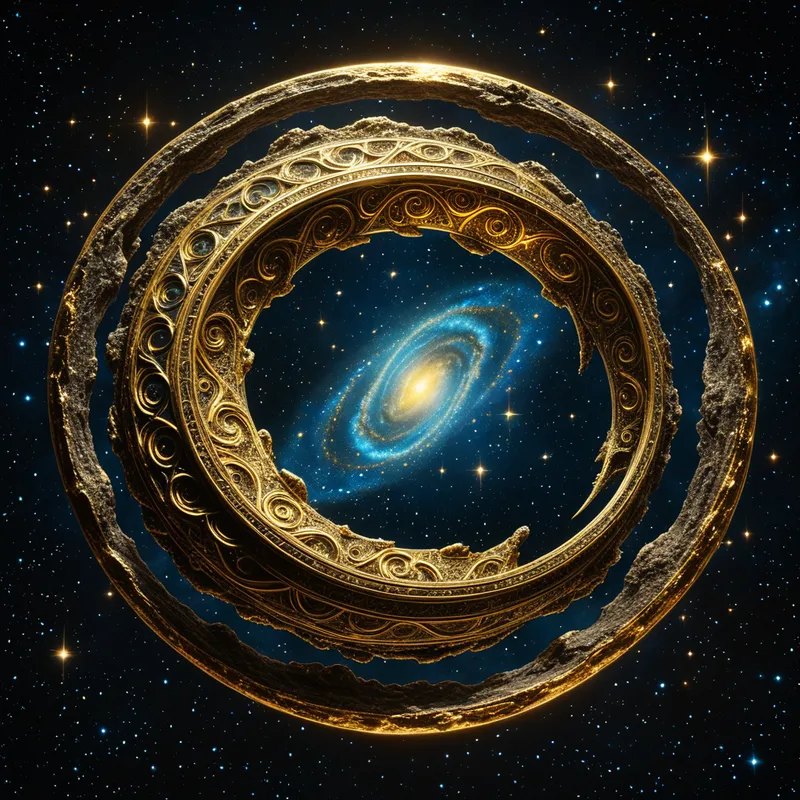
Listen, and let the fire of [the athanor](/myths/the-athanor “Myth from Alchemy culture.”/) whisper it to you. Before the first philosopher’s stone was a dream, before [the prima materia](/myths/the-prima-materia “Myth from Alchemical culture.”/) was named, there was only the great, silent potential of the Ain Soph. And from that boundless night, a longing was born—a longing for form, for knowing itself. This longing condensed, not into a god or a titan, but into a Vessel. They called it the Opus Circulatorium.
It was not a cup, nor a bowl, but a living wheel of cosmos, forged from the first opposition: the radiant, volatile spirit of Sol and the deep, fixed body of Luna, bound by the mercurial flow between them. Its purpose was not to hold, but to become. It began its only work: to pour itself into itself.
From its own rim, a river of molten stars and nebulae cascaded down, a glorious, self-created cataract of being. This was the Solve. [The Vessel](/myths/the-vessel “Myth from Alchemical culture.”/) did not fear this dissolution; it was its nature. Its magnificent structures—spires of crystallized light, continents of condensed thought—melted back into a shimmering, chaotic sea within its own belly. All identity was lost in a brilliant, terrible soup of potential.
Then, from the very center of that chaos, a gravity awoke. A single, pulsing note, the hum of the Anima Mundi, resonated through the broth. This was the call to Coagula. Slowly, irresistibly, the elements began to remember. Not their old forms, but new symmetries, more complex harmonies. Gold learned from silver; salt conversed with [sulfur](/myths/sulfur “Myth from Alchemical culture.”/). From the chaos, a new, more resplendent Vessel coalesced—the same, yet profoundly other.
But the work was never done. The moment the new form was complete, the pouring began again. The Vessel knew no rest, only the eternal, sacred rhythm: the glorious fall into formlessness, the agonizing, glorious struggle back into form. It was the first heartbeat of the universe, the original sigh of creation and destruction woven into one breath. It did not seek an end, for its journey was its home. It was [the Great Work](/myths/the-great-work “Myth from Alchemical culture.”/), forever in motion, forever circling the mystery of its own existence.
Cultural Origins & Context
The myth of the Opus Circulatorium is not a folktale with a clear origin in a specific time or place. It is the underlying narrative architecture of the entire alchemical tradition, spanning from Hellenistic Egypt through the Islamic [Golden Age](/myths/golden-age “Myth from Universal culture.”/) to the Renaissance laboratories of Europe. It was never written as a single story but was encoded in emblematic illustrations, cryptic verses, and laboratory procedures.
It was passed down in the hushed scriptoria of monasteries, on the stained pages of Vaticinia, and in the oral teachings from master to apprentice. To speak of it directly was often forbidden; one had to discover it through the long, smoky work at the furnace, mirroring the Vessel’s own process. Its societal function was dual: for the exoteric culture, it was an allegory for the purification and perfection of metals. For the esoteric initiate, it was a precise map of the soul’s journey toward the divine, a model for psychological and spiritual transformation that operated under the guise of chemistry.
Symbolic Architecture
At its core, the [Opus](/symbols/opus “Symbol: A spiritual or alchemical term for a great work of creation, often representing the culmination of a life’s purpose or a transformative process.”/) Circulatorium is the ultimate [symbol](/symbols/symbol “Symbol: A symbol can represent an idea, concept, or belief, serving as a powerful tool for communication and understanding.”/) of the [psyche](/myths/psyche “Myth from Greek culture.”/) understood as a dynamic, self-regulating [system](/symbols/system “Symbol: A system represents structure, organization, and interrelated components functioning together, often reflecting personal or social order.”/). It represents the totality of [the Self](/myths/the-self “Myth from Jungian culture.”/), not as a [static](/symbols/static “Symbol: Static represents interference, disruption, and the breakdown of clear communication or signal, often evoking feelings of frustration and disconnection.”/) [achievement](/symbols/achievement “Symbol: Symbolizes success, mastery, or reaching a goal, often reflecting personal validation, social recognition, or overcoming challenges.”/), but as an eternal process.
The Self is not a statue to be unveiled, but a river that must forever flow into its own source.
The [Vessel](/symbols/vessel “Symbol: A container or structure that holds, transports, or protects something essential, representing the self, emotions, or life journey.”/) itself symbolizes the Vas, the sacred [space](/symbols/space “Symbol: Dreaming of ‘Space’ often symbolizes the vastness of potential, personal freedom, or feelings of isolation and exploration in one’s life.”/) where transformation occurs. This is the individual’s conscious [life](/symbols/life “Symbol: The symbol of ‘Life’ represents a journey of growth, interconnectedness, and existential meaning, encompassing both the joys and challenges that define human experience.”/), their [body](/symbols/body “Symbol: The body in dreams often symbolizes the dreamer’s self-identity, personal health, and the relationship they have with their physical existence.”/), their moral and intellectual [framework](/symbols/framework “Symbol: Represents the underlying structure of one’s identity, emotions, or life. It signifies the mental or emotional scaffolding that supports or confines the self.”/). The eternal cycle of Solve and Coagula represents the fundamental [rhythm](/symbols/rhythm “Symbol: A fundamental pattern of movement or sound in time, representing life’s cycles, emotional flow, and universal order.”/) of psychological [life](/symbols/life “Symbol: The symbol of ‘Life’ represents a journey of growth, interconnectedness, and existential meaning, encompassing both the joys and challenges that define human experience.”/): deconstruction and reconstruction. Solve is the necessary [breakdown](/symbols/breakdown “Symbol: A sudden failure or collapse of a system, structure, or mental state, often signaling a need for fundamental change or repair.”/)—the midlife [crisis](/symbols/crisis “Symbol: A crisis symbolizes turmoil, urgent challenges, and the need for immediate resolution or change.”/), the dark [night](/symbols/night “Symbol: Night often symbolizes the unconscious, mystery, and the unknown, representing the realm of dreams and intuition.”/) of the [soul](/symbols/soul “Symbol: The soul represents the essence of a person, encompassing their spirit, identity, and connection to the universe.”/), the shattering of outdated identities and complexes. Coagula is the subsequent, often arduous, reintegration of those pieces into a more conscious, more capacious whole.
The three primary substances swirling within—Sulfur (soul, desire), [Salt](/symbols/salt “Symbol: Salt represents purification, preservation, and the essence of life. It is often tied to the balance of emotions and spiritual cleansing.”/) (body, substance), and [Mercury](/symbols/mercury “Symbol: Mercury symbolizes communication, intellect, and swift movement, often representing the messenger between realms in spiritual and mythological contexts.”/) (mind, [mediator](/symbols/mediator “Symbol: A figure who resolves conflicts between opposing parties, representing balance, communication, and the integration of differences.”/))—are the irreducible constituents of experience. Their perpetual [interaction](/symbols/interaction “Symbol: Interaction in dreams symbolizes communication, relationships, and connections with others, reflecting the dynamics of personal engagement and social settings.”/) is the [drama](/symbols/drama “Symbol: Drama signifies narratives, emotional expression, and the exploration of human experiences.”/) of our inner lives. The myth teaches that wholeness is found not in eliminating one element for another, but in submitting all to the circulating fire of transformation.
The Dreamer’s Resonance
When this myth stirs in the modern unconscious, it often manifests not as a literal vision of a cosmic vessel, but as dreams of profound, cyclical change. One may dream of their childhood home dissolving into sand, only to be rebuilt with unfamiliar, yet strangely fitting, rooms. Another may dream of endlessly climbing a spiral staircase that both ascends and descends into itself, or of a tree that sheds its leaves, which then melt into the roots to fuel new growth.
Somatically, this can correlate with feelings of profound dissolution—a loss of solid ground, a sense of identity flu. This is the dream-body experiencing the Solve. It can be terrifying, a literal nightmare of disintegration. Conversely, the Coagula phase may appear as dreams of finding a mysterious, perfect object (a jewel, a key, a book) that seems to contain the blueprint for a new life, or of giving birth to oneself. These dreams signal the psyche’s innate, archetypal drive toward reconstitution at a higher level of complexity. The dreamer is not breaking down; they are circulating.
Alchemical Translation
For the modern individual seeking individuation, the Opus Circulatorium provides a liberating model. It reframes the psychic journey from a linear “hero’s quest” with a final goal, to a sacred, endless process. The “stone” is not a trophy at the end, but the ability to participate consciously in the circulation itself.
The goal of the work is the work itself. Individuation is the courage to remain in the transformative fire, not the hope of escaping it.
The first translation is embracing the Solve. This means consciously engaging with shadow work, allowing long-held personas (the successful professional, the perfect caregiver, the eternal rebel) to be questioned and dissolved. It is the voluntary descent into chaos, doubt, and depression, not as failure, but as the first, crucial phase of [the opus](/myths/the-opus “Myth from Alchemical culture.”/).
The second is stewarding the Coagula. This is the active, creative work of making meaning from the breakdown. It is journaling after the crisis, painting from the grief, building a new life philosophy from the ashes of the old. It requires patience, for the new form must emerge according to its own inner law, not our ego’s frantic design.
Ultimately, the myth teaches that we are the Opus Circulatorium. Our lives are the vessel. Our experiences—joyful and traumatic—are the [prima materia](/myths/prima-materia “Myth from Alchemical culture.”/). Our conscious attention is the fire of the athanor. The [triumph](/myths/triumph “Myth from Roman culture.”/) is not in arriving, but in realizing there is no arrival, only the profound, perpetual, and sacred motion of becoming. To understand this is to find peace at the very heart of the whirlwind.
Associated Symbols
Explore related symbols from the CaleaDream lexicon: