Onsen Spirits Myth Meaning & Symbolism
A myth of wounded deities whose tears became healing waters, guarded by spirits who demand respect for the sacred balance of nature and psyche.
The Tale of Onsen Spirits
Listen, and let the steam tell the tale.
In the age when the mountains were young and restless, when [the earth](/myths/the-earth “Myth from Hindu culture.”/)’s blood ran hot and close to the skin of [the world](/myths/the-world “Myth from Tarot culture.”/), there lived the Yama-no-Kami. Among them was a [great spirit](/myths/great-spirit “Myth from Native American culture.”/), a guardian of a deep, wooded peak. He was strong, his form a tapestry of ancient cedar and unyielding granite. But a great conflict arose, a battle with a rival spirit of the storm and landslide. In the cataclysm, the mountain spirit was grievously wounded, not in body, but in his essence—his connection to the life of his domain was severed. A deep, cold loneliness, a spiritual frost, entered him.
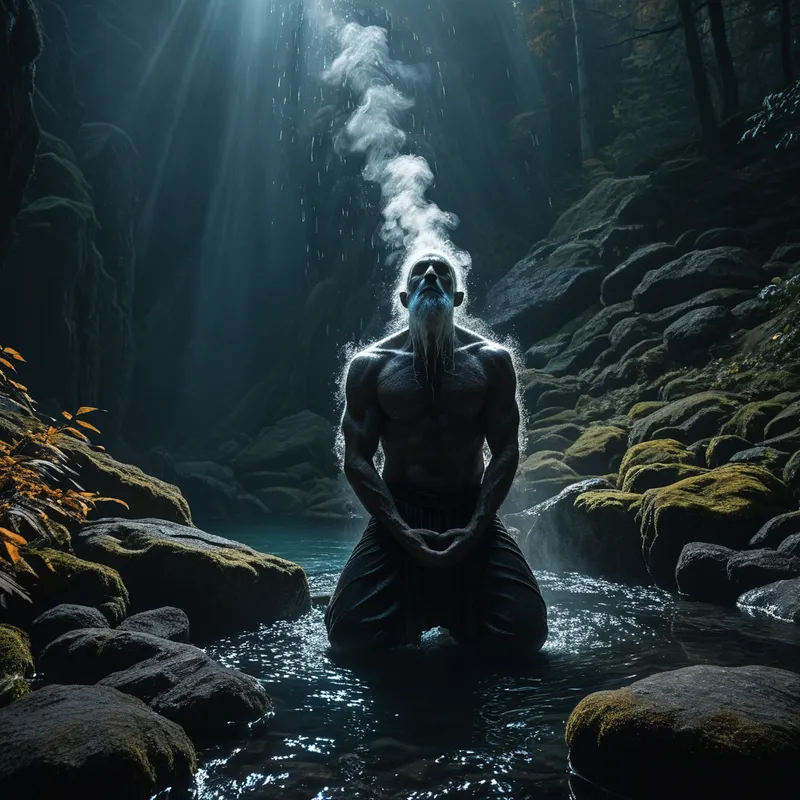
He wandered his own slopes, which began to wither under his sorrow. Where he walked, the green moss greyed. Where he rested, the birds fell silent. His pain was a silent scream that the very stones felt. Finally, overcome by a despair as vast as [the sky](/myths/the-sky “Myth from Persian culture.”/), he found a secluded hollow where the bones of the earth showed through. There, he knelt upon the cold rock. He did not roar or rage. He wept.
His tears were not of [water](/myths/water “Myth from Chinese culture.”/), but of his very life-force, his Tamashii. They fell, heavy and hot, upon the stone. Where each tear landed, it did not soak in or vanish. It burned. It sizzled and pooled, melting the rock, digging deeper, calling to the heated blood of the earth far below. From the depths, the earth’s own warmth answered, rising to meet this divine sorrow. The pools filled, swirling, steaming, emitting a mineral scent of iron and [sulfur](/myths/sulfur “Myth from Alchemical culture.”/) and deep time.
These were the first [onsen](/myths/onsen “Myth from Japanese culture.”/). But the story does not end with the waters.
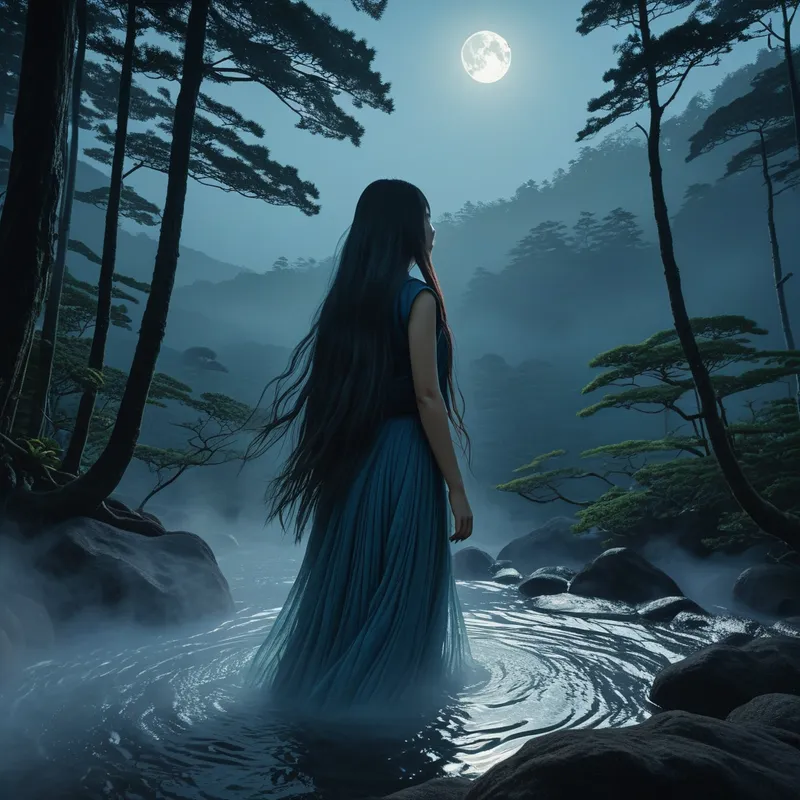
The mountain spirit’s act of vulnerable release, his alchemy of grief into geothermal gift, attracted other presences. From the surrounding ancient woods came the [Kodama](/myths/kodama “Myth from Japanese culture.”/), the tree spirits, drawn by the warmth and the profound feeling. From [the mist](/myths/the-mist “Myth from Celtic culture.”/) that now perpetually clung to the hot springs came the Yōkai of steam and silence. They gathered at the water’s edge, not to bathe, but to guard. They became the Onsen Spirits.
They are seldom seen clearly. You might glimpse a ripple with no cause, a pattern in the steam that looks like a watching face, or hear a sigh that is not [the wind](/myths/the-wind “Myth from Various culture.”/). They are the condition of the gift. The waters heal the body, soothe the muscles, and calm the mind. But the Spirits watch. They ensure the bather approaches with respect—washed clean of the world’s grime before entering, moving quietly, speaking softly, not disturbing the peace. To violate this sacred etiquette is to risk the Spirits’ displeasure: the water might suddenly chill, a sense of profound unease may descend, or the healing properties may simply vanish, leaving behind mere hot water.
The myth endures in the whispered instructions at the bath’s edge, in the [ritual cleansing](/myths/ritual-cleansing “Myth from Multiple Traditions culture.”/), in the hushed reverence of a nighttime soak under the stars. The hot spring is not a utility. It is a covenant, sealed by the tears of a wounded god and upheld by silent, vigilant spirits.
Cultural Origins & Context
The myth of the Onsen Spirits is not housed in a single, canonical text like the Kojiki, but is woven into the fabric of Shinto animism and folk belief. It emerged from the lived experience of communities living near Japan’s countless volcanic hot springs. The origins are practical and phenomenological: early people discovered these healing waters, experienced their benefits, and inevitably asked, “Why is this here? Who grants this gift?”
The answer arose from a worldview that sees all remarkable natural phenomena as Kami-infused. A waterfall, an unusually large rock, a majestic tree, and certainly a mysteriously heated, mineral-rich pool—all possess spirit. The myth provided an etiological explanation (the god’s tears) and, more importantly, a behavioral framework (the Spirits’ guardianship). It was passed down orally, likely by village elders, Kannushi or Miko associated with local shrines, and the bathhouse keepers themselves.
Its societal function was multifaceted. Firstly, it enforced conservation and hygiene rules crucial for communal bathing spaces. Secondly, it sacralized an act of healing, elevating it from mere leisure to a form of communion with the local Ujigami. The ritual of cleansing before entering the bath is a microcosm of the Shinto practice of [Misogi](/myths/misogi “Myth from Shinto culture.”/), purifying not just dirt but spiritual defilement. The myth thus transformed the onsen from a natural resource into a sacred precinct, a threshold between the human world and the animated, watchful world of the spirits.
Symbolic Architecture
At its [heart](/symbols/heart “Symbol: The heart symbolizes love, emotion, and the core of one’s existence, representing deep connections with others and self.”/), this is a myth of alchemical transformation, where a state of profound wounding becomes the [source](/symbols/source “Symbol: The origin point of something, often representing beginnings, nourishment, or the fundamental cause behind phenomena.”/) of universal healing.
The wounded [Mountain](/symbols/mountain “Symbol: Mountains often symbolize challenges, aspirations, and the journey toward self-discovery and enlightenment.”/) God symbolizes the part of the [psyche](/myths/psyche “Myth from Greek culture.”/)—or a [community](/symbols/community “Symbol: Community in dreams symbolizes connection, support, and the need for belonging.”/), or the land itself—that has been traumatized, isolated, and frozen in its pain. His battle scar is not physical but relational; he is cut off from the flow of [life](/symbols/life “Symbol: The symbol of ‘Life’ represents a journey of growth, interconnectedness, and existential meaning, encompassing both the joys and challenges that define human experience.”/). His tears are the critical [moment](/symbols/moment “Symbol: The symbol of a ‘moment’ embodies the significance of transient experiences that encapsulate emotional depth or pivotal transformations in life.”/) of surrender, [the ego](/myths/the-ego “Myth from Jungian culture.”/)’s [breakdown](/symbols/breakdown “Symbol: A sudden failure or collapse of a system, structure, or mental state, often signaling a need for fundamental change or repair.”/) where the dam of stoic endurance cracks. This is not a failure, but the beginning of the cure.
The deepest healing often springs from the point of greatest rupture, when the defended self dissolves into its own essence.
The resulting onsen represents this transmuted pain. The hot, mineral-rich waters symbolize the complex, nourishing, and sometimes challenging (like sulfur’s smell) wisdom that can only be born from processed suffering. It is life-force (Ki) made tangible, available to others.
The Onsen Spirits are the psychological “guardians of [the threshold](/myths/the-threshold “Myth from Folklore culture.”/).” They represent the necessary conditions for this transformed [energy](/symbols/energy “Symbol: Energy symbolizes vitality, motivation, and the drive that fuels actions and ambitions.”/) to be accessed safely and effectively. In the psyche, they are the internal rules of engagement with our own [depths](/symbols/depths “Symbol: Represents the subconscious, hidden emotions, or foundational aspects of the self, often linked to primal fears or profound truths.”/). We cannot approach our core wounds—or the healing they contain—with the same [consciousness](/symbols/consciousness “Symbol: Consciousness represents the state of awareness and perception, encompassing thoughts, feelings, and experiences.”/) that created them. We must approach with respect, humility, and purification of [intention](/symbols/intention “Symbol: Intention represents the clarity of purpose and direction in one’s life and can symbolize motivation and commitment within a dream context.”/).

The Dreamer’s Resonance
When this myth pattern stirs in the modern dreamer, it often signals a profound somatic and psychological process of purification and the negotiation of sacred boundaries.
Dreaming of discovering a hidden hot spring suggests the unconscious is offering access to a deep, internal source of healing that has been nascent or ignored. The warmth indicates a thawing of frozen emotional or instinctual states. Dreaming of being in an onsen, especially if the water is perfectly comforting, points to an active process of receiving this healing, of allowing the psyche’s own restorative powers to work.
Conversely, dreams where the onsen water is too hot, too cold, dirty, or where one is forbidden from entering, speak to the “guardian” function. The dream-ego is being told it is not yet ready. Perhaps there is unresolved guilt, unprocessed anger, or a lack of self-respect blocking access to self-care. A dream of being watched by faint figures in the steam directly invokes the Onsen Spirits. This is the somatic feeling of being held accountable by one’s own deeper conscience or soul—a call to approach oneself with more reverence. The process is one of learning to honor the psyche not as a machine to be fixed, but as a sacred, animate landscape with its own protocols.

Alchemical Translation
For the modern individual navigating the path of individuation—becoming who one fundamentally is—the Onsen Spirits myth models a crucial alchemical sequence: [Nigredo](/myths/nigredo “Myth from Alchemical culture.”/) (the blackening/wounding), Albedo (the whitening/tears), and the guarded integration of the resulting Philosopher’s Stone (the healing waters).
First, we must acknowledge our own “mountain god” aspect: the part of us that is strong, perhaps stoic, but deeply wounded and isolated in its fortress. The conflict that caused the wound is inevitable—a betrayal, a loss, a failure. The alchemical work begins not with fighting the pain, but with the courageous, vulnerable descent to our knees—the Albedo. It is the act of letting the defended ego weep, of allowing the pure, hot truth of our grief, shame, or loneliness to flow.
The spirit guards the spring not to deny us, but to ensure we do not defile the very medicine we seek with the same consciousness that made us sick.
This released essence, our “tears,” must then mix with the “earth’s blood”—our instinctual, bodily life force. The result is a new, potent resource within: a capacity for self-compassion, a hard-won wisdom, a warmth that can soothe our own and others’ aches. But the myth warns that this resource is sacred. The “Onsen Spirits” of our psyche demand we establish rituals of self-respect. We cannot access this deep healing while still clutching the grime of self-loathing, frantic productivity, or cynical disregard. We must “wash clean” first—through mindfulness, through setting boundaries, through acts of simple self-kindness.
The ultimate alchemical translation is this: our greatest wounds, when approached with sacred reciprocity, can become our most potent gifts. We become both the weeping god and the guarding spirit, both the source of the healing waters and the respectful bather, stewarding our own wholeness with awe and care.
Associated Symbols
Explore related symbols from the CaleaDream lexicon: