Onsen Kami Myth Meaning & Symbolism
A myth of divine sacrifice where a deity's suffering transforms into healing waters, teaching the sacred alchemy of pain into communal blessing.
The Tale of Onsen Kami
Listen, and let the steam of memory carry you back. Before the first village was built, when the mountains were young and spoke in the language of groaning stone, there was a deep and silent suffering in [the world](/myths/the-world “Myth from Tarot culture.”/). The people knew cold that bit to the bone, sickness that twisted the spirit, and weariness that turned the heart to lead. They cried out to the emptiness between the stars, but the heavens were silent, wrapped in their own celestial chill.
Then, from the realm of Yaoyorozu no Kami, a being of profound compassion heard their cries. This was a kami of the deep earth, one who understood the slow, patient pulse of the world’s blood. To see the suffering of mortals was to feel a wound in its own divine essence. It could not abide.
The kami descended, not in a blaze of glory, but as a quiet presence at the foot of a sorrowful mountain. It saw a child shivering, an elder coughing a dry, rattling breath, a warrior whose old wounds ached with every movement. The divine heart broke open. And in that breaking, the kami made a choice—a terrible, beautiful choice.
It called the poison of the world to itself. It drew the chill from the children’s bones into its own spirit. It inhaled the fevers, gathered the aches of a thousand tired limbs, and absorbed the grief that had settled in the valley like a fog. The kami, once radiant with the pure energy of [the earth](/myths/the-earth “Myth from Hindu culture.”/), grew heavy and dark. Its form, once as light as mist, became leaden. A great illness, a divine malady, took root within it. This was the sacrifice: to become [the vessel](/myths/the-vessel “Myth from Alchemical culture.”/) for all the pain it sought to cure.
Wracked with this burden, the kami stumbled to a barren, rocky place. Its strength failing, it knelt upon the cold stone. As its divine body could no longer contain the concentrated suffering, it began to weep. Not tears of [water](/myths/water “Myth from Chinese culture.”/), but tears of its very essence, hot and pure, infused with the power of its spirit. It pressed its fevered brow and aching limbs against the unyielding earth, and where it touched, the stone softened. The poison it had gathered, transformed by the alchemy of its compassion, began to flow out.
From its hands, its brow, the place where its heart touched the ground, steaming, mineral-rich water began to seep and then to gush. It was not an expulsion, but a final, generous offering. The kami’s form dissolved, not into death, but into a new state of being. Its consciousness spread, becoming one with the bubbling, healing waters that now filled the rocky basin, creating the first [onsen](/myths/onsen “Myth from Japanese culture.”/).
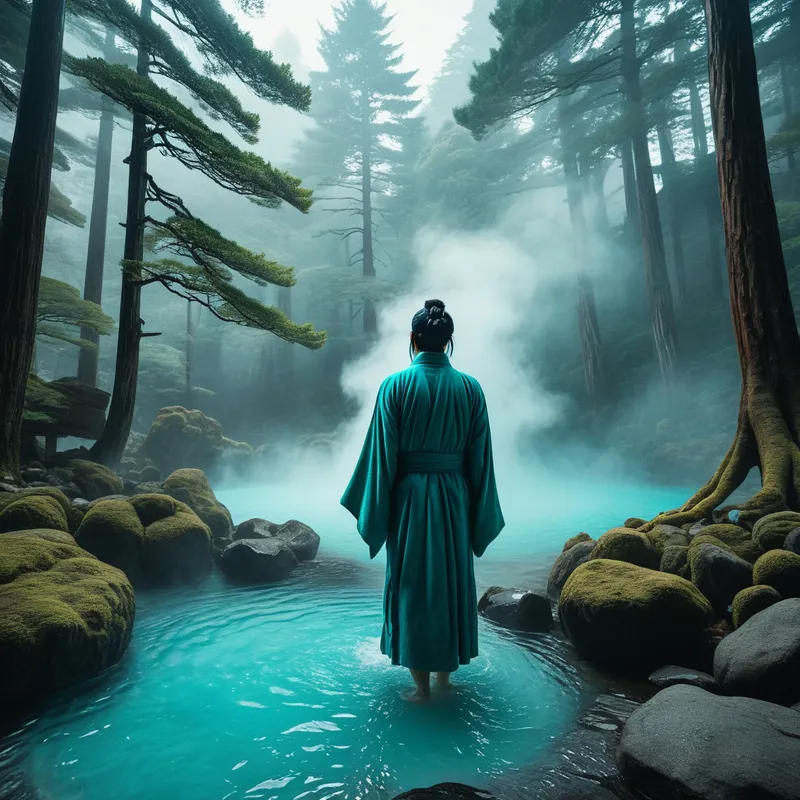
Where there was once a barren scar on the mountain, there now lay a pool of milky blue, wreathed in gentle, life-giving steam. The first mortal to tentatively step into those waters felt not scalding heat, but a deep, penetrating warmth that loosened knotted muscles and soothed the spirit. The coughs quieted, the chills receded, the weary found rest. They understood. The water was not just water; it was the embodied compassion of the Onsen Kami, a perpetual gift born from sacred suffering.
Cultural Origins & Context
The myth of the Onsen Kami is not a single, codified story from a classic text like the Kojiki or Nihon Shoki. Instead, it is a folk tradition, an kuden that blossomed locally around countless hot springs across the Japanese archipelago. Each renowned onsen—from Kusatsu to Gero—often has its own variant, a foundational legend explaining the origin of its specific waters.
These tales were told by village elders, by traveling monks, and by the kannushi who tended the small shrines erected at the spring’s source. The myth served a profound societal function. It transformed a beneficial geological phenomenon into a sacred site, a power spot in modern parlance. It instilled a sense of ritual respect and gratitude, preventing the commodification of the spring and ensuring its careful, communal stewardship. Bathing was not merely hygiene or leisure; it was [misogi](/myths/misogi “Myth from Shinto culture.”/), a form of purification and an act of communion with [the self](/myths/the-self “Myth from Jungian culture.”/)-sacrificing deity. The myth provided the “why” behind the ritual, grounding the physical act of bathing in a deep narrative of divine compassion.
Symbolic Architecture
At its core, the myth is a masterclass in the [symbolism](/symbols/symbolism “Symbol: The use of symbols to represent ideas or qualities, often conveying deeper meanings beyond literal interpretation. In dreams, it’s the language of the unconscious.”/) of transformative suffering. The Onsen Kami is the archetypal embodiment of the Wounded [Healer](/symbols/healer “Symbol: A figure representing restoration, transformation, and the integration of physical, emotional, or spiritual wounds. Often symbolizes a need for care or a latent ability to mend.”/), a being whose [authority](/symbols/authority “Symbol: A symbol representing power structures, rules, and control, often reflecting one’s relationship with societal or personal governance.”/) to heal springs directly from its willingness to be wounded.
The most potent medicine is always distilled in the vessel of personal suffering.
The “illness” the kami takes on is symbolic of the collective [shadow](/symbols/shadow “Symbol: The ‘shadow’ embodies the unconscious, repressed aspects of the self and often represents fears or hidden emotions.”/)—the unspoken pains, the latent [grief](/symbols/grief “Symbol: A profound emotional response to loss, often manifesting as deep sorrow, yearning, and a sense of emptiness.”/), the psychic toxins of a [community](/symbols/community “Symbol: Community in dreams symbolizes connection, support, and the need for belonging.”/). The hot spring that results is not a magical cure that erases pain, but its [transmutation](/symbols/transmutation “Symbol: A profound, alchemical process of fundamental change where one substance or state transforms into another, often representing spiritual evolution or personal metamorphosis.”/). The myth teaches that pain, when fully embraced and consciously processed, can change its state from a blocking, destructive force into a flowing, healing one. The minerals in the [water](/symbols/water “Symbol: Water symbolizes the subconscious mind, emotions, and the flow of life, representing both cleansing and creation.”/) symbolize the wisdom and [strength](/symbols/strength “Symbol: ‘Strength’ symbolizes resilience, courage, and the ability to overcome challenges.”/) gained through the ordeal; they are the tangible “nutrients” left behind after the poison has been alchemized.
The kami’s [dissolution](/symbols/dissolution “Symbol: The process of breaking down, dispersing, or losing form, often representing transformation, release, or the end of a state of being.”/) is also critical. It does not “die” and depart; it becomes the healing medium. This represents the ultimate [integration](/symbols/integration “Symbol: The process of unifying disparate parts of the self or experience into a cohesive whole, often representing psychological wholeness or resolution of internal conflict.”/) of the [caregiver](/symbols/caregiver “Symbol: A spiritual or mythical figure representing nurturing, protection, and unconditional support, often embodying divine or archetypal parental energy.”/) [archetype](/symbols/archetype “Symbol: A universal, primordial pattern or prototype in the collective unconscious that shapes human experience, behavior, and creative expression.”/), where the [boundary](/symbols/boundary “Symbol: A conceptual or physical limit defining separation, protection, or identity between entities, spaces, or states of being.”/) between the healer and the healing [action](/symbols/action “Symbol: Action in dreams represents the drive for agency, motivation, and the ability to take control of situations in waking life.”/) dissolves. The help is no longer given from a place of detached superiority, but from a state of identification and unity.
The Dreamer’s Resonance
When this myth pattern activates in the modern [psyche](/myths/psyche “Myth from Greek culture.”/), it often manifests in dreams of immersion, illness, and paradoxical healing. A dreamer might find themselves in a strange, steaming pool that both burns and soothes. They may dream of carrying a heavy, hot stone in their chest that slowly melts away in water. Or they may witness a loved one—or a luminous, unknown figure—becoming ill only to transform into a landscape of warm springs.
These dreams signal a profound somatic and psychological process: the conscious engagement with carried pain. This could be personal trauma, generational grief, or the simple, accumulated exhaustion of modern life. The body-mind is announcing that the old strategy of ignoring or compartmentalizing suffering is failing. The “poison” must be acknowledged and brought to the surface—the kami’s act of drawing it in. The dream immersion represents the beginning of the alchemical process, where [the ego](/myths/the-ego “Myth from Jungian culture.”/)’s solid form must soften and dissolve in the waters of the unconscious to allow for transmutation. It is often a dream of necessary breakdown preceding breakthrough.
Alchemical Translation
For the individual on the path of individuation, the Onsen Kami myth provides a powerful model for psychic transmutation. The journey is not about avoiding suffering or achieving a state of painless perfection. It is about learning to become [the sacred vessel](/myths/the-sacred-vessel “Myth from Various culture.”/) for one’s own darkness.
The first step is the kami’s compassionate hearing: turning inward with radical acceptance to truly listen to one’s own aches, fears, and “poisons.” The second is the courageous incorporation: to stop projecting these shadows onto others or the world, and to take responsibility for them as part of one’s own totality. This is the “divine illness,” [the dark night of the soul](/myths/the-dark-night-of-the-soul “Myth from Christian Mysticism culture.”/) where one feels burdened and transformed by their own material.
The goal is not to expel the shadow, but to provide it the sacred heat of consciousness until it yields its hidden nutrients.
The final, alchemical stage is the offering. As the processed pain loses its toxic charge, it transforms into a resource—a warmth, a wisdom, a capacity for depth and empathy that can flow out to nourish one’s own life and, by extension, the lives of others. The individual’s identity shifts. They are no longer a person who was hurt, but a source of understanding born from that hurt. Their consciousness, like the kami’s, becomes less a fixed, isolated entity and more a quality of presence, a healing atmosphere they carry and can offer. They have built an inner onsen, a perpetual spring where the waters of experience, however initially cold or bitter, are forever being warmed and transformed into sources of renewal.
Associated Symbols
Explore related symbols from the CaleaDream lexicon: