Onsen Myth Meaning & Symbolism
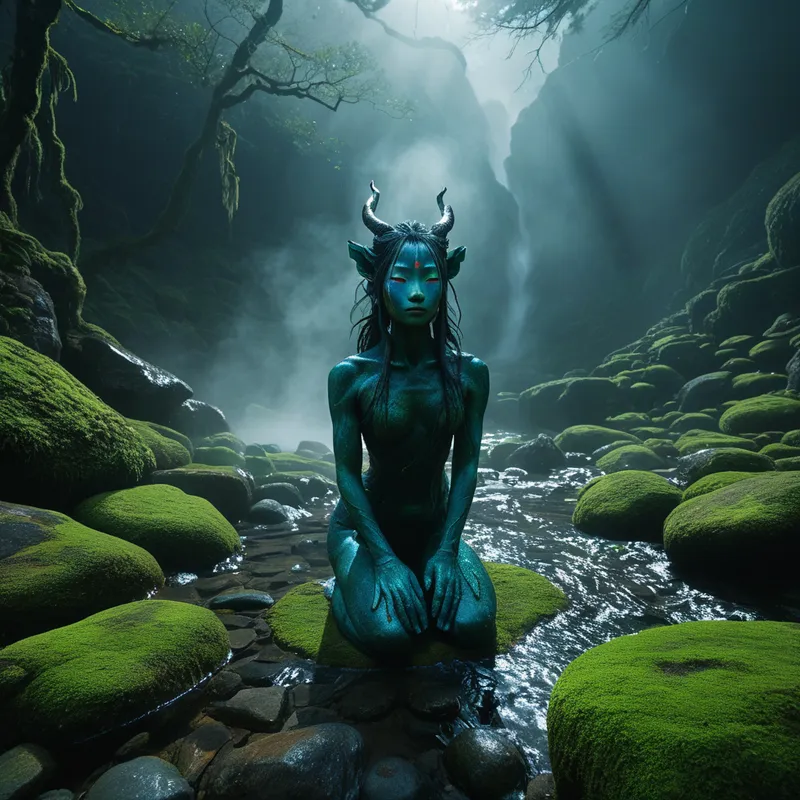
A kami, wounded and in agony, transforms its spilled blood into the first hot springs, gifting humanity a place of profound healing and purification.
The Tale of Onsen
In the age when the world was still raw and the mountains breathed with the fire of the earth’s heart, there walked a being of great power and gentle spirit. This was kami, not of the distant, perfect heavens, but of the deep, tumultuous flesh of the land itself. Some say it was a mountain god, its form a shifting tapestry of rock and forest, of eagle’s wing and bear’s strength. Others whisper it was a wanderer, a bridge between the realms of the wild and the first stirrings of human hearts.
This kami loved the world with a fierce tenderness. It watched the early people struggle against the biting cold of winter, their bodies wracked with aches, their spirits weighed down by toil and the fragility of flesh. The kami felt their suffering as a thorn in its own side, a cold echo in its fiery blood.
One fateful season, a great conflict erupted among the primal forces of the land. Perhaps it was a battle with a raging orochi, or a cataclysm as the earth’s plates groaned and shifted. The kami stood as a protector, a shield for the vulnerable valleys where people dwelt. In the titanic struggle, it was struck a grievous blow. A spear of poisoned malice or a claw of elemental fury tore deep into its side. Not a wound that would end its existence, but one that poured forth its vital essence—its hot, divine blood—onto the cold, unyielding stone of the mountain pass.
The kami fell to its knees, not in defeat, but in a moment of profound surrender. Agony was a fire in its veins. As its lifeblood, shimmering with the very heat of creation, spilled onto the earth, it did not simply stain the ground. It communed with it. The blood seeped into fissures, down to where the sleeping fires of the world slumbered. It called to them. And the earth answered.
Where the crimson drops fell, the stone began to weep. Not with water, but with a new kind of tears—clouds of fragrant steam rose first, then a gentle bubbling, and finally, a generous, continuous flow of milky, mineral-rich water, heated by the earth’s own heart and infused with the kami’s sacrifice. The scorching pain of the wound was translated, alchemized, into a pervasive, enveloping warmth. The pool filled, cradled by rocks now smooth and welcoming.
Exhausted, the kami rested at the water’s edge. It lowered its wounded flank into the pool. And a miracle of reversal occurred. The searing pain began to ebb, soothed by the very waters born from its injury. The minerals knit not its divine flesh, but something deeper—its purpose. It understood. This was the gift. Not from a place of untouched power, but from a place of shared wounding. The first onsen was born, not as a geographical feature, but as a testament written in water and steam: that from profound rupture can flow profound healing.

Cultural Origins & Context
The myth of the onsen’s divine origin is not a single, codified story from a text like the Kojiki, but a living folklore that permeates countless local traditions across Japan. Every renowned hot spring region—Beppu, Kusatsu, Hakone—often has its own yurai, or origin story, frequently involving a wounded animal (a deer, a tanuki), a weary traveler, or a local deity discovering the springs. The version with the wounded kami synthesizes these local tales into a foundational archetype.
These stories were passed down by village elders, by the keepers of the baths themselves, and are intrinsically tied to Shinto animism. In Shinto, natural phenomena are not inert; they are alive with spirit. A waterfall, a large rock, and certainly a geothermal spring, are iwakura or yorishiro—dwelling places or vessels for kami. The onsen myth gives narrative form to this belief, explaining the why of its sacredness. Its societal function was multifaceted: it established the spring as a protected, ritual space (often with a small shrine nearby), it dictated codes of purifying behavior before entering, and it framed the act of bathing not as mere hygiene, but as a participatory ritual in receiving a divine gift born from sacrifice.
Symbolic Architecture
At its core, the myth is a powerful map of alchemical transformation. The central symbols are clear: the Wound, the Blood/Life Essence, the Earth, and the resulting Healing Waters.
The wound is not a mistake or a punishment; it is the catalyst. It represents a necessary rupture in the established order of the self or the world—a moment of profound vulnerability, pain, or sacrifice. The kami’s blood is its vital force, its tama or spirit-energy, being expended. This is not a loss, but an investment.
The most profound gifts are not given from surplus, but are forged in the crucible of personal cost. The healing offered to others is first distilled from one’s own endured pain.
The earth represents the unconscious, the receptive, foundational layer of reality—both the physical world and the psychic ground of being. It does not reject the blood but receives it, interacts with it, and transmutes it through its own latent fires. The resulting onsen is the symbol of integration. It is the tangible, accessible result of this alchemy: suffering, processed through the depths of nature (or the unconscious), becomes a source of renewal, warmth, and communal healing. The waters are not purely “clean”; they are mineral-rich, often sulfurous—carrying the distinct character (the “flavor”) of the original struggle.
The Dreamer’s Resonance
When this mythic pattern stirs in the modern dreamer, it often signals a profound somatic and psychological process of transmutation. To dream of discovering a hidden hot spring, or of being invited to bathe in one, especially while feeling wounded, weary, or ill, points to the psyche’s innate healing intelligence activating.
The somatic process is one of moving from contraction to expansion. The initial wound—perhaps dreamt as an injury, an illness, or an emotional shock—causes a contraction, a guarding of the self. The dream-onsen offers a space for a conscious, surrendered re-immersion into that feeling-state, but within a container of warmth and support. The heat of the water in the dream parallels the often uncomfortable but necessary “heat” of feeling one’s emotions fully. The minerals symbolize the nutrients of insight and character being absorbed from the processed experience. This is not a dream of quick fixes, but of slow, osmotic healing. It suggests the dreamer is in a phase where their deepest pains are being “cooked” in the unconscious, beginning to transform from isolating trauma into a potential source of wisdom and resilience.

Alchemical Translation
For the individual on the path of individuation, the Onsen Myth is a master lesson in the ecology of the soul. It reframes the hero’s journey from one of conquest to one of sacrificial catalysis.
The modern ego often seeks to avoid wounding, to heal scars until they disappear. The myth proposes a different path: the wound itself, when acknowledged and surrendered to a force greater than the ego (the “Earth,” the Self, the unconscious), becomes the very aperture through which healing energy flows—not just for oneself, but for the world around one. The alchemical stages are clear:
- Nigredo (The Blackening): The wounding blow. The experience of pain, failure, illness, or betrayal—the descent.
- Albedo (The Whitening): The surrender and the spill. Allowing the pain to flow, to be felt, rather than dammed up. This is the kami letting its blood fall, the conscious acknowledgment of one’s broken state.
- Rubedo (The Reddening): The alchemical marriage. The individual’s life-essence (blood) meets the transpersonal ground of being (earth). In therapy, art, or deep reflection, personal pain is connected to universal archetypes.
- Citrinitas (The Yellowing, or here, The Warming): The emergence of the gift. From this union bubbles forth the “healing water”—a new capacity for empathy, a creative outlet, a deeper sense of purpose, a hard-won wisdom that can comfort others.
Individuation is not about becoming a perfectly sealed vessel, but about becoming a sacred spring: a place where what was once a site of rupture now offers sustained warmth, where one’s transformed wounds become a sanctuary for others.
The individual learns that their deepest vulnerabilities, processed through the slow, geothermal heat of introspection and acceptance, do not make them a burden. Instead, they become a source of natural, healing presence. One does not just “get over” a wound; one builds a communal bathhouse around it, turning private agony into a public good. This is the ultimate alchemical translation: the lead of suffering is not discarded, but patiently transmuted into the gold of compassionate, grounded healing.
Associated Symbols
Explore related symbols from the CaleaDream lexicon: