Onion of Truth Myth Meaning & Symbolism
A hero journeys to the Oracle's cave to peel the sacred Onion of Truth, confronting illusions to find the empty, luminous core of the self.
The Tale of Onion of Truth
Hear now, you who seek, of the time when truth was not a word but a thing, heavy with the scent of earth and rain. It was an age when the gods still walked in the spaces between thoughts, and the greatest mysteries were kept not on Olympus, but in the deep, breathing dark beneath the world.
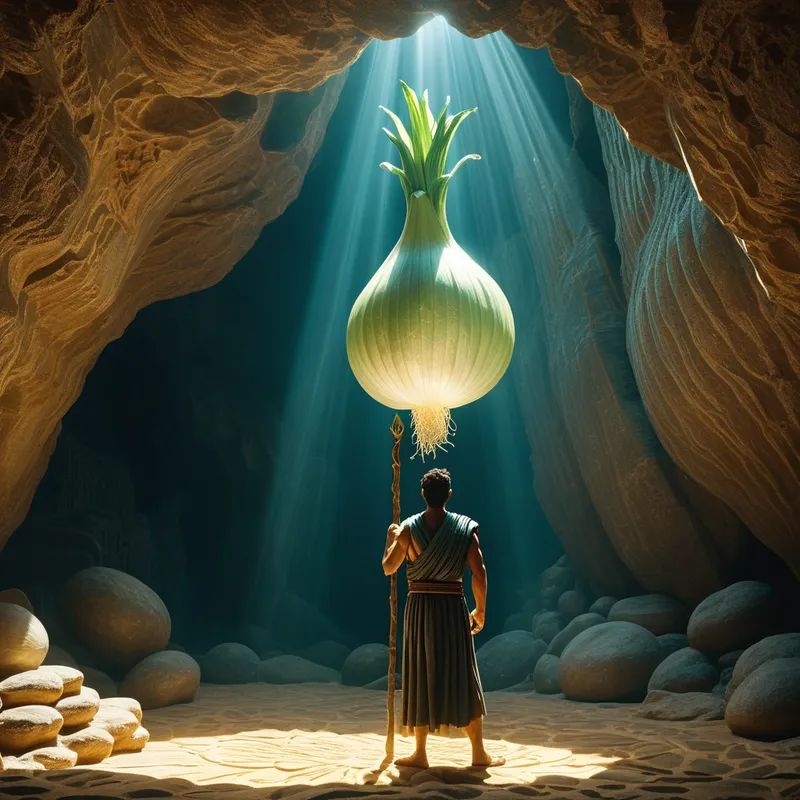
There was a seeker, Alexanor, whose mind was a cage of questions. He had studied the philosophers' scrolls until the ink blurred, and listened to the sophists until their clever words rang hollow. A fever was upon him—a need to know what is, stripped of all adornment. He journeyed to the most ancient of places, the Cave of Unseeing at Omphalos, where the air is thick with silence and the whispers of the past cling to the stone like moss.
Within, attended by no priestess but by shadows, floated the Onion of Truth. It was not grand, but humbly radiant, a sphere of layered, luminous membranes that pulsed with a soft, interior light. No oracle spoke. The cave itself seemed to breathe a single command: Peel.
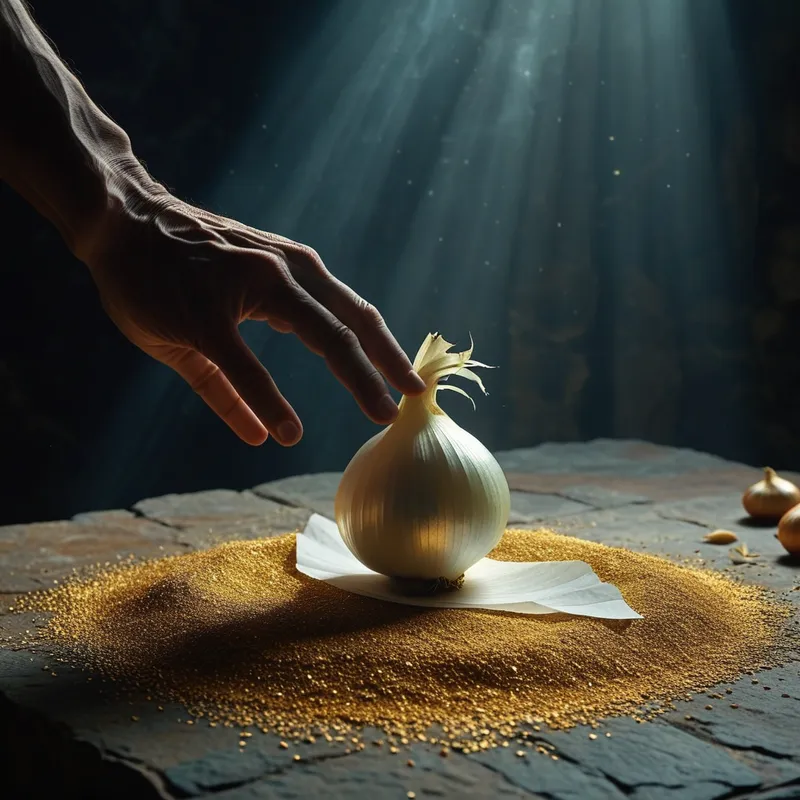
With hands that shook not from fear, but from the terrible gravity of the act, Alexanor reached out. His fingers touched the first layer. It came away like the petal of a moonflower, and as it parted from the whole, a vision filled the cave. He saw himself as the world saw him: the noble seeker, the respected man. It was a glorious image, gilded with the admiration of others. It was also a lie. The layer dissolved into motes of light.
The next layer was tougher, a membrane of remembered slights and nurtured wounds. As it peeled, he felt the old angrises, the justifications for his solitude. This too dissolved. Layer after layer fell before his relentless hands. Layers of cleverness he mistook for wisdom. Layers of piety performed for the eyes of gods and men. Layers of fear masquerading as caution, and desire pretending to be love. Each revelation was a humiliation, a stripping bare. The glorious hero was gone, the philosopher vanished, leaving only a raw and trembling man in a dark cave, surrounded by the fading ghosts of his own illusions.
Finally, he stood before the last layer. This one did not shimmer. It was dull, thin, fragile—the final skin over the secret heart. A profound terror seized him. To remove this was to be unmade. Yet, the compulsion was absolute. He peeled.
And found… nothing.
An emptiness. A silent, dark, perfect sphere at the center where he expected a jewel, a seed, a final answer. He cried out in despair, a sound swallowed by the void. He had destroyed the sacred object and found only absence.
But as his eyes adjusted to the dark of that core, he saw it was not mere nothing. It was a space filled with potential, a clean vessel. And within that emptiness, a new light began—not from the onion, but from himself, reflected and purified in the void he had created. He had not found Truth as a thing to hold. He had become the hollow space where truth could live. He walked from the cave, not with answers, but with a quietness he had never known. The world looked the same, yet utterly new, seen for the first time through unlayered eyes.
Cultural Origins & Context
The myth of the Onion of Truth is not found in the canonical works of Hesiod or Homer, but belongs to the rich substratum of Orphic and philosophical mystery traditions that flourished in the later archaic and classical periods. It was an esoteric teaching, a mythos passed not in public theaters but in the hushed telesterion of philosophical schools and mystic circles. Its tellers were likely guides for initiates, using it not as historical narrative but as a map for an inner journey.
Its societal function was subversive in the most profound sense. In a culture built on public honor (timē), civic identity, and clearly defined roles, the myth proposed a terrifying and liberating idea: that the social self is a construct, a series of layers to be respectfully dissolved. It served as a corrective to the heroic individualism of the epics, pointing toward a different kind of heroism—the heroism of radical self-honesty. It was a narrative companion to the Delphic maxim "Know Thyself," illustrating not the finding of a solid self, but the un-finding of the false ones.
Symbolic Architecture
The myth’s power is an architectural marvel built of simple, profound symbols. The Onion of Truth itself is the central paradox. An onion is common, earthly, even lowly—yet here it is the vessel of the ultimate. This embodies the principle that profound truth is not remote or celestial, but immanent and organic, hidden in the plainest of forms.
The journey to the center is a journey through the self, and what one finds at the terminus is the space the self occupies, not its solid contents.
Each layer represents a prosōpon, a face we present to the world and come to believe is our own. The glorious first layer is the persona, the social mask. Subsequent layers are the complexes—clusters of memory, emotion, and identity—that structure our unconscious reactions. The painful peeling is the work of apocalypsis, literally an "un-covering." The final, terrifying emptiness is the encounter with the Self, which in its purest form is not a content but a unifying function, a void that holds the potential for all things. It is the Chaos at the heart of order, the fertile nothing from which authentic being can spring.
The Dreamer's Resonance
When this myth stirs in the modern dreamer, it announces a season of deconstruction. One may dream of peeling skin, shedding endless coats, opening nested boxes that grow smaller, or walking through a series of empty rooms. The somatic sensation is often one of exposure, vulnerability, or a chilling lightness. Psychologically, this signals that the psyche has begun its own work of individuation by dismantling outworn identities.
The dream-ego, like Alexanor, is compelled to peel, even when it is painful. Each dissolved layer in the dream represents a conscious attitude or an unconscious identification that has served its purpose and must now be released—perhaps the "competent professional" layer, the "dutiful child" layer, the "wounded victim" layer. The anxiety in the dream mirrors the resistance of the conscious ego, which rightly fears its own dissolution. The dream does not promise comfort; it enacts the necessary suffering of truth. To dream this myth is to be in the cave, actively engaged in the psychospiritual process of distinguishing the essential from the accreted.

Alchemical Translation
The myth of the onion is a perfect allegory for the alchemical nigredo and albedo, the core of psychic transmutation. The seeker’s initial state is one of unconscious identification with their layers (the prima materia). The journey to the cave is the conscious decision to engage the process (voluntas).
The peeling is the separatio and solutio. It is a controlled disintegration, a breaking down of the composite personality into its constituent illusions. This is the dark night, the despair of Alexanor in the cave. He believes he has failed, that the core is empty. This is the critical moment of the mortificatio.
The treasure is not found in the center, but is made possible by the creation of the center. The void is not the end of the process, but its most crucial vessel.
Then comes the turn, the conjunctio within the self. The emptiness is recognized not as nihilistic void, but as sacred vessel—the Lapis in its potential state. The light that arises is the illuminatio, the realization that the true "I" is not the layers that were peeled, nor the emptiness that remains, but the awareness that holds both. The individual returns to the world (reditus), not with a new, thicker layer of "enlightened one," but with a capacity for presence that is empty of fixed identity, yet full of authentic response. They have performed the alchemy of the self: turning the lead of illusion into the gold of conscious being, not by adding something, but by subtracting everything that is not gold.
Associated Symbols
Explore related symbols from the CaleaDream lexicon: