Ogun's Forge Myth Meaning & Symbolism
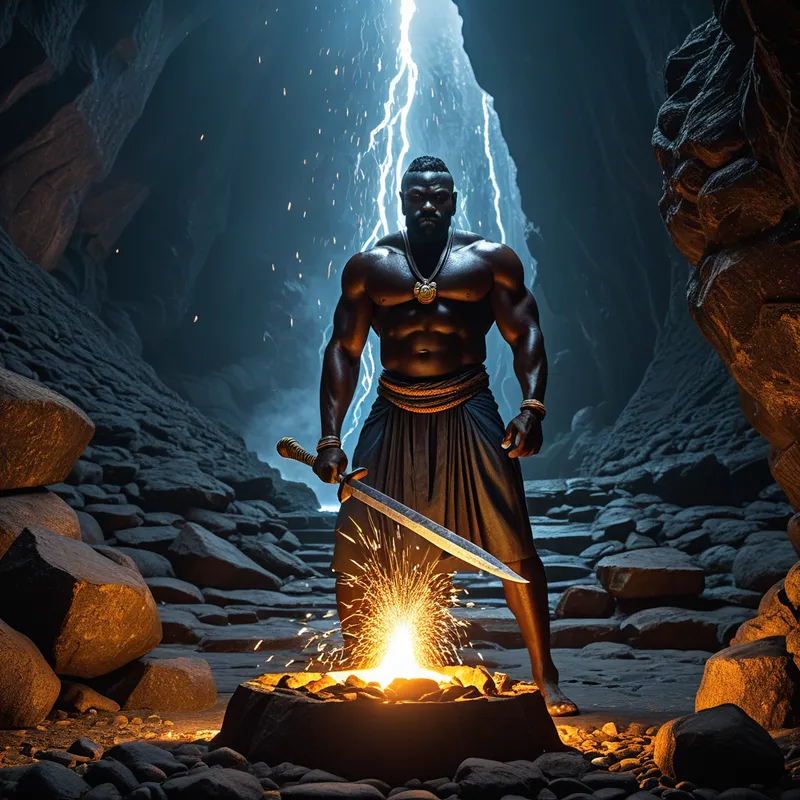
The god Ogun descends to a primal world, sacrificing his peace to forge the first tools from the world's core, bringing order from chaos.
The Tale of Ogun’s Forge
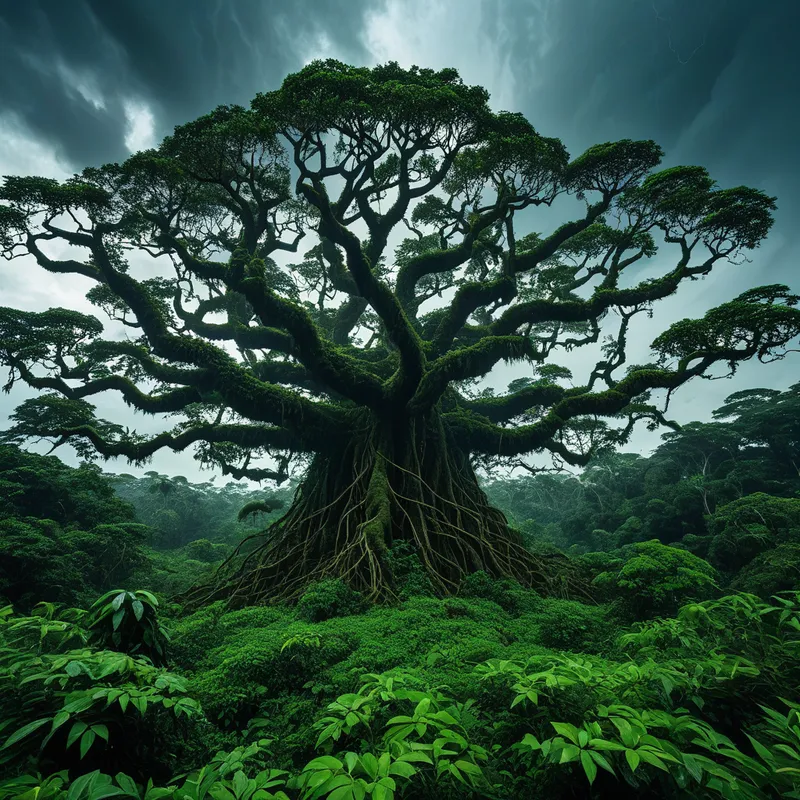
In the time before paths, when the world was a throat of green, choked and silent, the people cried out. The Earth was a womb of relentless growth, a tangle of roots thicker than serpents, vines that strangled the light, forests so dense they breathed as one monstrous lung. There was no here to there. Only a suffocating everywhere. To move was to be consumed. To build was impossible. The people huddled in clearings, their spirits wilting under the weight of the unmovable, untamable wild.
Above, in Orun, the Orisha Ogun heard their despair. He was the lord of iron, of the silent, enduring metal within the mountain’s heart. His essence was not of airy thought or fluid emotion, but of decisive action, of the clear, sharp line. The chaos below was an affront to his very nature. He looked upon his brothers and sisters, deities of river, storm, and earth, and found no answer in their domains. The solution required not a flood or a quake, but a cut. A separation. A making.
With a resolve that shook the foundations of Aye, Ogun descended. He did not arrive on a sunbeam or a cloud. He plunged like a meteor, drawn to the deepest, hottest secret of the world. He found it in the belly of the greatest mountain—a cavern where the bones of the Earth wept molten fire. Here, in this primordial crucible, was the raw potential of order. But it was silent, formless, a red and gold lake of pure possibility.
Ogun knelt. He did not pray. He acted. With his bare, indomitable hands, he plunged into the living fire. The heat was a agony beyond telling, a pain that seared not just flesh but spirit. This was the pact: to shape chaos, one must first endure its essence. He drew forth a fistful of the world’s burning blood—the first ore. Upon a shelf of unshaped rock, he began to beat it. The sound that echoed through the cavern was the first true sound of civilization: not a growl, not a song, but the clear, ringing clang of purpose.
Clang. A spark flew, cutting the eternal gloom. Clang. The molten blob flattened, resisted, then yielded. Clang. An edge appeared, sharp and terrible and beautiful. Sweat, like the first rain, fell from his brow and hissed on the anvil. He forged not just one tool, but the principle of all tools: the axe to cleave the vine, the hoe to break the soil, the machete to open the path, the spear to defend the clearing. Each strike was a word in a new language—the language of making.
Exhausted, covered in the soot of creation, Ogun emerged from the mountain. In his hands, he carried the future. He demonstrated the axe to the people, and with the first swing, a path was born. Where the blade fell, chaos receded, and space—precious, inhabitable space—was carved into being. The people, their fear turning to awe, then to understanding, took up the tools. The great work began. Ogun did not rule them from a throne; he worked beside them, his forge-fire now kindled in every hearth, his principle embedded in every cleared field and built wall. He had taken the world’s chaotic heart and forged it into a means of its own cultivation.
Cultural Origins & Context
This myth originates from the Yoruba people of West Africa, whose worldview intricately links the spiritual (Orun) and the physical (Aye). The stories of the Orishas like Ogun were not mere entertainment but the foundational pillars of culture, ethics, and identity. Passed down orally by priests (Babalawos), elders, and through ritual ceremonies like those of the Ifá corpus, these narratives served as sacred maps for living.
Ogun’s myth functioned as a societal charter. It sanctified the professions of blacksmithing, hunting, warfare, and surgery—all fields that employ iron and require precision, courage, and transformative force. It explained the sacred nature of technology and the moral responsibility that comes with the power to cut, shape, and destroy. Festivals like the Ogun festival involved sacrifices, the cleaning of tools, and communal reaffirmation of the pact between humanity, the deity, and the materials that sustain civilization. The myth taught that progress is born from sacred sacrifice and directed effort, not granted by whim.
Symbolic Architecture
At its core, Ogun’s Forge is a supreme allegory for the principle of conscious differentiation. The impenetrable jungle represents the undifferentiated psyche—a state where all potentials, drives, and thoughts are entangled, leading to paralysis. It is the inner chaos of unprocessed emotion, conflicting desires, and unconscious impulses.
The forge is the crucible of the conscious will, where raw, unconscious content is subjected to the heat of attention and the hammer of discipline.
Ogun himself symbolizes the focused, disciplined aspect of the ego that can engage with this chaos. His descent is the difficult decision to confront one’s own shadowy, primal depths. The molten ore is the searing, often painful, raw material of the psyche—repressed memories, innate talents, fierce passions. The act of forging is the slow, arduous process of giving this raw material form and function. The resulting tools—axe, machete, spear—are not weapons of indiscriminate destruction, but instruments of discernment. They represent the psychic faculties we forge to navigate life: the ability to cut away what is unnecessary (the axe), to clear a path forward (the machete), and to defend our nascent individuality (the spear).

The Dreamer’s Resonance
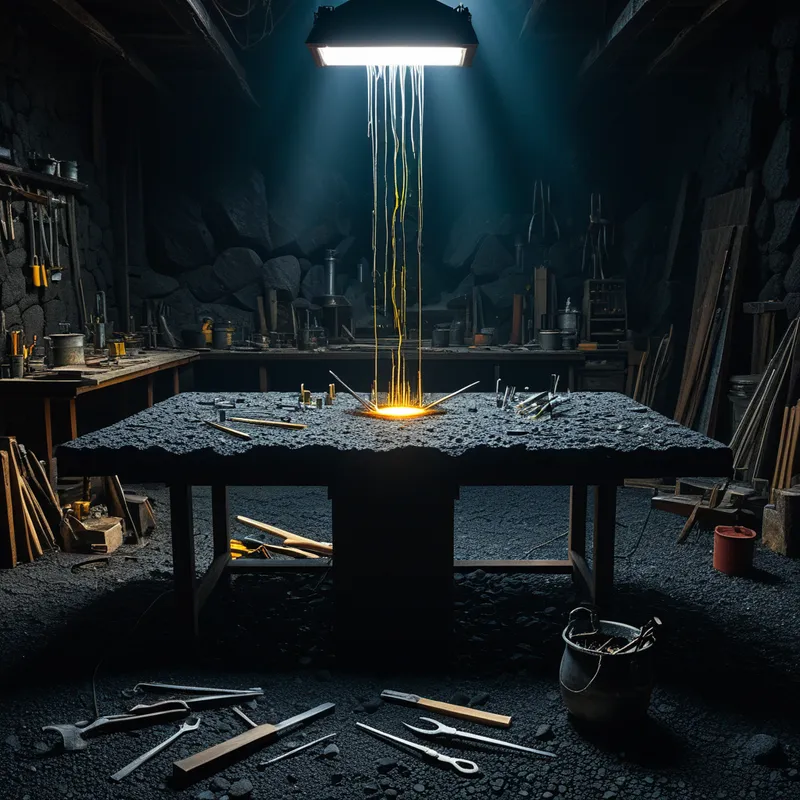
When this myth activates in the modern psyche, it often manifests in dreams of intense, focused struggle within a confined, hot, or metallic space. One might dream of being in a basement workshop, desperately trying to repair a vital machine as it falls apart. Or of holding a piece of glowing metal, knowing it must be shaped, but feeling terrified of the heat and the hammer.
Somatically, this can correlate with feelings of pressure in the head or chest, a sense of being “in the fire” of a life crisis, or restless energy in the hands and arms—the body’s memory of the tool-maker. Psychologically, this dream pattern signals a critical phase of psychic distillation. The dreamer is in the forge. The conflict is between the comfort of old, tangled ways (the jungle) and the painful but necessary act of self-definition. The rising action is the gathering of one’s raw willpower (the ore). The climax is the decisive commitment to the transformative act, despite the pain. The resolution is not always seen in the dream, for the forging is ongoing, but it is hinted at by the emergence of a sharp edge, a functional shape—a new, more precise way of thinking or a firm boundary finally set.
Alchemical Translation
The alchemical journey mirrored in Ogun’s descent is the Nigredo, the descent into the blackness, the massa confusa. For the individual, this is the often-unavoidable plunge into a period of depression, confusion, or life-altering crisis where old structures dissolve. The mountain’s heart is the core of one’s being, where the primal, unvarnished truth resides.
Individuation is not a gentle awakening, but a forging. The self is not found, it is made—through the relentless, loving application of truth upon the ore of experience.
The forging process is the Albedo and Citrinitas—the purification and illumination. The hammer is conscious reflection and disciplined action. The anvil is the stable, enduring core of one’s values or the therapeutic container that holds the process. The fire is the emotional and intellectual heat of engagement—the willingness to feel fully and think clearly.
The final tool, the symbol of the Rubedo, is the forged “weapon” of the integrated personality. It is not used against the world, but in service to it. It is the specific, unique talent, perspective, or mode of action that an individual brings into being through their struggle. One becomes, like Ogun, a conduit for transformative power, no longer trapped in the jungle of the collective or the personal unconscious, but capable of carving a authentic path and helping others find their way. The forge-fire becomes internalized; the creator and the creation become one.
Associated Symbols
Explore related symbols from the CaleaDream lexicon: