Ogou Ferraille Myth Meaning & Symbolism
The myth of the scarred warrior deity who transforms the violence of iron into the justice of the forge, embodying the alchemy of rage into righteous power.
The Tale of Ogou Ferraille
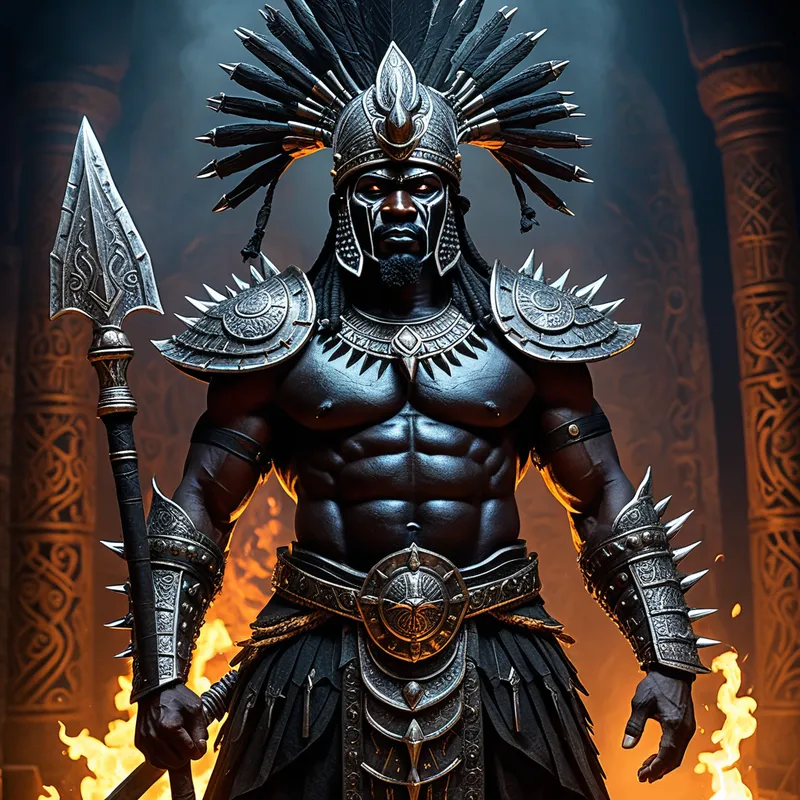
Hear now the tale of the one forged in fury, tempered in tears. In the time before time, when the world was raw spirit and unshaped potential, there was a fire that would not be contained. It was not the gentle hearth-fire, nor the wild forest-fire, but the deep, groaning fire at the heart of the mountain, the fire that births iron from stone.
From this primordial heat, a consciousness awoke. He was not born of soft clay or whispered breath, but hammered into being on the anvil of necessity. He was the first spark struck from flint, the first ring of metal on metal. They named him Ogou, and his domain was the edge, the point, the unyielding line. But this Ogou was different. His essence was not pure, gleaming steel, but something harder, more complex.
He walked into the great conflict, the war to shape the world. He fought not with distant strategy, but with the intimate, brutal work of the front line. His weapon, the machete, became an extension of his will. He clashed with forces of chaos and forces of tyranny alike, and in each battle, he did not emerge unscathed. The enemy’s blades bit deep. Lightning scarred his form. The very fires he commanded sometimes turned and licked his skin. Each wound was a betrayal, a lesson in the cost of power.
He became a patchwork being, a living testament to every struggle. His skin, once like dark, smooth ore, was now a landscape of ridges and valleys, of silvery seams and keloid peaks. The other spirits whispered, some in pity, some in disdain. They saw only brokenness. But in the silence of his forge, Ogou Ferraille—Ogou of the Scrap Iron—gazed at his reflection in a pool of cooling quench-water. He did not see ruin. He saw a map. A record. A text written in pain, waiting to be read.
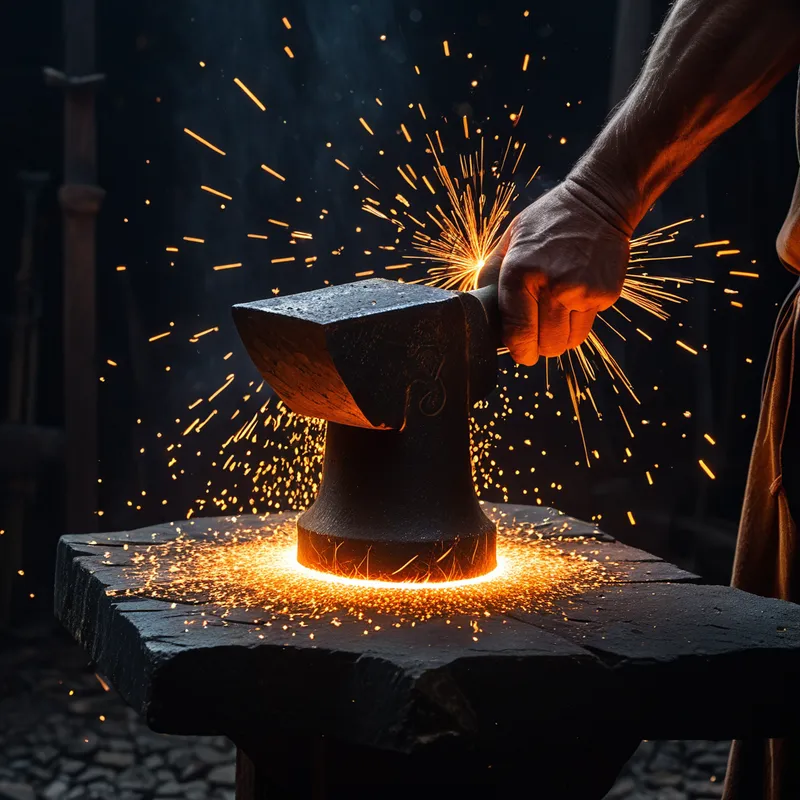
He gathered the fragments—the shattered blades, the spent bullets, the rusted chains of captivity, the bent nails of abandoned hopes. He did not discard them as refuse. He placed them in his forge, the belly of the sacred mountain. He worked the bellows not with anger, but with a focused, righteous breath. He did not melt the scars away; he melted the fragments into the scars. He began to re-forge himself, not back into what he was, but into what he had become. The scrap iron became his new flesh, fused with the old. His machete, once simply sharp, now carried the weight of history and the promise of justice. He emerged not as a pristine god of war, but as the deity of the veteran, the revolutionary, the survivor, the blacksmith who transforms the instruments of oppression into tools of liberation. His scars were no longer wounds; they were the seams where his purpose had been welded, stronger than any untouched metal.
Cultural Origins & Context
The spirit of Ogou Ferraille traveled the Middle Passage, not in the holds of the ships, but in the clenched fists and defiant hearts of the enslaved Fon, Yoruba, and Kongo peoples. In the brutal crucible of Saint-Domingue (later Haiti), colonial sugar plantations, and the fight for survival, the West African Ogun underwent a profound alchemy. He split into a family, a battalion of aspects, each addressing a specific facet of the diasporic experience.
Ogou Ferraille is a distinctly New World creation, born from the collision of African spirituality with the harsh, metallic reality of colonialism. “Ferraille” means scrap iron, junk metal—the discarded, the used, the broken. This Ogou is the spirit of that very material. He is the deity of the rusted machete used for both labor and revolt; of the recycled iron of old tools and weapons; of the railroad spikes and industrial detritus of a new, oppressive world. He was invoked by hougans and mambos not just for victory in war, but for justice in the courtroom, for strength in political struggle, and for the power to rebuild a broken society from its own shattered pieces. His myth is not an ancient, distant story but a living narrative of resistance, resilience, and recycling trauma into strength, told through ritual, song, and the very practice of forging community from fragmentation.
Symbolic Architecture
At its core, the myth of Ogou Ferraille is a masterclass in the [symbolism](/symbols/symbolism “Symbol: The use of symbols to represent ideas or qualities, often conveying deeper meanings beyond literal interpretation. In dreams, it’s the language of the unconscious.”/) of alchemical transformation, where the base [material](/symbols/material “Symbol: Material signifies the tangible aspects of life, often representing physical resources, desires, and the physical world’s influence on our existence.”/) of suffering is transmuted into the gold of conscious power.
The wound that is merely suffered remains a prison. The wound that is consciously integrated becomes the forge.
The machete symbolizes discriminating [consciousness](/symbols/consciousness “Symbol: Consciousness represents the state of awareness and perception, encompassing thoughts, feelings, and experiences.”/)—the [ability](/symbols/ability “Symbol: In dreams, ‘ability’ often denotes a recognition of skills or potential that one possesses, whether acknowledged or suppressed.”/) to cut through illusion, [injustice](/symbols/injustice “Symbol: A perceived violation of fairness, rights, or moral order, often evoking a sense of imbalance or ethical breach.”/), and overgrown psychic thickets. It is not a [weapon](/symbols/weapon “Symbol: A weapon in dreams often symbolizes power, aggression, and the need for protection or defense.”/) of blind aggression, but of precise, necessary [action](/symbols/action “Symbol: Action in dreams represents the drive for agency, motivation, and the ability to take control of situations in waking life.”/). The Ferraille represents the fragmented psyche: our traumas, our [shame](/symbols/shame “Symbol: A painful emotion arising from perceived failure or violation of social norms, often involving exposure of vulnerability or wrongdoing.”/), our rage, our feelings of being used up and discarded by [life](/symbols/life “Symbol: The symbol of ‘Life’ represents a journey of growth, interconnectedness, and existential meaning, encompassing both the joys and challenges that define human experience.”/)’s circumstances. These are not to be spiritualized away or hidden.
The forge is the contained, focused heat of conscious [attention](/symbols/attention “Symbol: Attention in dreams signifies focus, awareness, and the priorities in one’s life, often indicating where the dreamer’s energy is invested.”/)—often felt as righteous anger or the painful heat of self-confrontation. The process of gathering the [scrap](/symbols/scrap “Symbol: Represents discarded remnants, potential waste, or raw material for transformation, often symbolizing what is leftover, unfinished, or deemed worthless.”/) and subjecting it to this fire is the act of individuation, where we consciously take [responsibility](/symbols/responsibility “Symbol: Responsibility in dreams often signifies the weight of duties and the expectations placed upon the dreamer.”/) for our broken parts. The resulting form—the scarred, composite deity—is the [symbol](/symbols/symbol “Symbol: A symbol can represent an idea, concept, or belief, serving as a powerful tool for communication and understanding.”/) of the integrated Self. The scars are not failures; they are the [evidence](/symbols/evidence “Symbol: Proof or material that establishes truth, often related to justice, guilt, or validation of beliefs.”/) of work done, the seams where our deepest pains have been welded into the [structure](/symbols/structure “Symbol: Structure in dreams often symbolizes stability, organization, and the framework of one’s life, reflecting how one perceives their environment and personal life.”/) of our [character](/symbols/character “Symbol: Characters in dreams often signify different aspects of the dreamer’s personality or influences in their life.”/), making it uniquely resilient and potent.
The Dreamer’s Resonance
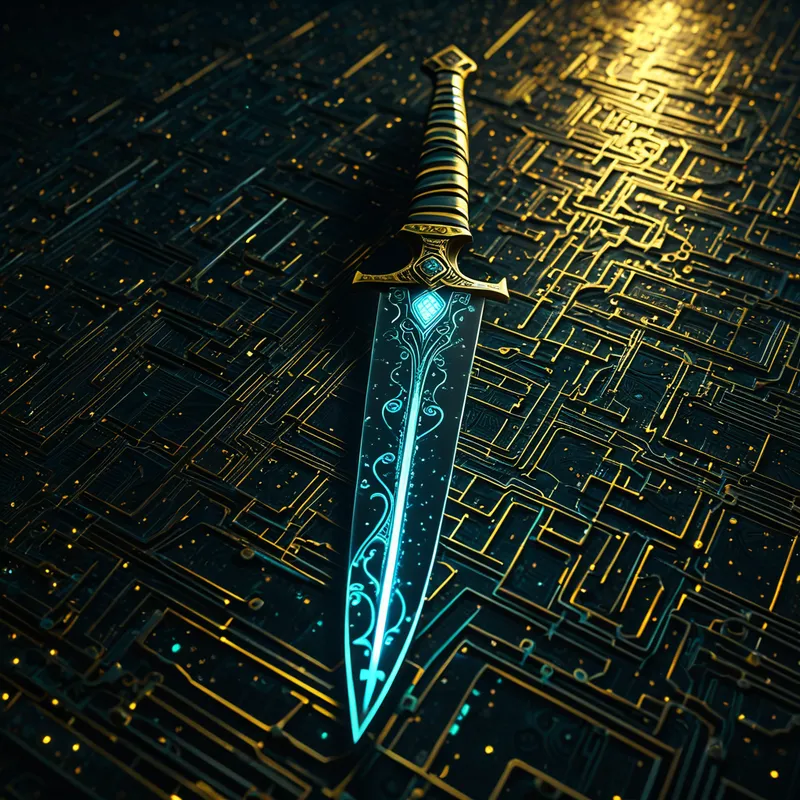
When the archetype of Ogou Ferraille stirs in the modern dreamscape, it often announces a profound phase of psychic re-forging. The dreamer may find themselves in a junkyard of memories, handling rusted, sharp objects that feel familiar and painful. They may dream of broken machinery, stalled cars made of scrap, or a figure who is both terrifying and compelling, covered in welds and scars.
Somatically, this can correlate with a feeling of being “in the fire”—experiences of intense, burning shame, flashes of hot rage that feel dangerous yet clarifying, or a sense of pressure and heat in the body, as if being hammered into a new shape. Psychologically, it is the process of confronting the “scrap” of one’s history: childhood wounds, inherited traumas, past failures, and bottled fury. The dream is not presenting these as trash to be disposed of, but as raw material. The critical question the dream poses is: Will you leave these fragments to rust and poison your soil, or will you have the courage to gather them, bear the heat of their memory, and forge them into something of use? The appearance of this mythic pattern signals that the psyche is ready to stop being victimized by its wounds and start wielding them as a source of unshakeable authority.
Alchemical Translation
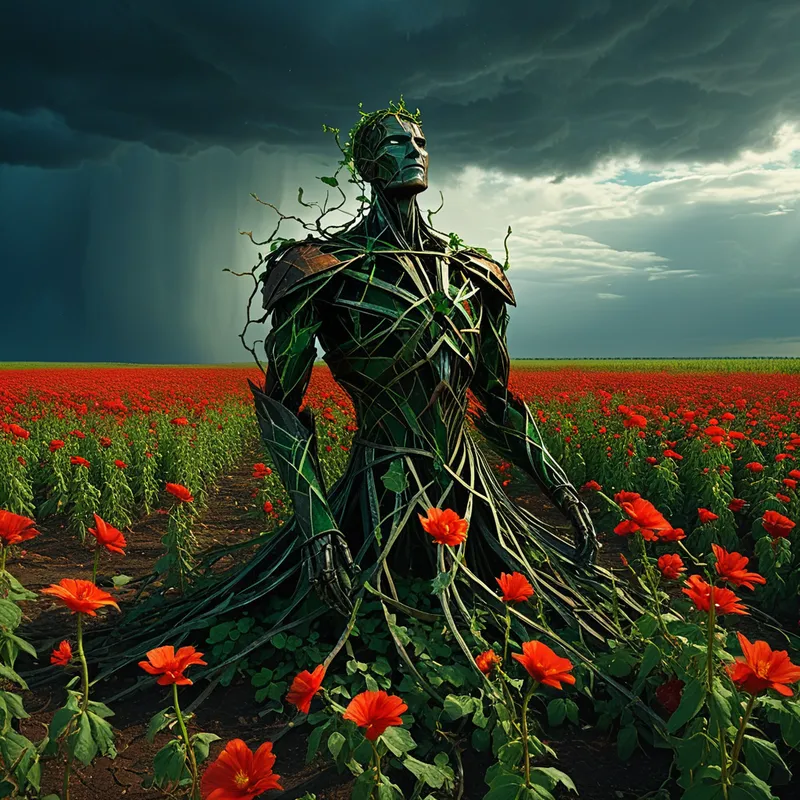
The journey of Ogou Ferraille provides a precise model for the most difficult alchemical operation: the transmutation of rage and trauma into righteous power and conscious justice. For the modern individual, this is the move from reactive aggression to proactive integrity.
The first step is NIGREDO: Acknowledging the “Ferraille.” This is the dark, chaotic stage of collecting the scrap—admitting one’s rage, grief, and sense of brokenness without judgment. It is giving a voice to the inner veteran who has been through unspeakable battles.
The second is ALBEDO: The Quenching Mirror. This is the moment represented by Ogou gazing at his reflection. It is the conscious, often painful, self-examination of how these wounds have shaped one’s behavior, relationships, and self-image. The water of reflection cools the hot, reactive emotion into a clear, cold understanding.
The final, enduring stage is RUBEDO: The Forged Self. This is not an end state but a continuous practice. It is the daily, conscious choice to direct one’s forged will—the machete of discrimination—toward cutting away injustice, both internal and external. It is using the heat of one’s passion not to burn others or oneself, but to fuel purposeful action. The individual becomes a living testament to the process; their “scars” (their past, their vulnerabilities) are no longer sources of shame but badges of hard-won wisdom and the very source of their unique strength. They become a blacksmith of their own destiny, recycling every blow life has dealt into the unbreakable iron of their character.
To be forged is not to be destroyed by fire, but to be defined by it. The true weapon is not the blade, but the hand that knows the cost of its making.
Associated Symbols
Explore related symbols from the CaleaDream lexicon:
- Fire — The transformative and purifying element of the forge, representing both destructive rage and the sacred heat necessary for alchemical change and rebirth.
- Scar — The visible record of a healed wound, symbolizing integrated trauma, resilience, and the unique history that forges an individual’s strength and identity.
- Machete — The tool and weapon of Ogou, representing discriminating consciousness, the ability to cut through deception and overgrowth, and the focused application of will.
- Forge — The sacred, contained workspace of transformation, symbolizing the crucible of intense experience or introspection where base materials of the self are transmuted.
- Iron — The metal of will, strength, and sovereignty, representing the unyielding core of character that is tempered, not softened, by hardship.
- Warrior — The archetype of disciplined action and protection, embodying the courage to confront chaos and fight for a principle, whether in the outer world or the inner psyche.
- Rage — The raw, hot emotional fuel that, untamed, destroys, but when mastered and directed, becomes the fire of the forge for profound transformation.
- Justice — The ultimate principle served by Ogou Ferraille, representing the right ordering of things, fairness, and the use of forged power to correct imbalance and oppression.
- Rebirth — The core promise of the myth, symbolizing the emergence of a new, more complex and potent self from the fragments of the old, shattered one.
- Shadow — The unconscious repository of the “scrap metal”—the rejected rage, pain, and brokenness that must be gathered and integrated to achieve wholeness.