Ogham Script Myth Meaning & Symbolism
The myth of Ogham's creation by the god Ogma, a secret script born from the world tree, encoding the soul of the forest into language.
The Tale of Ogham Script
Listen. The wind does not merely blow through the branches; it speaks. In the deep, green heart of the world, where the roots of the great trees drink from the well of memory, a secret was born. It was a time when the gods walked the misty hills of Tír na nÓg, and the mortal world was a tapestry of raw, singing power.
The one who heard the secret was Ogma. He was not just a warrior of the Tuatha Dé Danann, but the master of eloquence, his tongue a weapon that could bind or break a kingdom. Yet, he felt a silence at the core of things. The wisdom of the land—the sigh of the oak, the resilience of the hazel, the purity of the birch—was trapped, a song without words.
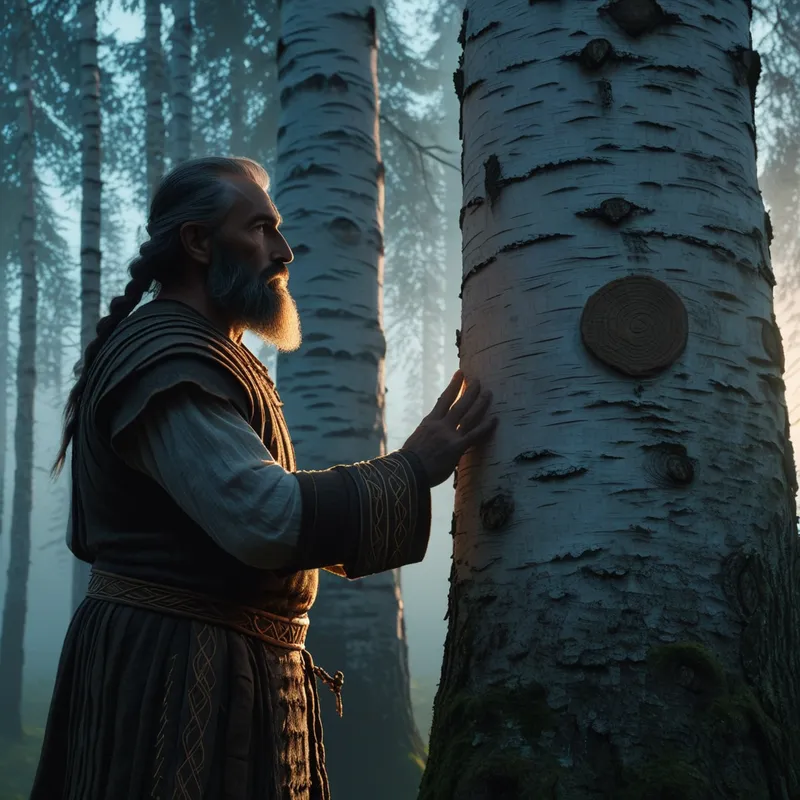
One evening, as the veil between worlds grew thin, Ogma stood before the Bile, the sacred tree that was the axis of the world. He placed his palm upon its bark and listened. Not with his ears, but with his bones. He heard the struggle of the salmon in the pool of knowledge, the keen of the hawk circling the sun, the deep, slow chant of the stone in the earth. Each was a voice, but their language was chaos.
Then, he saw it. A single straight line, like the edge of a spear, or the trunk of a tree. His own finger, moved by a force older than the gods, scored a mark upon the birch’s pale skin. One stroke, perpendicular. This was the spine, the Druim. From this spine, like branches, like fingers gesturing, he carved notches. One to the right. Two to the left. Three across. Four like the points of a star.
Each combination was a key. The single notch for the Birch, Beith, was not just the letter ‘B’. It was the essence of beginnings, of purity, of the flash of white bark in a dark wood. The five strokes for the Heather, Úr, was the soil itself, the fertile land waiting. He worked through the night, the twenty letters of the first Aicme taking form. He did not invent them; he unveiled them. He was the midwife for a script born from the very soul of the forest, a language where to name a tree was to invoke its spirit, its medicine, its hidden truth. When dawn broke, the secret was no longer silent. It was etched into the world, waiting to be read by those who knew how to listen to the trees.

Cultural Origins & Context
The myth of Ogham’s origin is preserved in the medieval Irish text Auraicept na n-Éces. While the script itself was a practical, cryptographic alphabet used primarily for inscriptions on stone and wood from roughly the 4th to 7th centuries CE, its mythological framing is profound. It was not considered a mundane human invention, but a divine gift.
This myth was the domain of the Filid, the poet-seers who were the inheritors of the druidic tradition. For them, Ogham was far more than an alphabet. It was a mnemonic system, a cosmological map, and a tool of divination. Each character, or fid, was linked to a specific tree or plant, embedding botanical knowledge, seasonal cycles, and symbolic attributes into the very structure of writing. To inscribe a boundary stone with Ogham was not just to claim land legally; it was to invoke the protective spirit of the trees named within the script, weaving a spell of sovereignty and memory into the landscape.
Symbolic Architecture
At its core, the myth of Ogham is about the birth of conscious articulation from the womb of unconscious, natural wisdom. Ogma, the god of eloquence, represents the human (or divine) intellect striving to give form to the formless. The chaotic voices of nature—the salmon, hawk, stone—symbolize the undifferentiated contents of the unconscious psyche, rich with meaning but inaccessible.
The spine of the Ogham script is the axis of consciousness itself; the notches are the distinct thoughts and feelings that branch from it, giving specific shape to the wild, flowing sap of the soul.
The trees are the ultimate symbols. They are archetypal forms bridging worlds: roots in the underworld (the unconscious), trunk in the middle world (the ego or conscious self), and branches in the upper world (spirit or the Self). To learn the Ogham was to learn the language of the Anam, the world-soul. Each letter became a psychic complex—a bundle of associated meanings, energies, and histories. The Hazel (Coll) meant wisdom and inspiration; the Blackthorn (Straif) meant strife and authority; the Apple (Quert) meant beauty and choice. The script was a symbolic architecture for the psyche, a way to categorize, navigate, and ultimately converse with the inner forest.

The Dreamer’s Resonance
When this myth pattern stirs in the modern unconscious, it often manifests in dreams of discovery. A dreamer may find strange markings on the walls of a familiar house (the psyche), or in the bark of a tree in a recurring dream landscape. They may try to trace these markings with their fingers, feeling a tactile, somatic memory awakening.
Psychologically, this signals a process of differentiation. The dream ego is beginning to discern specific “letters” or patterns within a previously vague or overwhelming emotional or intuitive state. It is the psyche’s attempt to create its own inner Ogham—to develop a personal symbolic lexicon to understand its own depths. The somatic sensation of carving or tracing is key; it represents the effort to make an impression, to move psychic energy from a fluid state into a structured, memorable form. This dream often accompanies a period where one is learning to “name” their experiences more accurately, moving from “I feel bad” to understanding the specific texture of that pain—is it the sharp isolation of the Blackthorn, or the tangled confusion of the Ivy?
Alchemical Translation
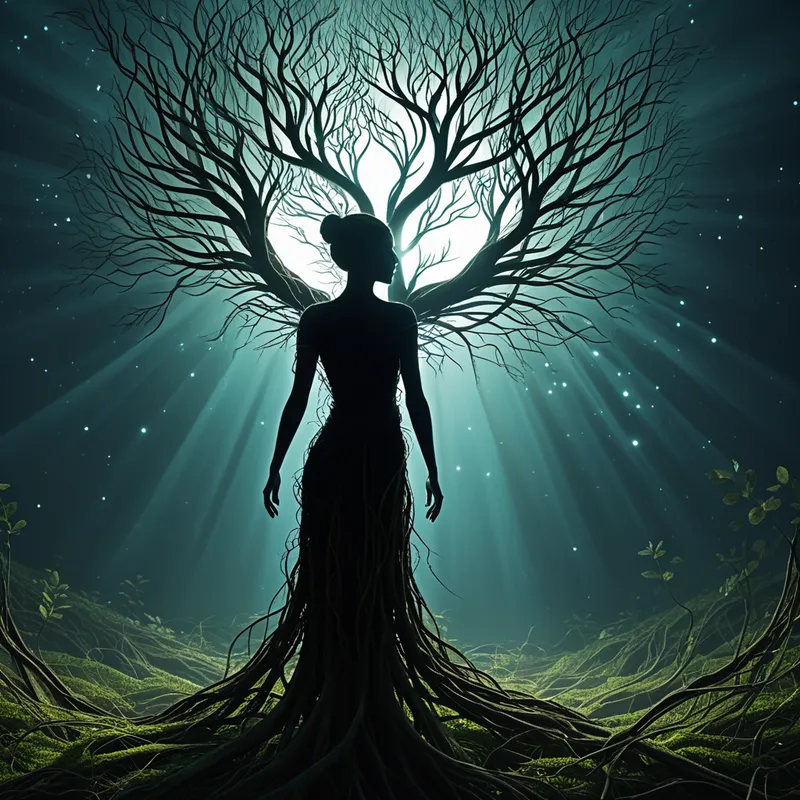
The alchemical journey modeled by the Ogham myth is the transmutation of latent wisdom into active knowledge. It begins with the nigredo, the blackening: Ogma’s frustration, the silent chaos of the unarticulated world. This is the modern individual’s sense of having deep feelings, intuitions, or creative impulses that remain frustratingly inchoate, causing a kind of psychic congestion.
The act of carving the Druim, the central line, is the albedo, the whitening. It is the establishment of a conscious direction, a commitment to the work of self-inquiry. It is the decision to start a journal, to begin therapy, to dedicate time to an art form—to create the central axis of attention.
The final stroke of each Ogham character is the rubedo, the reddening: the moment the inner knowledge becomes manifest, is “readable” to the self and can be communicated to the world.
The twenty trees of the first Aicme represent the multitude of psychic contents that must be acknowledged and integrated. The individuation process is not about creating a single, monolithic “self,” but about learning the unique language of one’s own inner ecosystem. To become “lettered” in one’s own Ogham is to achieve a state where instinct, emotion, thought, and spirit are in dialogue. One no longer has a feeling of resilience; one knows the Oak within. One doesn’t just experience love; one understands its particular quality as the Apple or the Vine. The myth teaches that wisdom is not imported; it is decoded from the living scripture of our own nature, one sacred stroke at a time.
Associated Symbols
Explore related symbols from the CaleaDream lexicon: