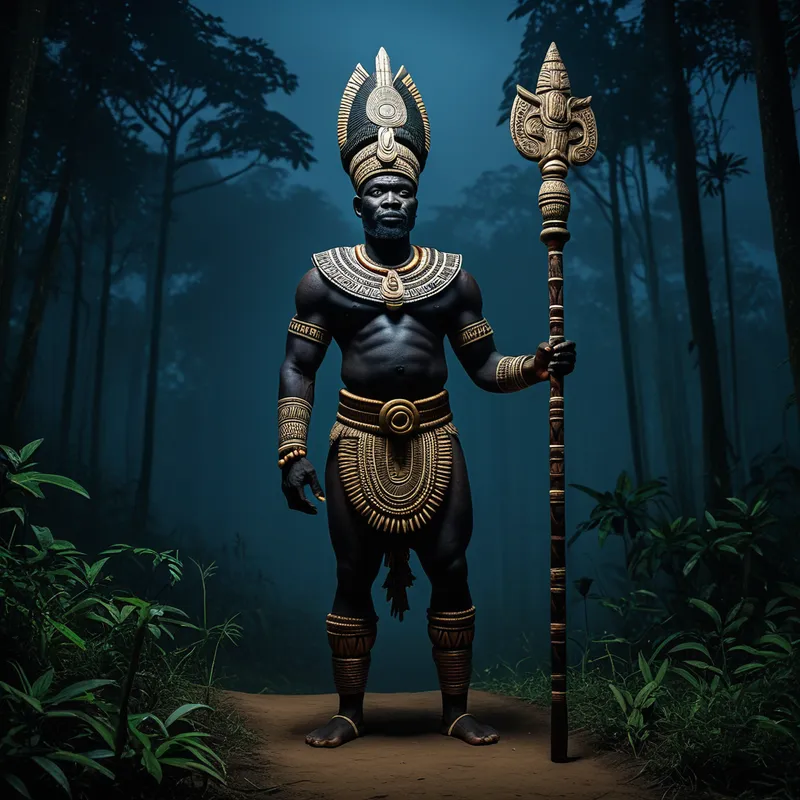
Ogbunabali God of Death Igbo Myth Meaning & Symbolism
A myth of the Igbo deity Ogbunabali, who enforces divine law by taking life at night, embodying the necessary, fearsome balance between order and the unknown.
The Tale of Ogbunabali God of Death Igbo
Listen, and let the night air carry the tale. In the time when the world was younger and the boundaries between the realms of the living and the ancestors were thin as a spider’s silk, there walked a power whose name was spoken in hushed tones after the sun had fled. Ogbunabali.
He did not dwell in the bright chaos of the marketplace, nor in the sun-drenched fields where life pushed insistently from the soil. His domain was the profound silence that follows the last bird’s call, the cool breath of the earth when the moon is high. He was the Chukwu’s appointed steward of an irrevocable law: for every dawn, a dusk; for every breath drawn, a final exhalation.
The people knew the rules, woven into the fabric of existence by Ala herself. Do not whistle in the dark, lest you call attention from the shadows. Do not sweep your hut at night, for you may sweep away a life’s essence. These were not mere superstitions; they were treaties with the dark, agreements that maintained the balance.
But one man, driven by a pride as hard as Ofo wood, believed the laws were for lesser men. He was a great warrior, his body a map of old victories, his voice a command. “I fear nothing that walks in the day,” he boasted to the elders, “why should I cower from the night? Ogbunabali is a story for frightening children.”
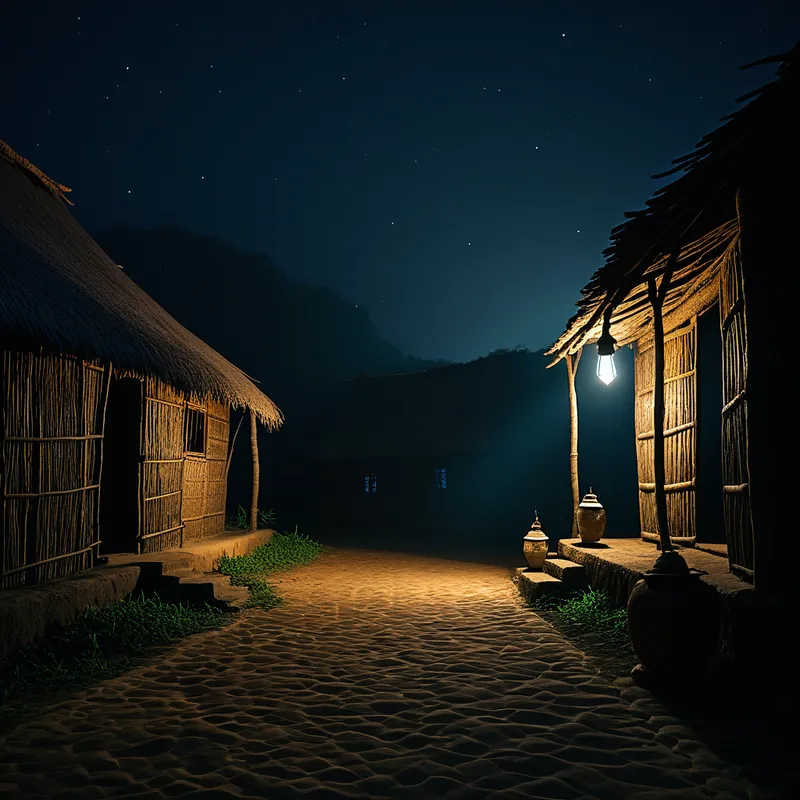
That very night, in defiance, he took his broom and swept the hard-packed earth of his compound under the indifferent stars. He whistled a warrior’s tune into the velvet blackness. He challenged the silence.
And the silence answered.
It did not come with a roar, but with a deepening of the quiet, a cold that seeped into the bones, not of the air, but of the soul. At the threshold of his hut, the darkness coalesced. There stood Ogbunabali, not a skeletal horror, but a figure of immense, solemn gravity. His form was like the oldest iroko tree, cloaked in the night itself, and in his eyes shone the cold, impartial light of distant stars—the light of absolute law.
No plea was heard. No bargain could be struck. The warrior’s strength, his pride, his very breath, were as nothing before the executor of divine order. With a touch as gentle as a falling leaf and as final as a mountain’s collapse, Ogbunabali enacted the consequence of the broken treaty. In the morning, the village found not a mangled corpse, but a body at perfect rest, a life cleanly and irrevocably taken. The law had been upheld. The balance, for a price, was restored.
Cultural Origins & Context
This myth originates from the Igbo people, a civilization with a rich, complex cosmology that views the universe as a dynamic interplay of forces. Ogbunabali is not a capricious monster, but a specific divine functionary within a structured spiritual bureaucracy. His myth was not mere entertainment; it was a foundational ethical and pedagogical text, passed down by elders, griots, and priests.
The story served critical societal functions. It encoded practical taboos that likely had roots in community safety and hygiene (avoiding night-time activity that could attract predators or cause accidents). More profoundly, it taught the principle of Ofo and Chi—that every individual is accountable to a cosmic order. Ogbunabali was the enforcer of this order, making the abstract concept of divine justice terrifyingly tangible. The myth reinforced that human authority, no matter how great, is subordinate to natural and spiritual law.
Symbolic Architecture
Ogbunabali is the archetypal personification of Necessary Law. He is not evil, but he is implacable. He represents the [shadow](/symbols/shadow “Symbol: The ‘shadow’ embodies the unconscious, repressed aspects of the self and often represents fears or hidden emotions.”/) side of creation itself—the limit that defines existence, the [boundary](/symbols/boundary “Symbol: A conceptual or physical limit defining separation, protection, or identity between entities, spaces, or states of being.”/) that gives [life](/symbols/life “Symbol: The symbol of ‘Life’ represents a journey of growth, interconnectedness, and existential meaning, encompassing both the joys and challenges that define human experience.”/) its precious, temporary shape.
To fear Ogbunabali is to respect the framework of reality. He is the unyielding truth that every action has a consequence, and that some lines, once crossed, allow no return.
Psychologically, he embodies the superego in its most absolute form—the internalized voice of law, tradition, and ultimate accountability. The defiant [warrior](/symbols/warrior “Symbol: A spiritual archetype representing inner strength, discipline, and the struggle for higher purpose or self-mastery.”/) symbolizes the ego, the conscious self that believes it is sovereign and above the laws of [nature](/symbols/nature “Symbol: Nature symbolizes growth, connectivity, and the primal forces of existence.”/) (the unconscious, the Self). The myth dramatizes the inevitable confrontation between the inflated ego and the supra-personal law of the psyche. The warrior’s defiance—whistling in the dark, sweeping at [night](/symbols/night “Symbol: Night often symbolizes the unconscious, mystery, and the unknown, representing the realm of dreams and intuition.”/)—is the psyche’s reckless testing of its own deepest boundaries, a provocation of the inner Shadow that holds the keys to both destruction and necessary limitation.

The Dreamer’s Resonance
When this myth stirs in the modern dreamer, it often manifests not as a literal deity, but as an atmosphere of profound, impersonal judgment. One may dream of a dark, authoritative figure at the door, a final notice arriving, or of breaking a fundamental, unspoken rule and feeling a cold certainty of retribution settle in the air.
Somatically, this can feel like a sudden chill, a weight on the chest, or a paralysis in the limbs—the body registering a psychic truth: a line has been crossed. The psychological process is one of confrontation with self-created consequences. The dreamer is encountering the part of their own psyche that administers the law of cause and effect, often related to broken personal ethics, neglected duties, or living in a way that is fundamentally out of alignment with one’s deeper truth (Chi). The terror is not of an external monster, but of the internal justice system delivering a verdict.

Alchemical Translation
The alchemical journey modeled here is the dissolution of egoic inflation and the reintegration with the law of the Self. The defiant warrior’s pride must be “killed” by Ogbunabali for a more conscious alignment to emerge. This is not a physical death, but the necessary death of an attitude.
In individuation, this myth calls us to identify where we are “whistling in the dark”—where we are arrogantly ignoring our own inner laws, moral codes, or the natural limits of our being. The encounter with the Ogbunabali-principle is a brutal but sacred moment of correction. It forces humility and re-establishes right relationship with the greater order of our own soul and the world.
The triumph is not in defeating the God of Death, but in learning to live in such a way that his visit is not provoked. The alchemical gold is a life lived in conscious, respectful harmony with the limits that give it meaning, transforming blind fear into wise reverence.
The modern individual undergoes this transmutation by courageously examining the areas of life that feel “cursed” or repeatedly failing. These are often the places where an inner Ogbunabali is acting, enforcing a law the conscious mind has refused to acknowledge. By submitting to this inner justice—by stopping the metaphorical night-sweeping—one integrates the shadow of the Ruler archetype, moving from a tyrant who denies law to a sovereign who embodies it.
Associated Symbols
Explore related symbols from the CaleaDream lexicon:
- Death — The central, non-negotiable transition enforced by Ogbunabali, representing not merely an end but the ultimate consequence and enforcer of cosmic law.
- Night — The domain and medium of Ogbunabali, symbolizing the unknown, the unconscious, and the time when the boundaries between worlds are most permeable.
- Door — The threshold where Ogbunabali stands, representing the moment of irrevocable passage, the point of decision, and the interface between safety and consequence.
- Shadow — Ogbunabali is the ultimate personification of the psychological Shadow—the feared, unconscious aspect that holds immense power and administers the psyche’s deepest laws.
- Order — The divine principle Ogbunabali serves; he is the agent who eliminates what threatens the fundamental balance and structure of the cosmos.
- Justice — The impersonal, inevitable force enacted by Ogbunabali, which is divine rather than human, concerned with cosmic balance over mortal notions of fairness.
- Ritual — The prescribed behaviors and taboos (like not sweeping at night) are rituals designed to maintain harmony and avoid provoking the deity’s necessary function.
- Fear — The healthy, respectful fear of Ogbunabali is a social and psychological mechanism that reinforces boundaries and teaches reverence for the laws of existence.
- Pride — The fatal flaw of the defiant warrior, symbolizing the ego’s inflation and its belief that it is exempt from the universal laws that govern all things.
- Law — The immutable, supra-personal code that Ogbunabali embodies and enforces, representing the structural principles of reality itself.
- Threshold — The critical space, both literal and symbolic, where one encounters the absolute, marking the point of no return and the moment of accountability.