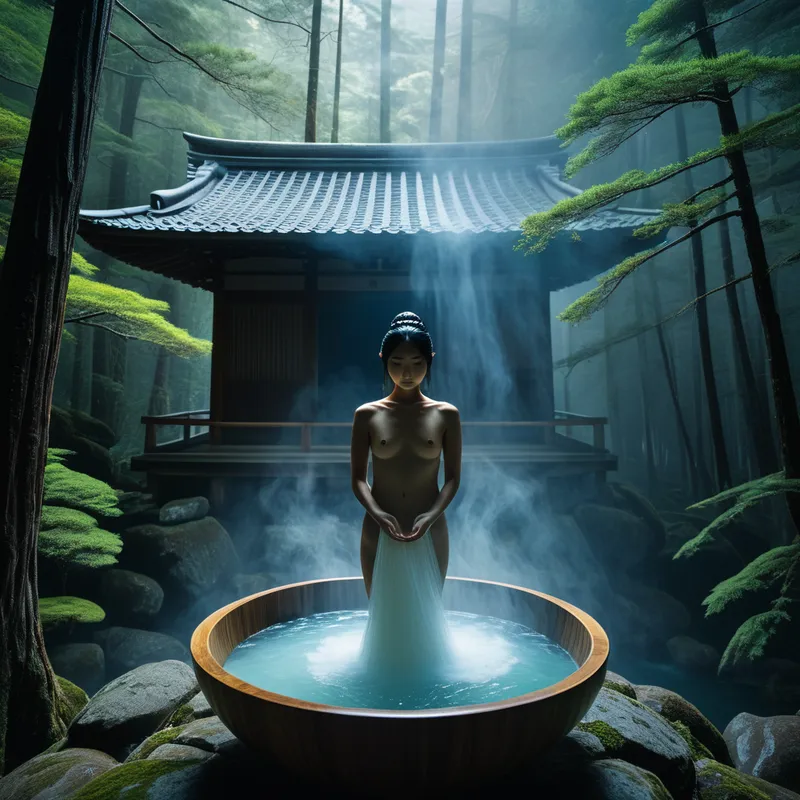
Ofuro Myth Meaning & Symbolism
A myth of a sacred bath, where water is not for cleaning the body, but for dissolving the soul's burdens, preparing it for rebirth.
The Tale of Ofuro
Listen, and let the steam of the story cloud your sight, so you may see more clearly.
In the time when the world was younger and the kami walked closer to the earth, there was a deep valley where the mountain’s tears gathered. It was a place of sorrow, for the waters that pooled there were not clear, but clouded with the weariness of the world—the dust of long journeys, the salt of unshed tears, the grime of toil without end. The people who lived nearby would come to wash, but their bodies remained heavy, their spirits dim. They scrubbed at skin, but could not reach the soul.
Into this valley came a being known as Kami of the Hearth and Hearth’s Shadow. She had witnessed the suffering of mortals, how they carried the weight of their days like stones in their pockets. She saw that their cleansing was but a surface ritual, a desperate pantomime that left the core untouched. Her heart, a vessel of both fire and deep stillness, was moved.
She went not to the clear, rushing streams, but to this very pool of collective fatigue. Kneeling at its murky edge, she did not scoop the water out. Instead, she breathed into it. Not a breath of air, but a breath of intention—a whispered vow of containment, of sacred holding. She hummed the song of the hot spring deep in the earth’s belly and the silent song of the wooden barrel that waits. From her hands, she shaped not the water, but the space for the water.
The clouded pool stirred. Its murk did not vanish, but it began to settle. The kami encircled the place with fragrant hinoki wood, whose scent was a memory of sunlit forests. She called upon the fire beneath the earth to warm the stones, and a gentle, pervasive heat began to rise. She declared, her voice the soft sound of steam meeting cool air, “This is no longer a place to wash away. This is a place to be washed. To be held, so that what is not you can fall away.”
The first to enter was a woodcutter, his spirit calloused from a life of splitting things apart. He stepped into the enveloping warmth and sank with a sigh that was half a sob. As he sat, still and contained, he watched in wonder. The physical dirt left his skin, yes. But so too did a grey film of resentment—for the heavy axe, for the unending winter—lift from his very being, dissolving into the water like mist. When he emerged, his body was clean, but more profoundly, his hands felt empty and ready, not for splitting, but for holding.
Word traveled. The weary, the guilty, the fragmented, all came to the Ofuro. Each found the same miracle: the water did not judge their stain. It simply provided a warm, silent, fragrant embrace. In that perfect containment, the armor of the day—the persona, the worry, the accumulated shadow—could finally soften. It loosened its grip and sloughed away, absorbed and transformed by the alchemy of the heated, blessed water. The bather did not do anything but surrender to being held. And in that surrender, they were remade, lighter, their true form revealed not by scrubbing, but by soaking.
Cultural Origins & Context
The myth of Ofuro is not a single, codified epic, but a living narrative woven into the very fabric of Japanese daily life and spiritual practice. Its origins are diffuse, emerging from the confluence of Shinto animism and the practical realities of life in a volcanic archipelago. Shinto, with its veneration of kami in all things, naturally saw sacred presence in the hot springs (onsen) that bubbled from the earth—gifts of purification and healing from the mountain kami.
The ritual of the bath evolved from this sacred source. It was never merely utilitarian. The construction of the deep wooden tub, often of hinoki, replicated a sacred container. The careful heating of the water echoed the geothermal gifts of the land. This practice was passed down not by bards, but by mothers and grandmothers, by innkeepers and monks, through the silent teaching of ritual. Its societal function was profound: it served as a daily harae, a micro-purification rite. Before entering a shrine, one purifies hands and mouth. Before re-entering the home’s intimate space, one purified the entire body and, by symbolic extension, the spirit accumulated from the public, profane world. The bath was the threshold ritual between the outer and inner self, a daily rebirth into the purity of the domestic and personal sphere.
Symbolic Architecture
At its core, the Ofuro myth is about the psychology of contained transformation. The water is not an aggressive, scouring force, but a receptive, transformative medium. The hero of the myth is not the bather, but the space itself—the sacred container forged by the Caregiver Kami.
The true vessel is not what holds the water, but what holds the self in a state of suspended becoming.
The Ofuro symbolizes the temenos—the sacred, protected enclosure where psychological work can occur safely. The steam represents the liminal state between conscious and unconscious. The heat is the gentle, penetrating energy of the psyche itself, facilitating the release of what is rigidly held. The dissolving grime is the persona—the adaptive mask—and the psychic toxins of daily life. Crucially, the myth instructs that this release happens not through frantic effort (scrubbing), but through stillness and surrender (soaking). The warm, perfumed embrace of the water is the unconditional acceptance of the Self, allowing the fragmented parts to feel safe enough to let go.

The Dreamer’s Resonance
When the Ofuro appears in modern dreams, it signals a profound somatic and psychological need for psychic detoxification and emotional containment. The dreamer may be drowning in stimuli, burdened by responsibilities, or carrying unprocessed emotional residue.
Dreaming of an overflowing, scalding, or dirty bath suggests the container of the self is overwhelmed; the psyche’s purification system is clogged. Dreaming of a pristine, inviting, deep hinoki tub, especially if one is hesitating to enter, points to a soul-deep recognition of the need for this sacred pause, coupled with a resistance to the vulnerability surrender requires. To step into the dream-ofuro is to consent to a process where the ego’s defenses are gently steamed away. The somatic sensation in the dream—the enveloping warmth, the weightlessness—is the body’s intelligence communicating the process of release that the conscious mind may be avoiding. It is the unconscious prescribing the medicine of deep rest and held solitude.

Alchemical Translation
The myth models the individuation process as an alchemy of immersion, not attack. Modern life champions the “heroic” scrub: relentless self-improvement, aggressive shadow-work, and forced positivity. The Ofuro myth proposes a different path.
The first alchemical stage is Containment (the building of the wooden tub). One must consciously create a sacred, bounded time and space for the psyche—through ritual, meditation, or simply protected solitude. This is the vas hermeticum of the soul.
The second is Calefaction (the heating of the water). This is the application of gentle, sustained attention—the warmth of self-awareness—to the contents of one’s inner life. It is not the blaze of confrontation, but a low, steady heat that encourages separation.
The goal is not to become empty, but to become clear, so the true form submerged beneath the accretions of living can be seen.
The final stage is Separatio and Solutio (the dissolution and settling). As one sits in the warm container of self-witnessing, the composite elements of the personality—the identifications, the traumas, the adopted masks—begin to dissolve their rigid bonds. They separate from the core Self. This is not annihilation, but differentiation. The “grime” settles, not to be ignored, but to be seen as distinct from the true essence of the bather. One emerges, not “cleansed” in a sterile sense, but clarified. The water, now holding the dissolved material, is drained away—a symbolic release of what has been consciously processed and let go. The cycle repeats daily, for individuation is not a one-time purification, but the continual practice of returning to the sacred container of the self, to soak, and to be remade.
Associated Symbols
Explore related symbols from the CaleaDream lexicon: