Odysseus' Sail Myth Meaning & Symbolism
A sacred sail, a forgotten oath, a fatal storm. Odysseus loses his last men and his way home, a myth of divine consequence and the psyche's long voyage.
The Tale of Odysseus’ Sail
Hear now the tale not of a beginning, but of an ending—an ending that was meant to be a beginning. The war at Troy was ten years of blood and ash. The voyage home became ten more of salt and sorrow. Odysseus, breaker of cities, was now a man broken by the sea, his fleet of twelve proud ships whittled down to one, his company of warriors reduced to a haunted, hungry few.
They had passed the singing Sirens, lashed to the mast. They had navigated the clashing rocks and escaped the many-headed Charybdis. Their final trial was the island of Thrinacia, where the sacred cattle of the Sun God grazed. Starving, desperate, the men slaughtered the immortal beasts. The smell of roasting sacred flesh was a blasphemy that reached the heavens. As they set sail from that cursed shore, a final, terrible oath was sworn to the gods: they would touch no food, drink no wine, until they saw the cliffs of their homeland, Ithaca.
For days, the sea was a flat, malevolent mirror. Hunger was a wolf in their bellies; thirst a fire in their throats. Then, on the horizon, a smudge of green and brown—land! It was not Ithaca, but a sheltered cove. The men wept, begging to go ashore, to break their fast. Odysseus, his own spirit frayed, refused, holding them to the oath. But in the ship’s hold, bundled and forgotten, lay a sacred object: a pure white sail, given by the enchantress Circe. It was no ordinary cloth. It was a charm, a promise of fair winds and a straight course home, if—and only if—it remained unstained by mortal hubris.
The men’s whispers became mutiny. One, driven mad by thirst, found a hidden skin of wine and drank. The dam broke. They fell upon their stores. As the first morsel passed their lips, the forgotten sail in the dark hold seemed to sigh. The wind died instantly. Then, from the west, a groaning sound arose, deeper than any whale song. The sky curdled to the color of a bruise.
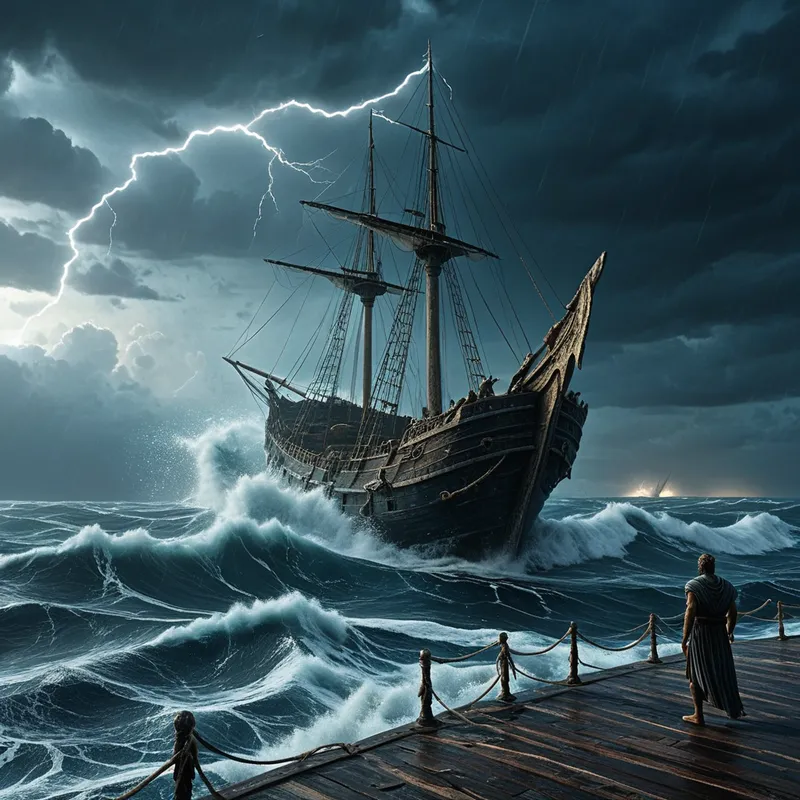
Poseidon, who had long pursued Odysseus for blinding his son, saw his moment. The oath was broken; the protection of the sail, forfeit. The storm he unleashed was not of wind and rain, but of the world’s ending. The sea became a vertical wall. The sky fell down in lightning bolts that smelled of ozone and wrath. The sacred sail, still furled, began to glow with a cold, guilty light.
The ship was not broken, but unmade. Planks splintered like bones. Men who had survived monsters and magic were plucked by the waves like insects, their cries swallowed by the roar. Odysseus alone, lashed to the keel of his shattered vessel, witnessed the final act. He saw the white sail, now free, catch for a moment in the maelstrom—a ghostly, accusing banner—before it was ripped into a thousand fragments and scattered across the face of the deep. The last of his men were gone. His last tangible hope for a guided return was destroyed. He was set adrift, not on a sea of water, but on an ocean of consequence, utterly alone, with only his cunning and his longing to keep him afloat. The voyage home now passed inward, into a deeper, more terrible solitude.
Cultural Origins & Context
This pivotal episode is found in the twelfth book of Homer’s Odyssey, an epic poem crystallized in the 8th century BCE but rooted in an older, oral tradition of bardic song. These tales were not mere entertainment; they were the cultural software of the Hellenic world, performed at feasts and festivals by rhapsodes who were keepers of memory, identity, and divine law.
The story of the sail functions as the catastrophic climax of Odysseus’s wanderings. It is the moment his journey ceases to be an external adventure and becomes an inescapable internal reckoning. Societally, it reinforced a fundamental Greek principle: hubris (excessive pride or defiance of the gods) inevitably begets nemesis (righteous retribution). The men’s transgression was twofold: the direct sacrilege of killing the Sun God’s cattle, and the indirect, fatal hubris of forgetting—of neglecting the sacred charm (the sail) in their mortal desperation. For a culture navigating a treacherous sea both literally and metaphorically, the myth served as a dire warning about the fragility of divine favor and the absolute necessity of ritual observance and mindful remembrance, even—especially—at the brink of salvation.
Symbolic Architecture
The sail is the myth’s central, tragic symbol. It is not a tool, but a covenant. Representing guided destiny, divine aid, and the possibility of a direct, blessed return, it is the link between human effort and cosmic order.
To forget the sacred object is to forget one’s own soul’s compass. The storm that follows is not punishment, but the natural state of a world from which meaning has been withdrawn.
Odysseus’s crew embodies the fragmented, instinct-driven parts of the psyche—the raw hunger, the impulsive body that seeks immediate relief from suffering, even at the cost of the greater goal. Their mutiny is the psyche’s civil war. The storm of Poseidon symbolizes the unleashed, chaotic power of the unconscious when a sacred boundary is violated. It is the tsunami of consequence that follows a broken oath to the Self. The destruction of the sail signifies the shattering of an old identity—the identity of the “Captain with a Crew,” the leader who shares his fate with his men. Its loss forces Odysseus into the alchemical vas (vessel) of utter isolation, where the only material left for the remaking of a man is his own indomitable, lonely consciousness.

The Dreamer’s Resonance
When this myth stirs in the modern dreamer, it often manifests as dreams of catastrophic forgetfulness at a critical moment. You dream of missing the vital exam, of forgetting the lines in the play, of losing the one key that opens the final door. The somatic feeling is one of sinking dread, of a terrible, irreversible oversight.
Psychologically, this signals a process where an emerging, more authentic Self (the sacred sail, the direct course home) has been glimpsed or even received, but then neglected in favor of old, hungry, “mutinous” patterns—the drive for immediate comfort, approval, or security. The ensuing “storm” in one’s life—a sudden loss, a depression, a rupture—is the unconscious enforcing the consequence of that self-betrayal. The dream asks: What sacred oath to your own journey have you broken? What guiding principle have you left bundled in the dark hold of habit, while you feed the immediate hungers that strand you?

Alchemical Translation
The myth of Odysseus’s Sail models the nigredo—the blackening, the dissolution—phase of psychic individuation. It is the necessary, devastating death of the provisional personality. The crew represents the collective, dependent aspects of the ego that must be sacrificed. Their drowning is not a failure, but a brutal prerequisite.
The soul’s true homecoming cannot begin until all false companions—the dependencies, the inherited oaths, the comforts of the herd—are swallowed by the sea. The lone survivor on the wreckage is the nascent individual.
Odysseus, clinging to the keel, is the core of consciousness that remains after everything else has been stripped away. The loss of the sail is paradoxically liberating; it destroys the illusion of a charmed, easy passage. His subsequent journey—washed ashore on Ogygia, trapped in a paradise of forgetfulness—begins the next stage: the albedo (whitening), a purification in solitude. The myth tells us that before we can find our Ithaca, we must first lose every sail that promised to take us there without cost. The true compass, it reveals, is forged not in the possession of magical gifts, but in the surviving awareness that remains when all such gifts are lost. The voyage home becomes, at last, an inward odyssey.
Associated Symbols
Explore related symbols from the CaleaDream lexicon: