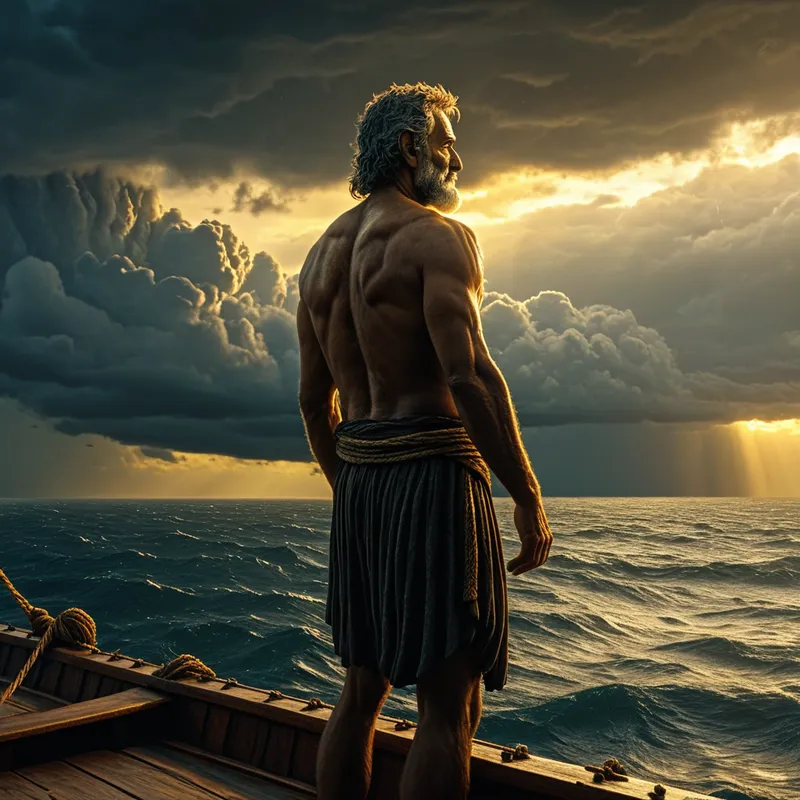
Odysseus' journey in Homer's O Myth Meaning & Symbolism
A warrior's decade-long voyage home becomes a labyrinth of the soul, confronting monsters, gods, and the seductive call to forget one's true self.
The Tale of Odysseus’ journey in Homer’s O
Hear now, a tale not of a single battle, but of a thousand. A tale of a man cleaved in two: the cunning king of Ithaca, and the nameless wanderer, Outis, a ghost upon the wine-dark sea.
It begins in ashes. The great war at Troy is done, its towers toppled into smoke and memory. For Odysseus, the victory is bitter. The gods are angered. Poseidon, the Earth-Shaker, unleashes his fury, scattering the fleet. For ten years, Odysseus fights his way home, and for ten more, he is lost. His journey is a descent into a world where the map of reality folds in upon itself.
He arrives first at the coast of the Lotus-Eaters, where the air is thick with sweet, forgetful scent. His men taste the lotus and dream of nothing, their desire for home dissolving like salt in warm water. Odysseus, his heart a knot of longing, drags them back to the ships, weeping.
Then, to the cave of the Cyclops Polyphemus. It smells of wet wool and old blood. Trapped in that stone womb, Odysseus watches his men be devoured. He does not meet brutality with brute force, but with a sharpened stake and a sharper mind. He names himself Outis—Nobody. When the blinded giant roars, “Nobody is killing me!” his brothers ignore his cries. It is a victory of wit, but it earns the undying wrath of Poseidon.
The winds of Aeolus are a gift and a curse, stolen by jealous men who see only treasure in a leather bag. They are blown back to the beginning. At the island of the sorceress Circe, his crew is transformed into grunting swine, their human minds trapped behind bristled hides. Only Odysseus, armed with the protective herb moly given by Hermes, can withstand her magic and command her power, turning her from foe to reluctant ally.
He sails to the edge of the world, to the dank House of Hades. There, in the whispering gloom, he pours out blood for the shades. The prophet Tiresias tells him his path: “You will return home, alone, on a stranger’s ship, to find chaos in your hall.” His mother’s ghost reaches for him, a touch of cold mist. He sees the heroes of old, pale echoes of their former glory. This is the nadir, the confrontation with death itself, not as an end, but as a mirror.
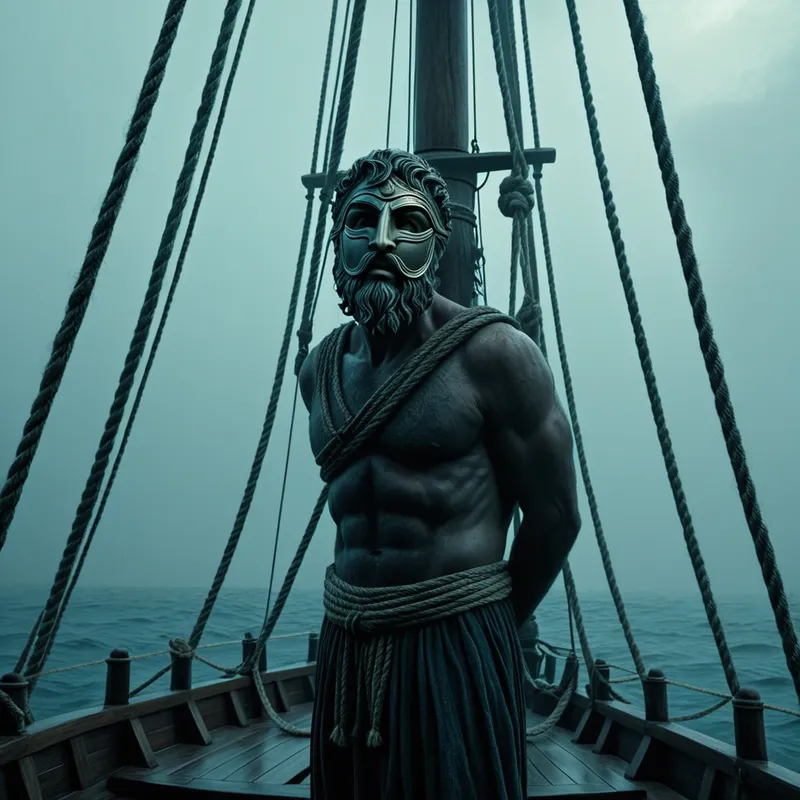
Then come the trials of choice. Past the singing Sirens, he has himself bound to the mast, to hear the unbearable song of infinite knowledge and live. Between the ravenous whirlpool Charybdis and the six-headed Scylla, he must choose the lesser loss, steering close to the monster to lose six men, rather than his entire ship. Each decision is a carving away of possibility, a narrowing toward a single, painful destiny.
Finally, shipwrecked and alone, he washes ashore on Ogygia, the isle of the nymph Calypso. For seven years, he lives in a gilded cage of immortality and bliss, with a goddess who offers him everything but his own name, his own mortality, his own rocky Ithaca. He sits each day on the shore, staring at the empty horizon, his heart scoured by a longing no paradise can satisfy.
Only by the decree of the gods is he released, building a raft with his own hands. Poseidon smashes it, but Ino gives him a veil, and for two days and nights he is a plaything of the waves, until he crawls, salt-crusted and near death, onto the shores of Scheria. There, in the court of the Phaeacians, he hears his own story sung by a bard. Hearing his trials recounted as epic, he weeps. He is no longer Outis. He is Odysseus, the man of many turns, and he is ready to go home.
His return is not an end, but another kind of battle. Disguised as a beggar by Athena, he enters his own house, unrecognized. He sees the suitors defiling his hall, testing the loyalty of his wife Penelope, and the growth of his son Telemachus. The final test is the bow that no other man can string. In one fluid motion, the beggar stands, strings the great bow, and turns it on the usurpers. The hall becomes a slaughterhouse, a brutal, necessary cleansing. Only then, in the quiet aftermath, does he stand before Penelope. The final proof is not the scar on his thigh, nor the secret of their bedpost built from a living olive tree, but the shared, silent knowledge of twenty years of waiting and wandering. The journey ends not with a crown, but with a recognition, deep in the night, in the home he had carried within him all along.
Cultural Origins & Context
This epic, known as the Odyssey, is a pillar of the Western literary canon, attributed to the blind poet Homer. It emerged from a rich oral tradition in the 8th century BCE, a product of a Greek world transitioning from a Bronze Age warrior-culture to the dawn of the city-state. It was not merely entertainment; it was a cultural database of values, geography, and identity. Performed by traveling bards (rhapsodes) at festivals and in the halls of the aristocracy, it served as a foundational narrative about what it meant to be Greek: clever, resilient, pious (in a transactional sense), and fiercely attached to oikos (household) and nostos (homecoming). It codified the complex relationship between humanity and the capricious gods, and explored the tensions between heroic kleos (glory) and the domestic virtues of fidelity and wisdom.
Symbolic Architecture
The journey of Odysseus is the quintessential map of the individuated psyche. Ithaca is not just a physical home, but the integrated Self. The decade of wandering represents the necessary period of disintegration and reformation that follows a great trauma or achievement (the Trojan War). Each island is not a geographical location, but a state of consciousness, a psychic complex to be navigated.
The Lotus-Eaters represent the temptation of psychic numbness, the desire to annihilate the painful but essential drive of desire and memory. The Cyclops is the brute, unconscious force of the id—blind, appetitive, and egocentric. To defeat it, the ego must become “Nobody,” shedding its social identity to employ cunning. Circe’s transformation is the danger of being consumed by instinctual, animal drives. The herb moly (with its black root and white flower) symbolizes the conscious discrimination (Hermes) needed to navigate the unconscious without being assimilated by it. The Underworld journey is the essential confrontation with the personal and collective past—the ghosts of one’s lineage, one’s guilt, and one’s mortality. It is the psyche looking into its own shadow. The Sirens are the seductive call of absolute knowledge, the fantasy of omniscience that, if embraced directly, leads to psychic death (shipwreck on the rocks of dogma). One must be bound to the mast of one’s conscious purpose to hear it and survive. Scylla and Charybdis embody the impossible, paradoxical choices of life—the lesser of two evils, the acceptance of necessary loss as part of forward motion. Calypso is perhaps the most profound trap: the offer of eternal comfort, beauty, and immortality at the cost of one’s own unique, mortal, striving identity. To leave her is to choose the difficult, specific reality of one’s own life over divine abstraction.

The Dreamer’s Resonance
When this myth stirs in the modern dreamer, it signals a profound process of re-orientation. Dreaming of being lost at sea, of encountering strange, isolating islands, or of a home that is familiar yet unreachable, speaks to a soul in the midst of its own nostos. The somatic feeling is often one of profound fatigue mixed with restless urgency—the body of Odysseus, forever rowing. Psychologically, it indicates a stage where the old identity (the “hero of Troy”) has dissolved, but the new, integrated self (“King of Ithaca”) is not yet formed. The dreamer is in the liminal space, confronting their personal Cyclops (a raging, unintegrated anger), their Circe (a seductive addiction or pattern), or their Lotus-Eaters (depressive apathy). The dream is the psyche’s way of charting this internal archipelago, showing the dreamer which “island” they are currently stranded upon, and what quality of consciousness is required to sail onward.
Alchemical Translation
The alchemy of the Odyssey is the transmutation of the scattered, war-torn persona into the sovereign, integrated Self. The prima materia is the hero Odysseus, fresh from the collective glory and violence of Troy. His nigredo, the blackening, occurs in the despair of constant shipwreck, the loss of all companions, and the descent into the underworld—the dissolution of all former certainties.
The albedo, the whitening, is symbolized by his time with Calypso and later the Phaeacians—a period of reflection, purification, and hearing one’s own story re-framed. He is washed ashore, naked and new. The citrinitas, the yellowing, is the dawning of conscious purpose: the building of the raft, the decision to leave immortality, the active striving toward home despite known peril. The final rubedo, the reddening, is the bloody, confrontational return to Ithaca. This is not a peaceful resolution, but a fierce, conscious engagement with the shadowy usurpers (the unintegrated complexes, the parasitic thoughts) that have taken over the inner hall. The stringing of the bow is the integration of will and skill; the slaughter is the necessary, often violent, act of re-claiming psychic sovereignty.
The ultimate goal is not perpetual wandering, but homecoming. The alchemical gold is the coniunctio, the sacred marriage, represented by the reunion with Penelope. This is the union of the long-wandering, experienced consciousness (Odysseus) with the faithful, discerning, weaving intelligence of the soul (Penelope) that has held the center during the struggle. The journey ends when the explorer returns, not as a tourist with tales, but as a king who has reclaimed his throne from within, his identity forged and tempered in the crucible of the deep, wine-dark sea of the unconscious.
Associated Symbols
Explore related symbols from the CaleaDream lexicon: