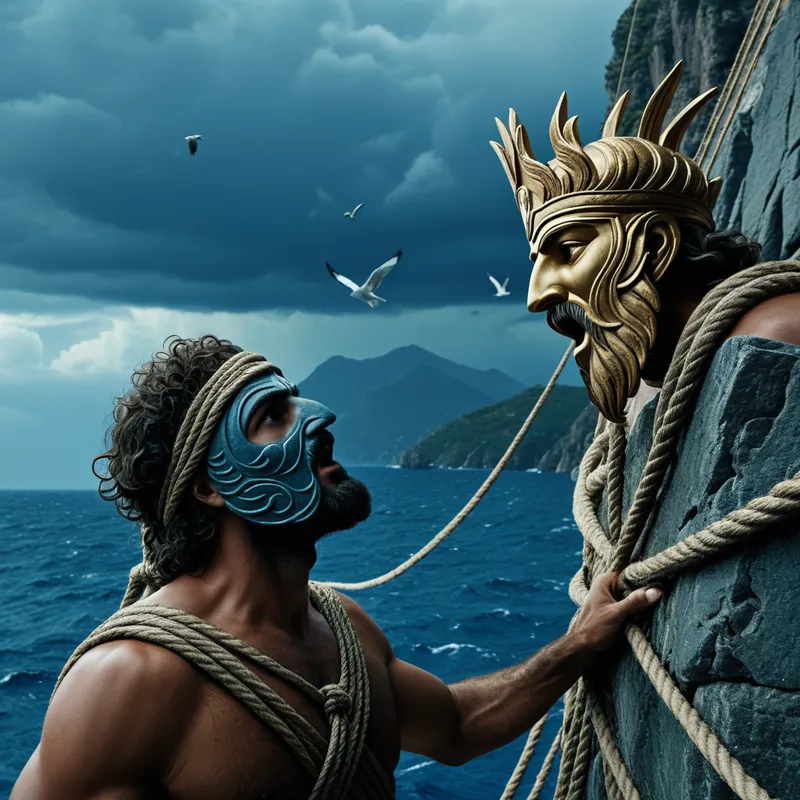
Odysseus gazing from the mast Myth Meaning & Symbolism
The hero, bound to the ship's mast, hears the Sirens' fatal song. He survives by being lashed to his own vessel, a paradox of will and surrender.
The Tale of Odysseus gazing from the mast
Hear now, you who have weathered storms and known the ache of a distant hearth, the tale of the man of twists and turns, Odysseus, and his most cunning trial. The salt-stained timbers of his ship groaned, not from the sea’s wrath this time, but from a deeper, more perilous calm. The air itself grew thick, sweet, and heavy, a perfume that promised everything and concealed oblivion.
The prophetess Circe had warned him. “Soon,” she said, her voice like smoke, “you will pass the island of the Sirens. They sit in a meadow piled high with the bones of men shriveled by the skin, and sing. Their song is honeyed, a promise of all knowledge—every secret of the war-torn earth and the wide heavens. To hear it is to be undone. Your heart will command you to leap into the surf and swim to them, and there you will perish, forgotten.”
But she gave him the key to the labyrinth of his own desire. “Take a wheel of beeswax,” she instructed, “knead it until it is soft, and stop the ears of every man in your crew. They must not hear a single note. But if you wish to hear it yourself, to know its terrible beauty, have them bind you hand and foot to the mast of your swift ship. Let them lash you tight with more ropes, so you cannot move. And if you beg, if you command them to set you free, they must bind you tighter still.”
And so, as the wind died and the current pulled them near that green, treacherous shore, Odysseus did as he was told. He saw the fear in his comrades’ eyes as he handed them the wax. He stood firm as they wound the rough, hemp ropes around his chest, his arms, his legs, securing him to the heart-tree of his vessel. The mast was solid, unyielding—the spine of the ship, the axis of his world.
Then it came. Not a sound at first, but a pressure in the blood. Then the song. It wove through the still air, a melody that bypassed the ear and spoke directly to the marrow. It was the sound of home, of glory, of perfect understanding. It whispered his name, not as a king or a warrior, but as the man he most secretly wished to be. “Come, glorious Odysseus, pride of the Achaeans,” they sang. “Steer your ship in, that you may hear our voices. No one has ever sailed past in his black ship until he has listened to the honey-sweet sound from our lips. He goes home having known joy and understanding deeper than any other.”
Agony and ecstasy became one. Odysseus’s eyes, wide and burning, fixed on the distant rocks where shadowy, graceful forms beckoned. Every fiber of his being, every cunning thought, screamed to go to them. The ropes became hateful things, the mast a prison. He strained until the cords bit into his flesh, and he began to shout, to nod fiercely, to command his men with wild eyes to set him free. But his crew, deaf to the enchantment, deaf to his ravings, saw only a captain driven mad. They did not unbind him. One, remembering the order, came and wrapped another coil around his struggling form, tying the knot all the tighter.
The song swelled, a tidal wave of longing. It promised an end to wandering, an end to striving. It was the siren call of perfection, of absolute knowledge, of a bliss that required no more journeying. And bound there, Odysseus could only receive it. He could not obey it. He gazed, a prisoner of his own foresight, lashed to the very vehicle of his survival, and endured the full, devastating beauty of the temptation that would have destroyed him. Only when the island faded astern, and the last haunting note dissolved into the seabird’s cry, did the terrible sweetness leave the air. His body went slack against the ropes, drenched in sweat, his spirit scarred and strangely enlarged. The crew, seeing the light return to his eyes, removed the wax from their ears and unbound their lord. Not a word was spoken. They simply took up their oars once more, and the ship sailed on, into the next trial.

Cultural Origins & Context
This episode is a pivotal moment in the Odyssey, composed in the 8th century BCE. It belongs to the oral tradition of the aoidoi, who would perform these tales for aristocratic audiences. The story functioned as more than adventure; it was a foundational narrative about the nature of intelligence, civilization, and the human condition in a world governed by capricious gods.
In the context of Greek thought, the myth sits at the crossroads of mētis (cunning intelligence) and sophrosyne (self-control, temperance). Odysseus, the embodiment of mētis, cannot outsmart the Sirens’ song—no one can. His only solution is a ritualized, social contract of restraint. He must rely on his crew, and they must obey his prior, rational command over his present, irrational one. The myth thus reinforces a societal ideal: the individual’s dangerous, transcendent impulses must be managed through foresight, trusted community, and binding oaths for the greater good of the journey home—the return to social order and responsibility.
Symbolic Architecture
The mast is the central symbol. It is the axis mundi of the personal voyage, the unwavering vertical that connects the depths of the ship (the unconscious, the instinctual) to the heavens (aspiration, consciousness). To be bound to it is to be secured to one’s own central purpose and identity.
The Sirens do not sing of evil, but of the ultimate good—perfect knowledge, an end to striving. Their temptation is the promise of transcending the human condition itself.
The Sirens represent not mere sensual temptation, but the seduction of a bypass. They are the lure of the absolute, the spiritual or intellectual shortcut that promises wholeness without the messy, embodied work of the journey. Their meadow of bones is a graveyard of those who sought to possess truth rather than live it. Odysseus’s binding is the ultimate paradox of the will: to consciously choose a state of enforced helplessness to survive one’s own deepest desires. He does not resist hearing the song; he resists obeying it. The distinction is everything. The wax in the crew’s ears symbolizes necessary ignorance, the pragmatic shielding required by the parts of the psyche that must simply do the work of rowing, unaffected by the captain’s visionary torment.

The Dreamer's Resonance
When this myth stirs in the modern dreamscape, the dreamer is navigating a core conflict between a transcendent calling and the necessities of the embodied journey. You may dream of being tied to a post in a flooding house, or strapped to the chair in a theater watching a mesmerizing, destructive film. The “Sirens” can manifest as the seductive pull of an all-consuming ideology, a spiritual bypass promising instant enlightenment, a relationship that demands the abandonment of self, or the addictive lure of a talent or ambition that threatens to burn out the vessel.
Somatically, the dream often carries the sensation of straining against bonds—a tightness in the chest, a struggle to breathe—alongside a powerful, almost erotic pull toward a beautiful, distant source of light or sound. Psychologically, this is the process of “binding the ego.” The conscious self (Odysseus) is undergoing an initiation where it must witness its own potential for self-destruction without acting it out. It is a crisis of desire, where the only way forward is through a painful, conscious submission to a previously chosen structure (the mast, the ship, the journey).

Alchemical Translation
In the alchemy of individuation, this myth models the mortificatio stage—the necessary binding and suffering that leads to transformation. The ego, identified with the heroic will and curiosity (Odysseus), must confront its own fatal attraction to inflation. The Sirens’ song is the allure of identifying with the Self prematurely, of claiming godlike knowledge without having completed the human journey.
The mast is the spine of consciousness; the ropes are the disciplines that keep us true to our course when the soul would rather dash itself on the rocks of perfection.
The alchemical work is threefold. First, the application of circean wisdom: receiving the prophetic advice from the deeper, instinctual Self (Circe) about what dangers lie ahead. Second, the binding ritual: the conscious, willful creation of containers—therapy, practice, community, vows—that will hold us fast when the enchanting voice of the unconscious threatens to dissolve all structure. Third, and most crucially, the ordeal of listening: to hear the song fully, to feel the full force of the temptation without fleeing or succumbing. This is the transmutation. By enduring this conscious suffering, the ego is not destroyed but humbled and redeemed. It learns that it is not the master of the journey, but the captain who must sometimes be lashed to the ship. The “home” it seeks is not a place untouched by the song, but a self that has integrated its knowledge, having passed by, bound, and survived.
Associated Symbols
Explore related symbols from the CaleaDream lexicon: